






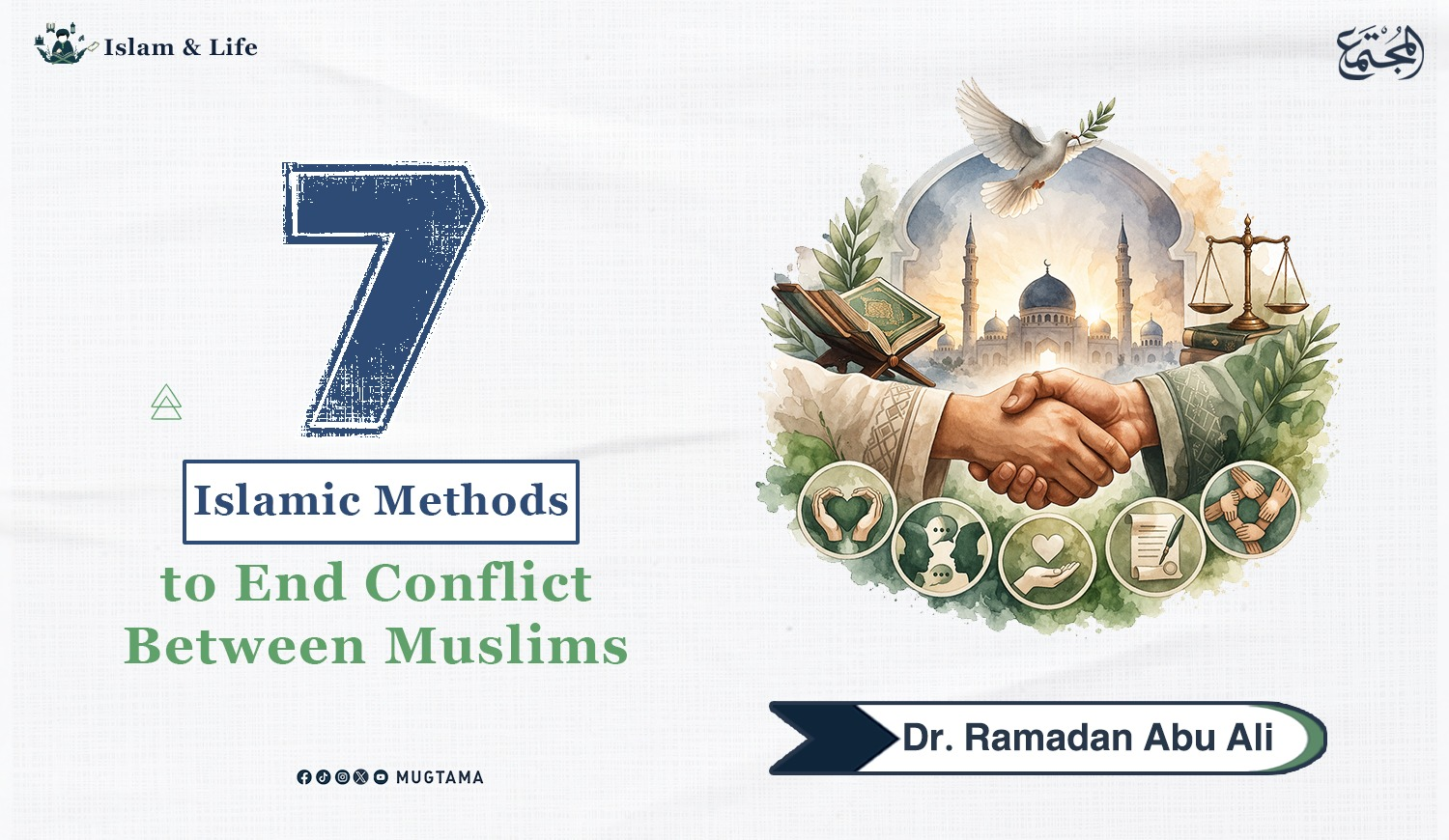
7 Islamic Methods to End Conflict Between Muslims
When
members of the same Ummah fall into conflict, when sacred blood is shed
unjustly, when energies are wasted before lives, and when unity turns into
arenas of conflict and fighting—then the urgent need arises to hold firmly to
revelation in order to end this strife. In it lies protection from deviation,
treatment of the causes of conflict, and restoration of rights.
Islamic
Guidance to Prevent and End Internal Conflict
Among the methods presented in the Quran and
the Sunnah to end conflict among Muslims are the following:
1. Preventing the Causes of
War
Islam
encourages its followers to avoid everything that provokes the self toward unjust war and fighting. It warns against anger, fanaticism, mockery, evil
suspicion, and all forms of transgression against others.
Allah the
Almighty says, {O believers! Do not
let some ˹men˺ ridicule others, they may be better than them, nor
let ˹some˺ women ridicule other women, they may be better
than them. Do not defame one another, nor call each other by offensive
nicknames. How evil it is to act rebelliously after having faith! And whoever
does not repent, it is they who are the ˹true˺ wrongdoers. O believers! Avoid
many suspicions, ˹for˺ indeed, some suspicions are sinful. And do not
spy, nor backbite one another. Would any of you like to eat the flesh of their
dead brother? You would despise that! And fear Allah. Surely Allah is ˹the˺ Accepter of Repentance,
Most Merciful.} [Al-Hujurat 49:11-12]
2. Prohibiting Fighting
Among Muslims
Allah
says, {Do not dispute with one another, or you
would be discouraged and weakened. Persevere!} [Al-Anfal 8:46]
In Sunan
Abu Dawud, with an authenticated chain of narration, the Prophet (peace be upon
him) said: “I have been prohibited from killing
people who pray.”
In Al-Bukhari
and Muslim, it is reported from Jabir Ibn Abdullah: We
were along with Allah's Messenger (peace be
upon him) in an
expedition that a person from amongst the emigrants struck at the back of a
person from the Ansir. The Ansiri said: O Ansar! And the Muhijir said: O
Emigrants! Thereupon Allah's Messenger (peace be
upon him) said: What
are these proclamations of the Days of Ignorance? They said: Allah's Messenger,
a person from the emigrants struck at the back of an Ansari, whereupon he said:
It is something disgusting.
3. Warning Against Unlawful
Bloodshed
Allah the
Almighty forbids killing the soul without right: {Do
not take a ˹human˺ life—made sacred by Allah—except
with ˹legal˺ right.} [Al-Isra’ 17:33]
In Sahih
Muslim, the Prophet (peace be upon him) said during the Farewell Pilgrimage: “Your blood and your wealth are as sacred to you as this
day of yours in this month of yours.”
In Sunan
An-Nasa’i, the Prophet (peace be upon him) said: “The
extinction of the whole world is less significant before Allah than killing a
Muslim man.”
4. Warning Against
Declaring Others Disbelievers During Conflict
In Sahih
Al-Bukhari and Muslim, the Prophet (peace be upon him) said during the Farewell
Pilgrimage: “Do not revert to disbelief after me
by striking (cutting) the necks of one another.”
Al-Baghawi
explained: Do not let your actions resemble those of disbelievers in killing
one another.
It has
also been said: Do not become divided factions, killing one another like the
disbelievers, who are hostile to one another—while Muslims are brothers who
preserve one another’s blood. (Al-Majmu` Al-Mughith Fi Gharibi Al-Quran Wal
Hadith, 3/58)
The
Prophet (peace be upon him) also said: “Defaming
a Muslim is evildoing and fighting him is Kufr.”
These
narrations do not refer to disbelief that expels one from Islam, but rather to
a lesser form of disbelief—meaning behavior resembling that of disbelievers in
unjust fighting and bloodshed. These hadiths call for avoiding conflict among
Muslims and encourage brotherhood and closeness, not division and hostility.
5. Commanding Intervention
to End Conflict and Establish Justice
Allah the
Almighty says, {And if two groups
of believers fight each other, then make peace between them. But if one of them
transgresses against the other, then fight against the transgressing group
until they ˹are willing to˺ submit to the rule
of Allah. If they do so, then make peace between both ˹groups˺ in all fairness
and act justly. Surely Allah loves those who uphold justice. The believers are
but one brotherhood, so make peace between your brothers. And be mindful of
Allah so you may be shown mercy.} [Al-Hujurat 49:9-10]
6. Reviving the Bond of
Islamic Brotherhood
Among the
means of ending conflict is reminding Muslims of the bond of brotherhood. Allah
says, {The believers are
but one brotherhood, so make peace between your brothers. And be mindful of
Allah so you may be shown mercy.} [Al-Hujurat 49:10]
In Sahih
Al-Bukhari and Muslim, the Prophet (peace be upon him) said: “The Muslim is the brother of the Muslim, he doesn't
oppress him and doesn't put him into ruin, and whoever is concerned for the
needs of his brother, Allah is concerned for his needs, and whoever relieves a
Muslim of a burden, Allah will relieve him of a burden from the burdens of the
Day of Judgement and whoever covers (the faults of) a Muslim, Allah will cover
(his faults) on the Day of Judgement.”
7. Severe Warning for
Persisting in Bloodshed
Allah the
Almighty says, {And whoever kills a believer
intentionally, their reward will be Hell—where they will stay indefinitely.
Allah will be displeased with them, condemn them, and will prepare for them a
tremendous punishment.} [An-Nisa’ 4:93]
In Sahih
Al-Bukhari and Muslim, the Prophet (peace be upon him) said: “I heard Allah's Messenger (peace be upon him) saying, 'If two Muslims meet each other with their swords then (both)
the killer and the killed one are in the (Hell) Fire.' I said, 'O Allah's
Messenger (peace be upon him)! It is alright for the killer, but
what about the killed one?' He said, 'The killed one was eager to kill his
opponent.”
For Further Reading:
-------------------------------------------------------------