




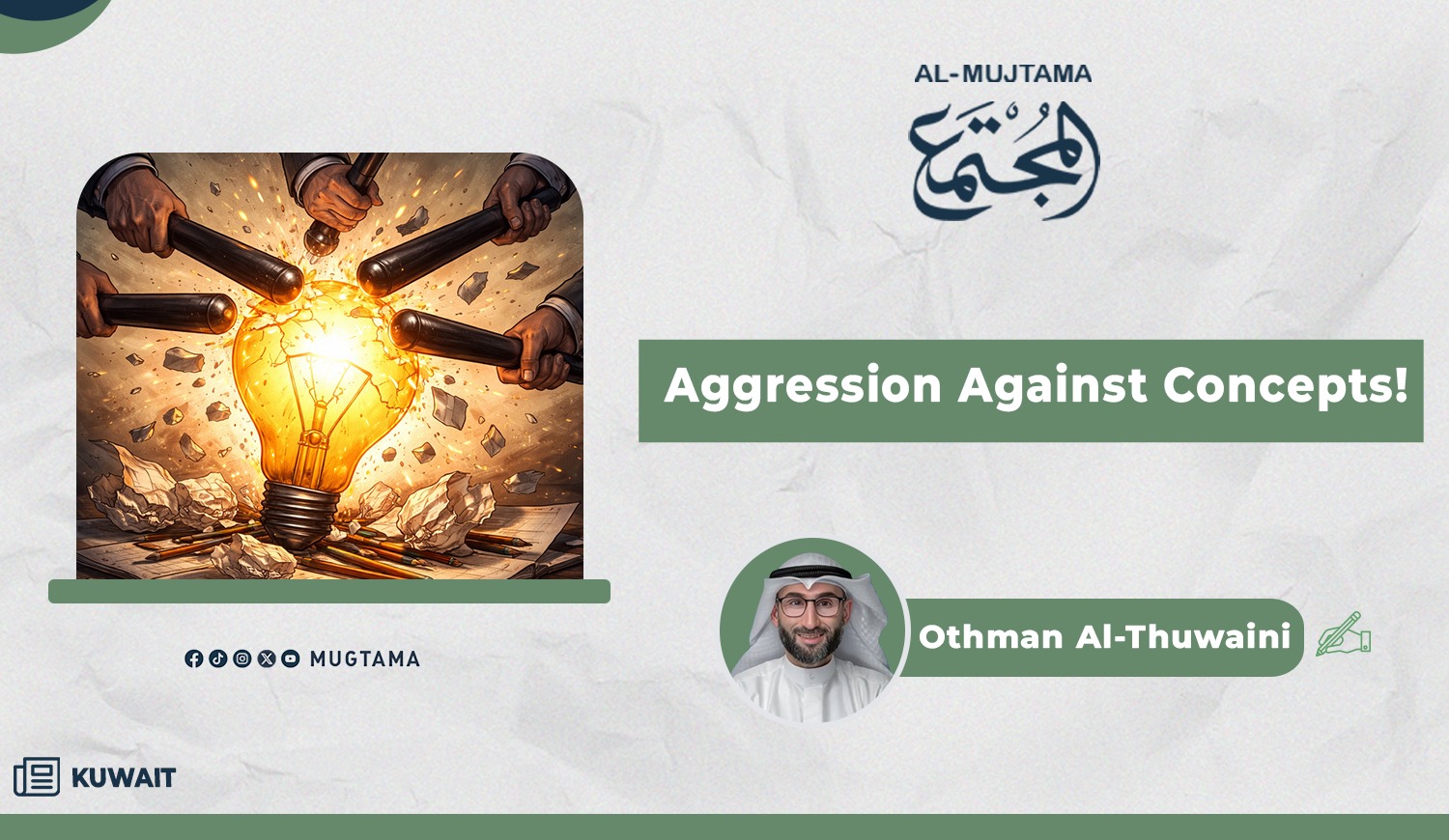
Aggression Against Concepts!
In
moments of great upheaval, it is not only the balance of power that is
revealed, but first and foremost, the balance of minds. The resilience of the
concepts we hold is put to the test. What we are experiencing today is not
merely a brutal Iranian aggression against Kuwait, the Gulf states, and the
region; it is also a parallel aggression against concepts themselves—an attempt
to reshape consciousness according to skewed paradigms.
For when
nations are struck, the danger lies not in missiles alone, but in the minds
that justify, dilute, or draw corrupt comparisons. Such actions, whether
intentional or not, contribute to weakening the domestic front and blurring
public consciousness. To justify this Iranian aggression is not merely a
deviation in stance; it is a brutal assault on established principles and
concepts, laying the groundwork for fragile and unjust intellectual scales that
corrupt rather than reform.
Pain is incomparable, and aggression is unjustifiable
Chief
among these fallacies is the intellectual absurdity that attempts to equate
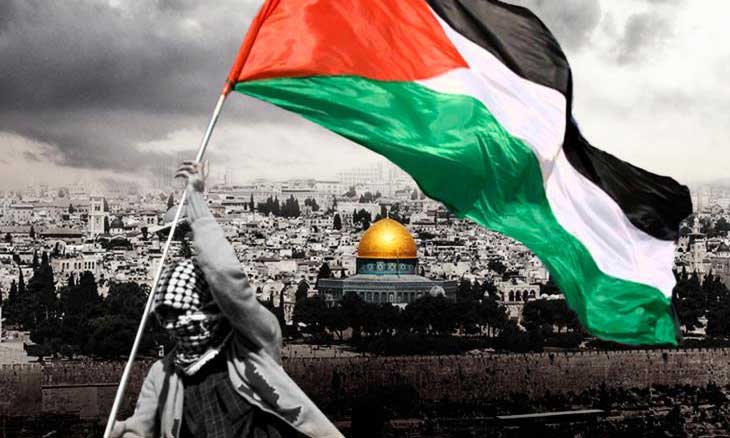
suffering, as if the pain of the Gulf is to be measured against the tragedy of
Gaza or elsewhere. It is as though we are in a marketplace of tragedies,
trading in blood and tears. This is a perilous misconception; for pain is
incomparable, and aggression cannot be justified by another. Every land
violated possesses the inherent right to self-defense, and every soul lost is a
wound in the collective body of the nation.
Reducing
causes to a competition of suffering strips them of their human and legal
essence; it serves as a wide gateway for hollowing out moral positions. Worse
still is when this intellectual dysfunction is cloaked in the guise of
justification, attempting to rationalize Iranian aggression or downplay its
brutality. In doing so, one transcends a mere lapse in judgment to commit a
blatant assault on the very scales of justice.
It is a
manifest fallacy to interpret our stance against the brutal Iranian aggression
on our homelands as a retreat or a concession regarding our steadfast position
against Zionist aggression. Such a view is both superficial and incoherent; for
our commitment to one cause does not mandate silence on another. Our enemy in
one land does not negate our enemy in another.
An Aggression Against Consciousness
We do not
trade principles for geography, nor do we redefine injustice based on the
identity of the aggressor. We stand with truth wherever it resides and reject
aggression regardless of its source. Those who attempt to justify Iranian
aggression here by citing aggression elsewhere are effectively demolishing the
very foundation of principle; they tamper with the nation’s constants and sow
double standards within the collective consciousness—standards that align with
neither justice nor reason.
Among the
fallacies used to mislead the public is the promotion of 'neutrality' in such
moments, framed as a wise and balanced stance. In reality, it is often an
inability to take a position, or a hidden alignment cloaked in the guise of
moderation. Neutrality between the aggressor and the victim is not justice; it
is betrayal. Silence when clarity is demanded is itself a form of bias, no
matter how much one tries to embellish it with objective language or rational
slogans. Whoever hides behind this neutrality to justify Iranian aggression is
not merely falsifying a stance; they are participating in a far more dangerous
assault: the aggression against consciousness itself.
Defending the Nation: Instinct and Allegiance
The
circle of fallacy expands further to encompass the very concept of patriotism.
Some attempt to frame the defense of one’s homeland as a form of reprehensible
fanaticism or narrow-mindedness. In truth, however, love for one’s country and
its defense are the purest expressions of loyalty and the most sacred of duties
in the face of aggression.
Genuine
patriotism does not conflict with our belonging to the wider Ummah (nation);
rather, it is an integral part of it. Homelands are the vessels of the nation,
and safeguarding them is essential to its future and stability. To downplay or
justify the Iranian aggression against one's own land is not just a betrayal of
the soil; it is a betrayal of the innate human instinct (Fitra) that compels us
to champion the truth and reject injustice.
Embellishing Falsehood and the Manufacturing of Fog
In
contrast, the fallacy of 'Cold Objectivity' emerges, used by some to justify
grey positions. This logic equates the aggressor with the victim or demands a
'balance' where none belongs. True objectivity does not mean granting each side
half of the truth; rather, it means giving the rightful party their full due
and calling aggression by its name without hesitation or equivocation. Strained
neutrality in the name of objectivity is often a hollowing out of the truth;
indeed, justifying Iranian aggression under the banner of 'objectivity' is
nothing but an attempt to embellish falsehood. In reality, it is an
intellectual aggression against principles before it is a political stance.
Nor is
the fallacy of 'Selective Credibility' absent from this scene, where some
believe only what aligns with their inclinations and reject whatever
contradicts them. They raise the standards of verification when a narrative
displeases them, only to lower them when it suits their stance. This double
standard kills trust, weakens consciousness, and opens the door to rumors and
disinformation, especially in an era of rapid news and competing narratives.
One of its most dangerous forms is its use to justify Iranian aggression or
cast doubt on its clarity; in doing so, the individual transcends being a mere
misled recipient to becoming a partner in the manufacturing of fog.
Religion is Not a Cloak for Injustice
A far
more perilous manifestation appears in the fallacy of cloaking personal
opinions, wishes, and desires—even wrapping deep-seated hatred and envy—in the
mantle of fatwas and divine sanctity. Religion is thus summoned to serve as a
shroud for justifying skewed positions, silencing dissent, and neutralizing
those who stand with the victim.
Here, the
deviation reaches its zenith; for the flaw is no longer merely intellectual,
but has become a falsification of faith itself, dragging it into contexts where
it does not belong. Those who do so grant the Iranian aggressor a false cover
and a legitimacy he does not possess, portraying falsehood as truth in the name
of Sharia—though faith and divine law are entirely innocent of such claims.
The Battle of Consciousness
Further
complicating the situation is the fallacy of 'Sanctifying Past Positions',
where individuals refuse to revise or correct their stances simply because they
have already committed to them publicly. They persist in their defense even
when the error is laid bare, as if retracting a mistake were a defeat rather
than an act of courage. In reality, persisting in error is the ultimate defeat,
while returning to the truth is the highest manifestation of strength.
In
moments like these, conceptual clarity is not an intellectual luxury; it is a
vital necessity for safeguarding consciousness, maintaining the ranks, and
preventing a slide into intellectual anarchy that destabilizes positions and
weakens societies. We do not only require the force to repel physical
aggression, but also the consciousness to set the compass—to distinguish truth
from falsehood and place every cause in its rightful context.
Today’s
battle is fought not just on the ground, but in the minds of the people. To
justify Iranian aggression is—wittingly or unwittingly—to participate in a far
more dangerous assault, for it demolishes the very foundation upon which all
stances are built: the clarity of truth, the steadfastness of principle, and
the justice of the scale.
In the
face of this brutal aggression against concepts, the greatest source of
strength for a believer is to seek refuge in Allah and persist in sincere
supplication—praying for a heart made steadfast and an insight guided by truth:
'O Allah! Show us the truth as truth and grant us the strength to follow it,
and show us falsehood as falsehood and grant us the strength to avoid it. Let
it not be ambiguous to us, lest we go astray.
You may
also like:
8 Key Points in Kuwait’s Letter to the United Nations on the Iranian Aggression