







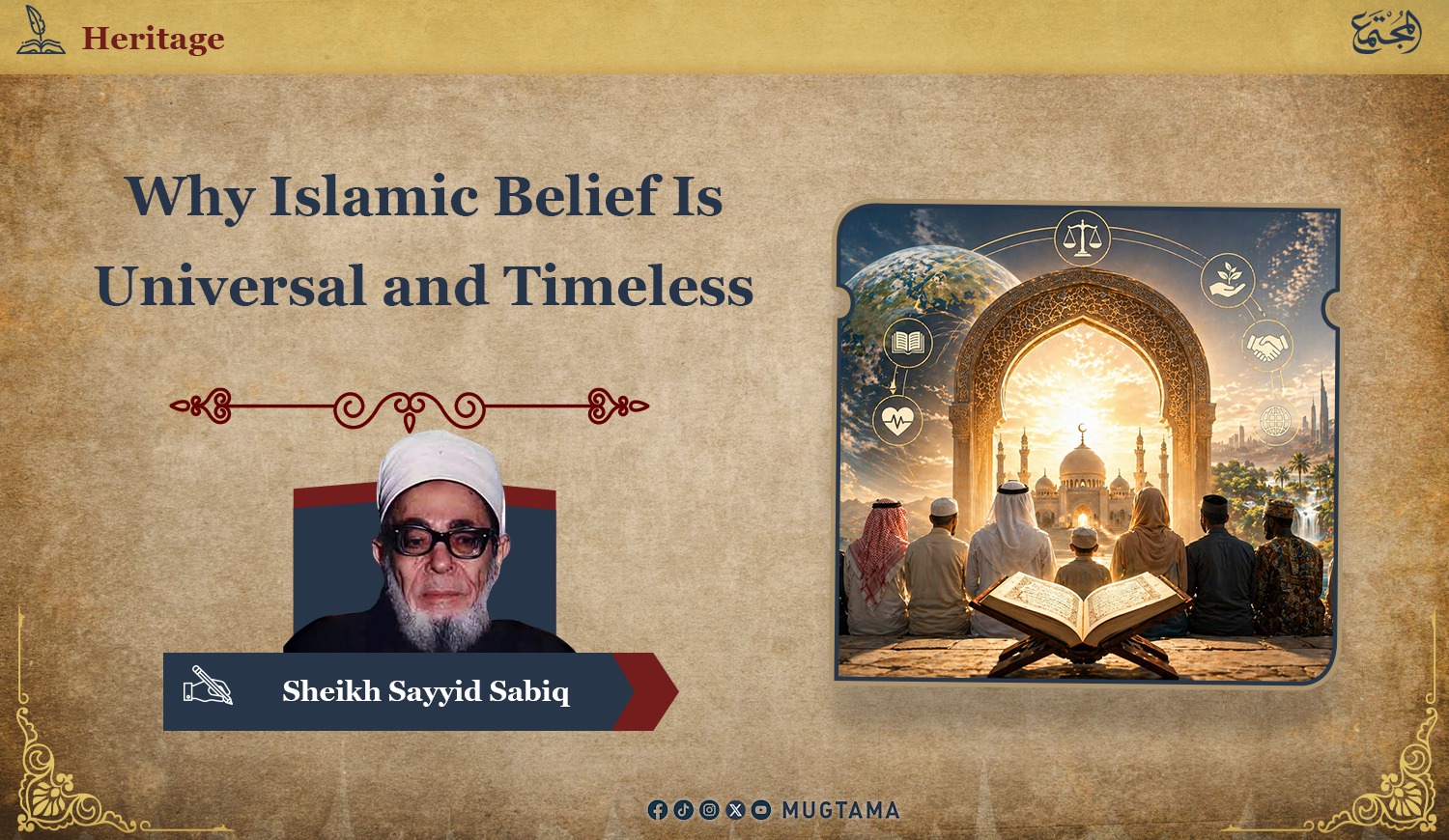
Why Islamic Belief Is Universal and Timeless
Islam is
the religion of Allah
that He revealed to Muhammad (peace and blessings be upon him). It is both
faith and action.
Faith
represents creed—the foundational principles upon which the laws of Islam are
built, and from which its branches emerge.
Action
represents the law—the practical branches that are the fruits of faith and
belief.
Faith and
action, or belief and law, are inseparably connected—like fruits to trees,
causes to effects, and results to their introductions.
The Concept of Faith and Islamic Creed
The
concept of faith or creed consists of six essential elements:
First: Knowledge of Allah—knowledge of His most beautiful names and exalted attributes, and awareness of the evidence
of His existence and the manifestations of His greatness in the universe and
nature.
Second: Knowledge of the unseen world—what
lies beyond physical perception, including the forces of good represented by
angels, and the forces of evil represented by Satan and his followers among the
devils, as well as knowledge of jinn and spirits.
Third: Knowledge of the divine books that Allah revealed to
define truth and falsehood, good and evil, lawful and unlawful, and what is
beautiful and what is ugly.
Fourth: Knowledge of the prophets and messengers whom Allah
chose to be guides and leaders directing humanity to the truth.
Fifth: Knowledge of the Last Day, including resurrection,
accountability, reward and punishment, Paradise and Hell.
Sixth: Knowledge of divine decree, which governs the system
of the universe in creation and management.
The Unity of Islamic Belief
This
concept of faith is the belief with which Allah revealed His books, sent His
messengers, and made it His commandment to both the early and later
generations.
It is one
unified belief that does not change with time or place, nor vary with
individuals or nations: {He has ordained for you ˹believers˺ the Way which He decreed for Noah, and
what We have revealed to you ˹O Prophet˺ and
what We decreed for Abraham, Moses, and Jesus, ˹commanding:˺ “Uphold the faith, and make no divisions
in it.”} [Ash-Shura 42:13]
What Allah
has legislated for us and commanded—just as He commanded previous messengers—is
the foundations of belief and the principles of faith, not the branches of
religion or its practical laws. For each nation has its own set of practical
laws suitable to its conditions, circumstances, and intellectual and spiritual
level: {To each of you We have ordained a code of
law and a way of life.} [Al-Ma’idah 5:48]
Why Islamic Belief Is Universal and
Timeless
Allah
made this belief universal for all humanity and everlasting because of its
clear impact and evident benefit in the lives of individuals and societies.
Knowledge of Allah
awakens noble emotions, stimulates goodness, develops a sense of inner
awareness of accountability, inspires the pursuit of higher values, and
distances a person from low and trivial actions.
Knowledge
of angels encourages imitation of their purity and cooperation with them in
goodness, while fostering constant awareness and vigilance—so that a person
only acts in goodness and with noble purpose.
Knowledge
of the divine books provides guidance to the balanced path that Allah has set
for humanity to achieve both material and moral perfection.
Knowledge
of the messengers encourages following their example, adopting their character,
and modeling one’s life after theirs, as they represent the righteous values
and pure life that Allah intended for humanity.
Knowledge
of the Last Day is among the strongest motivations for doing good and avoiding
evil.
Knowledge
of divine decree equips a person with strength and resilience to face hardships
and challenges, making even the greatest difficulties seem small.
The Role of Belief in Refining Character
and Society
It
becomes clear that belief is intended to refine behavior, purify souls, and
direct them toward the highest ideals—while also representing fixed and
absolute truths. It is among the highest forms of human knowledge, if not the
highest.
Refining
human behavior through instilling belief
is one of the greatest educational methods.
Religion
has a powerful influence over hearts and souls, shaping emotions and feelings
in a way that no other system developed by scholars, philosophers, or educators
can match.
Instilling
belief in individuals is the most effective way to produce righteous people who
can fulfill their role in life and contribute positively to society.
This type
of upbringing clothes life with beauty and perfection, and surrounds it with
love and peace.
When love
prevails, conflict diminishes, disputes end, harmony replaces discord, and
people grow closer to one another. Individuals begin to work for the good of
society, and society, in turn, strives to reform and support individuals.
Thus, the
wisdom behind making faith universal and everlasting becomes clear. Allah has
never left any generation or nation without a messenger calling to this belief
and strengthening its foundations.
Often,
this call came after the corruption of human conscience,
when values had collapsed and humanity was in desperate need of a
transformative force to return it to its natural state—so that it may fulfill
its role in building the earth and carrying the trust of life.
Faith as the Source of Life, Light, and
Virtue
This belief is the
soul of every individual. Through it, a person lives a good life, and without
it, one experiences spiritual death.
It is the
light that, if lost, leaves a person wandering in the darkness of life: {Can those who had been dead, to whom We gave life and a
light with which they can walk among people, be compared to those in complete
darkness from which they can never emerge?} [Al-An`am 6:122]
Belief is
the source of noble emotions, the foundation of pure feelings, and the origin
of all virtuous qualities. No virtue exists except that it stems from it, and
no righteousness exists except that it returns to it.
When the
Quran speaks about righteous deeds, it places belief at the forefront as the
foundation from which all goodness branches.
Allah
says, {Righteousness is
not in turning your faces towards the east or the west. Rather, the righteous
are those who believe in Allah, the Last Day, the angels, the Books, and the
prophets; who give charity out of their cherished wealth to relatives, orphans,
the poor, ˹needy˺ travellers, beggars, and for freeing captives; who
establish prayer, pay alms-tax, and keep the pledges they make; and who are
patient in times of suffering, adversity, and in ˹the heat of˺ battle. It is they
who are true ˹in faith˺, and it is they who are mindful ˹of Allah˺.} [Al-Baqarah 2:177]
You May Also Read:
- The Quranic Philosophy of Knowledge: Insights from the Story of Prophet Musa andAl-Khidr
- Raising Children with Strong Creed
- The Origin of Knowledge
-------------------------------------------------------------