









Why Albanians Refused Selling Sazan Island to Trumps
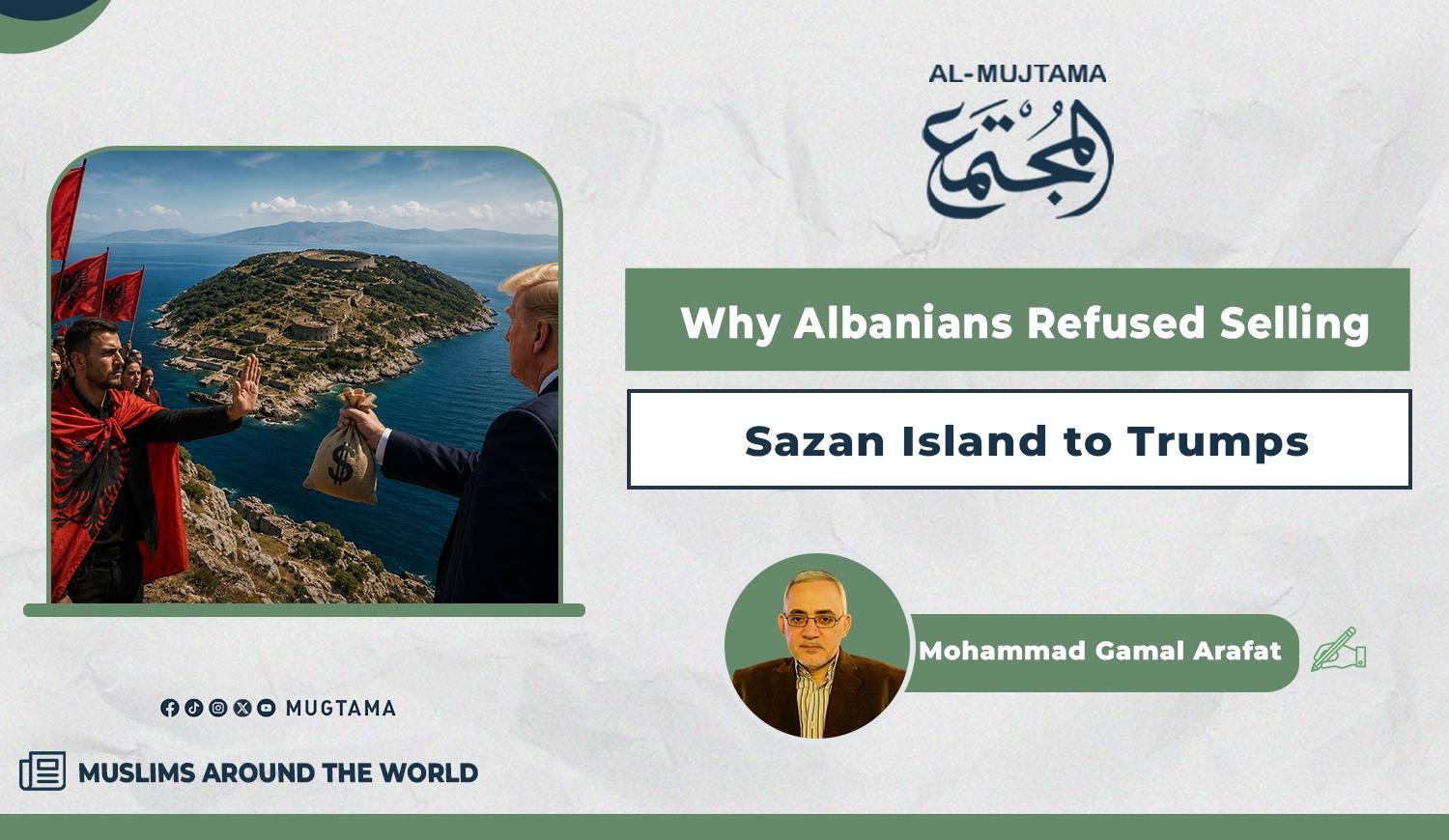
Although the plans of US President Donald Trump’s
family (his daughter Ivanka and his son-in-law Jared Kushner) to purchase Sazan
Island in Albania date back to 2025, the Muslim Albanian public—making up 80%
of the population—took to the streets this June to protest transforming the
island into a resort for the Western world's ultra-wealthy. Sazan Island
previously served as a strategic naval military base for the communist Albanian
army during the Soviet era before being transitioned into a tourist site.
The primary driver behind the protests was the underlying fear
of turning the island into a suspicious, Epstein-style luxury enclave, or that
the Jewish couple (Kushner and Ivanka) might eventually transform it into an
"Israeli" military outpost.
Officially, however, the demonstrations cited three main
reasons: deep environmental concerns, corruption and transparency allegations
against the pro-"Israel" and pro-Trump Prime Minister, and deep
sensitivities regarding the sale of a sovereign strategic asset without public
consensus under the pretext of investment.
The island had been a closed military zone for decades,
situated near ecologically sensitive areas that host flamingo populations, sea
turtles, and Mediterranean monk seals. Opponents of the project fear that the
planned luxury resort will decimate portions of the natural ecosystem,
converting a national public treasure into an exclusive zone for the
ultra-rich. Consequently, their multi-day demonstrations were dubbed the
"Flamingo Revolution," featuring prominent slogans such as "No
to Selling Albania."
Furthermore, opposition groups accused the government of
Albanian Prime Minister Edi Rama—infamous for physically kneeling before the
Italian Prime Minister during official functions—of granting the project
extraordinary, non-transparent concessions. Official investigations have since
been launched into the legal and environmental aspects of the project,
alongside land ownership disputes linked to other projects in the region,
leading to the freezing of assets belonging to a supervising firm due to corruption.
Crucially, Sazan Island is no ordinary piece of land. It
served as an Italian naval base during World War II, and later as a Soviet
military stronghold during Albania's communist era. It still contains extensive
networks of fortifications, tunnels, and old military infrastructure. For many
Albanians, surrendering its development to foreign investors compromises a
deeply sovereign and historical symbol.
This historical baggage fueled intense speculation: Could it
be transformed into an "Israeli" base? Given the Kushner family's
Jewish background, their deep ties to "Israel," and the island’s
immense strategic location at the entrance of the Adriatic Sea directly facing
the Italian coast, the location commands vital maritime corridors.
Irish writer and researcher Éilís Nic An Tsaoir pointed
directly to this reality, writing that Kushner is not purchasing Sazan Island
merely to build a luxury resort. She noted that the most critical geographical
reality to grasp is that whoever controls this island effectively controls the
Strait of Otranto—the sole maritime gateway connecting the Adriatic Sea to the
Mediterranean Sea.
The "Flamingo Revolution" Confronts Corruption
The popular protests erupted immediately after Trump’s
son-in-law, Jared Kushner, announced the acquisition of the former military
base, which is currently categorized as a protected bird sanctuary. The ongoing
public backlash has firmly solidified under the banner of the "Flamingo
Revolution."
While official talking points frame the deal as a luxury
tourism project valued at approximately 1.4 billion euros spanning Sazan Island
and Albania’s southern coast, reports indicate a deeper seduction. Ivanka Trump
and Jared Kushner allegedly hosted Prime Minister Edi Rama aboard the yacht of
billionaire Nat Rothschild, persuading him to sell the island—whose real-estate
potential is valued at 4 billion dollars—to the couple, sparked public fury
over the liquidation of national territory and a protected nature reserve.
Exacerbating public outrage, Albanian regulatory watchdogs
uncovered massive corruption vulnerabilities within the deal. This fueled
online activism and rumors among Albanian activists that the project carries a
hidden political agenda to establish an "Israeli" military foothold
or mirror the private island of the late, disgraced financier Jeffrey Epstein.
Recognizing that halting the project poses a direct threat to
his political survival, Prime Minister Edi Rama dismissed the escalating
protests, labeling them as politically motivated campaigns driven by critics
and detractors of US President Donald Trump.
Rama went as far as claiming that Iran was orchestrating the
protests against the acquisition, which is being spearheaded by a consortium of
American and "Israeli" businessmen led by Kushner. He publicly
characterized the demonstrations as a conspiracy aimed against both Albania and
"Israel."
Conversely, independent anti-corruption organizations asserted
that the transaction represents a textbook case of transnational corruption,
blending high-level politics, illicit financing, and environmental degradation.
Lindita Çela, a prominent investigative journalist celebrated
for her rigorous reporting on organized crime and corruption in Albania,
confirmed the presence of highly suspect financial dynamics behind the deal.
She noted that local anti-corruption watchdogs successfully froze the bank
accounts of a domestic real estate firm tied to Kushner’s luxury development
layout.
In a report published by the Organized Crime and Corruption
Reporting Project (OCCRP) on June 2, 2026, Çela detailed that Albania’s Special
Anti-Corruption Structure (SPAK) initiated an official investigation into the
legislative maneuvering surrounding the deal. The probe was launched after
disclosures revealed that the Albanian government specifically dismantled
environmental protection laws to facilitate the island's sale and bypass its
protected sanctuary status.
SPAK's official inquiry targets the government's tailored
legislative amendments that allowed a protected nature reserve to be re-zoned
for luxury commercial use and potentially hidden, undisclosed operations.
Severe accusations of "liquidating state assets,"
abuse of power, and conflicts of interest have been leveled against the Prime
Minister's cabinet, with critics alleging that Albanian sovereign territory is
being utilized as diplomatic currency to court favor with the current US
administration for political leverage in Washington.
Investigative disclosures have further unmasked a opaque
network of domestic partners backing the project behind the scenes, including
local businessmen with alleged ties to organized crime networks and former
judges who had previously resigned under a cloud of corruption.
Will It Become an "Israeli" Military Outpost?
During communist rule, Sazan Island was a heavily fortified
military installation overlooking the entrance to the Adriatic Sea at the Bay
of Vlorë in southwestern Albania. It sits at a razor-sharp strategic nexus
linking the Adriatic and Ionian seas via the Strait of Otranto—a choke point
that has historically attracted global empires due to its military and
geographic weight.
Despite encompassing an area of just about 6 square
kilometers, its location made it a prize for the Romans, Ottomans, Italians,
and Germans. During the Cold War, it was engineered into one of the most
heavily fortified military bastions in Eastern Europe.
In the 1950s, Albanian leader Enver Hoxha opened the island to
the Soviet Union, transforming it into a forward-deployed surveillance base in
the Mediterranean. During a historic 1958 visit to the island, Soviet Leader
Nikita Khrushchev famously remarked: "From here, I can monitor the
Mediterranean all the way to Gibraltar."
Because the island remains packed with military tunnels,
nuclear fallout shelters, abandoned ammunition depots, and concrete
fortifications left over from its Italian and Soviet-Albanian eras, rumors have
intensified. Activists argue that Kushner—widely known for advancing
"Israeli" regional interests—intends to use the luxury resort as a
civilian front for an underlying "Israeli" military facility. They
suspect it is designed to operate in tandem with another island acquired by "Israeli"
interests on the opposite bank, creating an exclusive military and economic
transit corridor.
This theory aligns with historical precedents; in 2012, former
Zionist Prime Minister Ehud Barak and former Defense Minister Benny Gantz
floated proposals to acquire uninhabited Greek islands to construct secure
havens for the Zionist elite and establish forward reconnaissance outposts
monitoring Turkey, whom they warn represents the next strategic challenge after
Iran.
These geopolitical anxieties have been further validated by
the deeply controversial relationship between the Albanian Prime Minister and
"Israel." In late January 2026, Rama conducted an official state
visit to Israel, meeting with Zionist Prime Minister Benjamin Netanyahu and
delivering a speech before the Knesset that praised the leadership, deeply
cementing public suspicions back home.
Read also:
With
Evidence: 7 Signs of Systematic Persecution of Indian Muslims
Ivanka
Trump, Jared Kushner purchase $30 million Indian Creek plot — report