






10 Factors Pointing to the Failure of Trump’s Peace Council
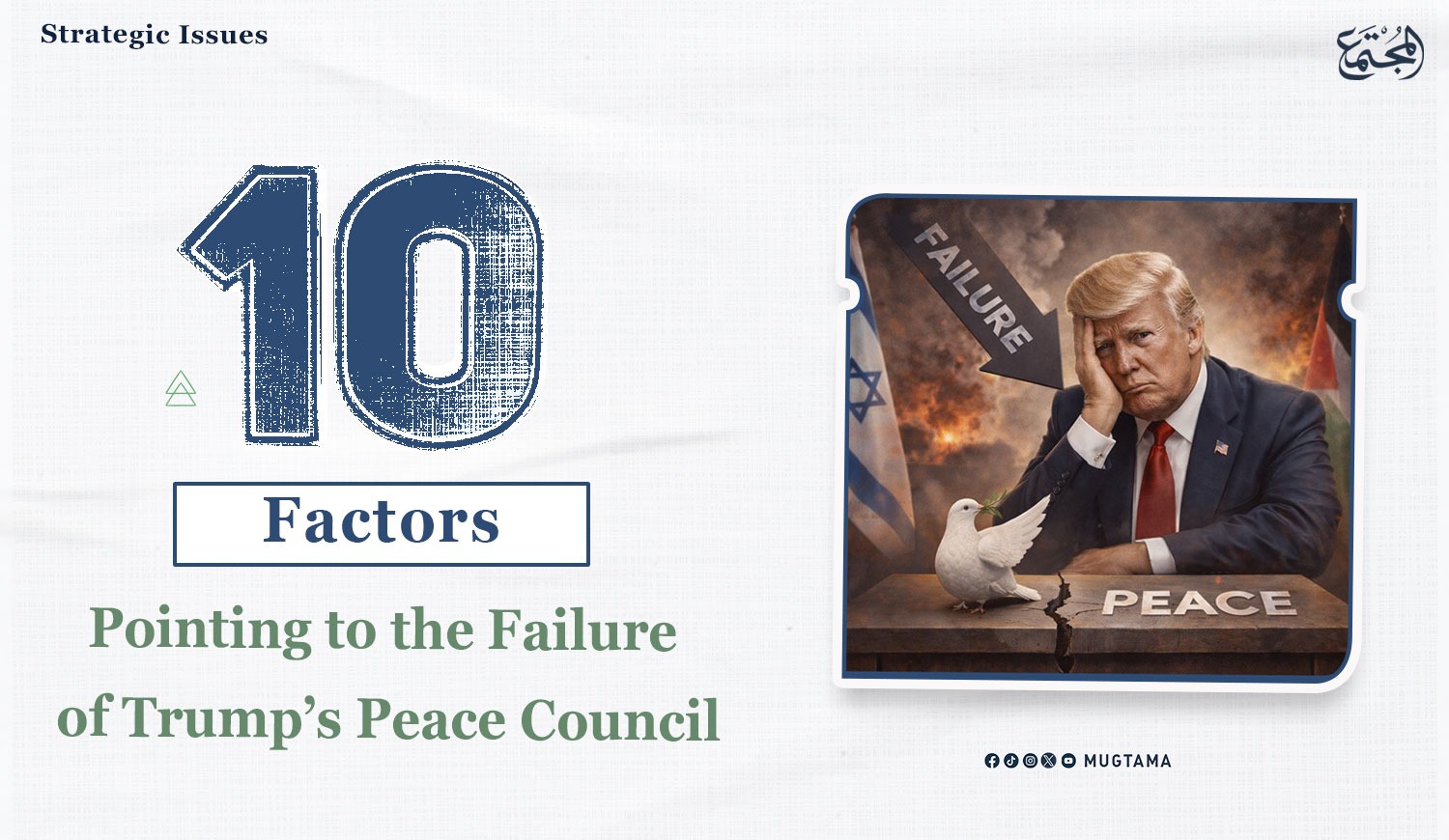
Amid the rapid transformations
sweeping the region, questions arise about the viability of political
initiatives that bypass the historical constants of the Palestinian Israeli
conflict.
The announcement of the “Peace
Council” by U.S. President
Donald Trump has sparked wide controversy—not only because of its
timing, but also due to doubts over its realism and ability to withstand the
complexities on the ground.
A close reading of current dynamics,
supported by international reports, highlights structural and fundamental
obstacles that undermine the council’s prospects. They can be summarized in the
following ten points:
1. Lack of Legal Legitimacy and International References
The council lacks the legal framework
provided by international organizations, relying instead on a unilateral vision
that sidesteps UN resolutions. Ignoring Resolution 242, which calls for
Israel’s withdrawal from occupied territories, and replacing it with
non-binding bilateral arrangements, amounts to a dismantling of the
international order.
2. Skipping Core Issues
The council adopts a technocratic
approach, focusing on economic management of the conflict rather than
addressing its political roots. Studies warn that prioritizing “living
conditions” projects in Gaza and the West Bank while
sidelining final-status issues such as the right of return and sovereignty over
Jerusalem reduces the initiative to a temporary palliative bound to collapse
under inevitable political upheavals.
3. Crisis of Palestinian Representation
The absence of genuine Palestinian
participation strips the council of political legitimacy. History has
shown—most notably with the failure of the “Deal of the Century”
in 2020—that externally imposed solutions cannot compel a people to accept
outcomes they reject.
4. Strategic Bias and Absence of a Neutral Mediator
The Trump administration’s image as
Israel’s unwavering ally disqualifies it from playing the role of a balanced
mediator. Moves such as relocating the U.S. embassy to Jerusalem have eroded
trust, positioning Washington as a party to the conflict rather than an
arbiter.
5. Disconnect Between Leadership and Grassroots
Policies crafted behind closed doors
without regard for Palestinian
public sentiment inevitably collide with reality. Past security summits in
Sharm el-Sheikh and Aqaba failed for precisely this reason: they ignored basic
demands for dignity and national rights.
6. Illusion of Regional Peace as a Substitute for Justice
The council’s strategy rests on the
assumption that regional normalization is the key to peace. Yet the Abraham
Accords, despite their diplomatic significance, did not prevent violent
flare-ups in Jerusalem and the West Bank—underscoring that the conflict is
rooted in land, not foreign relations.
7. Exclusion of Key Actors on the Ground
By sidelining resistance movements and
influential political forces, the council undermines any security arrangements.
Analysts stress that ignoring those who control realities on the ground,
especially in Gaza, renders implementation operationally impossible.
8. Negative Legacy of Previous Initiatives
The council inherits a credibility
deficit from failed experiments such as the 2019 Bahrain workshop. The
transactional mindset behind these initiatives fails to grasp the deep
ideological and historical dimensions driving the conflict.
9. Contradiction with Explosive Realities on the Ground
Peace cannot be built while settlement
expansion continues to devour land earmarked for a future Palestinian state.
Current geopolitical realities in the West Bank fragment territorial
continuity, reducing any “two-state solution” proposals to ink on paper.
10. Absence of Enforcement Mechanisms and Guarantees
The council’s outputs lack binding mechanisms, clear timelines, or international guarantees. Without real pressure tools on Israel—such as freezing settlement activity—the initiative risks becoming yet another unfulfilled promise.