








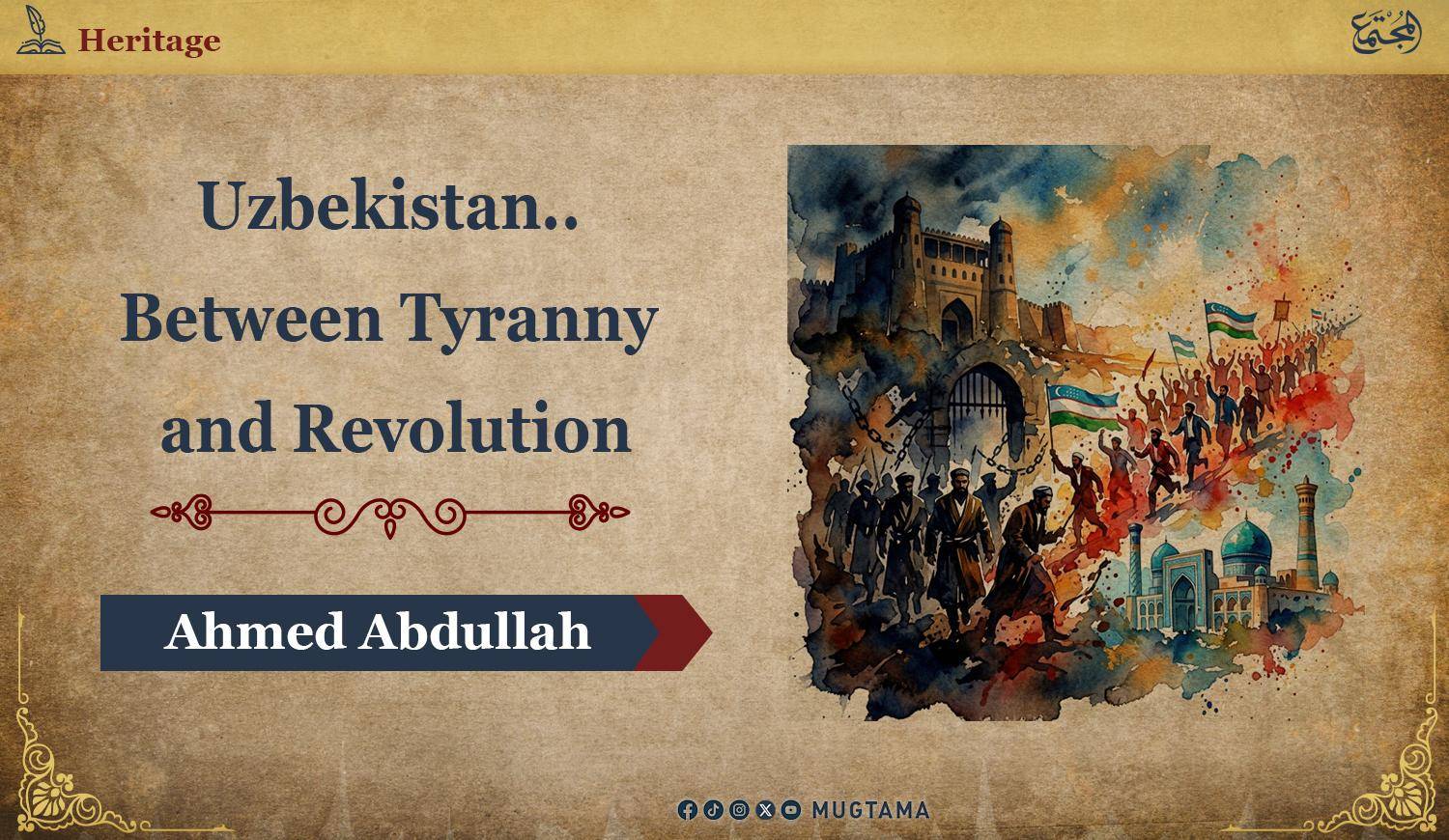
Uzbekistan.. Between Tyranny and Revolution
- Uzbek society is witnessing an Islamization
movement across a broad segment of the population despite restrictions by
the ruling regime.
- Islam Karimov has ruled Uzbekistan since the end
of communist rule in 1999 [sic] to the present day.
- Robert Blake: Washington is holding talks
regarding the resumption of assistance to Tashkent for its program to
bolster its defense and combat terrorism.
What prompted me to write these lines
are the reports reaching our ears concerning the oppression still endured by
tens of thousands of people of conscience in the wounded Muslim Republic of
Uzbekistan. Added to this are the statements made by the President of
Uzbekistan, Islam Karimov, during his visit to Russia, in which he
stressed his deep fear of what he labels terrorism in Afghanistan and his dread
that the popular movement seen in the Arab Spring countries might reach
his nation, which he has ruled for decades with an iron fist.
Karimov is particularly troubled by
the situation in Afghanistan, stating: "No one has declared war on us,
but the expansion of terrorism's march is worse than that. These issues are
very urgent, and they are knocking on the doors of everyone living in the
neighborhood of Afghanistan. What can we do together to face the rapidly
growing threat in the region? It is better to preempt this event than to chase
its tail," as he put it.
Naturally, these statements did not
come out of nowhere. Religious and Islamic life in Muslim Uzbekistan has become
intolerable and exceeded all imagination. Fear and persecution reign supreme in
every locality across the republic, and this lifestyle continues unabated for
decades.
The United States—the sponsor of all
who oppose "terrorism"—had its response ready as usual, sharing the
fears of the Uzbek "sole leader." Assistant Secretary of State for
South and Central Asian Affairs, Robert Blake, stated that "Washington
is holding talks regarding the resumption of assistance to Tashkent in its
program to bolster its defense and combat terrorism." This means the
people will remain under the weight of injustice until proven otherwise.
Despite the economic successes the
country has achieved since the collapse of the Soviet Union, and progress in
several vital economic sectors after gaining its "independence" from
Soviet hegemony like other republics, poverty and hardship remain visible in
the streets of Uzbek cities and villages. Furthermore, the number of Uzbek
migrants to Russia is steadily increasing, representing one of the largest
migrant communities working in public services, construction, and agriculture.
Karimov is concerned with normalizing
relations with Russia and the United States due to the declining legitimacy of
his regime. After being elected for a second term in 2007, Karimov amended the
constitution twice to postpone the elections scheduled for April 2015.
The political risks for Karimov's
regime are growing, and conflicts between Karimov's likely successors are
intensifying, particularly the feverish rivalry between the President's
daughter, Gulnara Karimova, and the President's "right-hand man,"
First Deputy Prime Minister Rustam Azimov.
Against this backdrop, Karimov
understands all the constraints placed upon him in rapprochement with the West,
which is unwilling to turn a blind eye to all the very obvious violations of
the law in an attempt to maintain control over the country. This contrasts with
Russia, which has long proven ready to defend the ruling elite against any
attempt at a bottom-up change of power—hence we fully understand the reason
behind these statements from Moscow.
Why All This Fear?
The question arises: Why all this fear
of neighboring countries and events taking place in distant Arab Spring
nations, especially since the man has held all the levers of state power for
decades?!
The truth is that the situation in the
republic does not inspire confidence. With recurring reports of the President's deteriorating health and his failure to name a successor, the future remains open to many possibilities. On the
other hand, regions bordering Afghanistan are witnessing increased activity by
the Islamic Movement of Uzbekistan, which sponsors armed struggle
against the regime. Although the regime in the capital, Tashkent, fights every Islamic
manifestation, it takes those armed groups very seriously given Uzbekistan's
strategic geopolitical location, the conflict of interests in the republic
between Russia on one side and the United States on the other, and the
possibility—even theoretically—of using those groups as leverage on the
government to gain ground realities.
This is on one hand. On the other
hand, there is the Islamization taking place in Uzbek society—which is
considered one of the most religiously attached societies—alongside the popular
movement that has begun looking toward freedom following the success of the
Arab revolutions in the Arab Spring nations.
Expected Scenarios
Another important question for
observers concerns the scenarios proposed in light of what we have mentioned.
What is certain is that the situation in that cage-like republic will end one
day, whether during Islam Karimov's rule or after him!! This is
evident from the popular movement we see, the restlessness in the street, and
the division of society into two classes separated by a wide gap: the society
of officials, statesmen, and the wealthy, versus the majority of the Uzbek
people, who grow poorer day by day despite the great wealth possessed by the
republic.
We point out here the strange anomaly
experienced by all the Islamic republics in Central Asia (Kazakhstan,
Tajikistan, Turkmenistan, Uzbekistan, and Kyrgyzstan) and the Republic of
Azerbaijan in the southern Caucasus region: all these republics retained the
presidents who led them since the communist era, unlike all other Christian
republics (Ukraine, Georgia, Russia, and Armenia). Today, there is talk of
hereditary succession for sons, as happened in Azerbaijan, even though everyone
speaks of "democratic countries" with democratic competition for
power.
----------------------------------
Written by: Ahmed Abdullah
Published in Al-Mujtama Magazine, Issue No. 2055 — Saturday, June 1, 2013
