









Texas Muslims Gain Political Weight After Midterms, Imam Tells Al-Mujtama

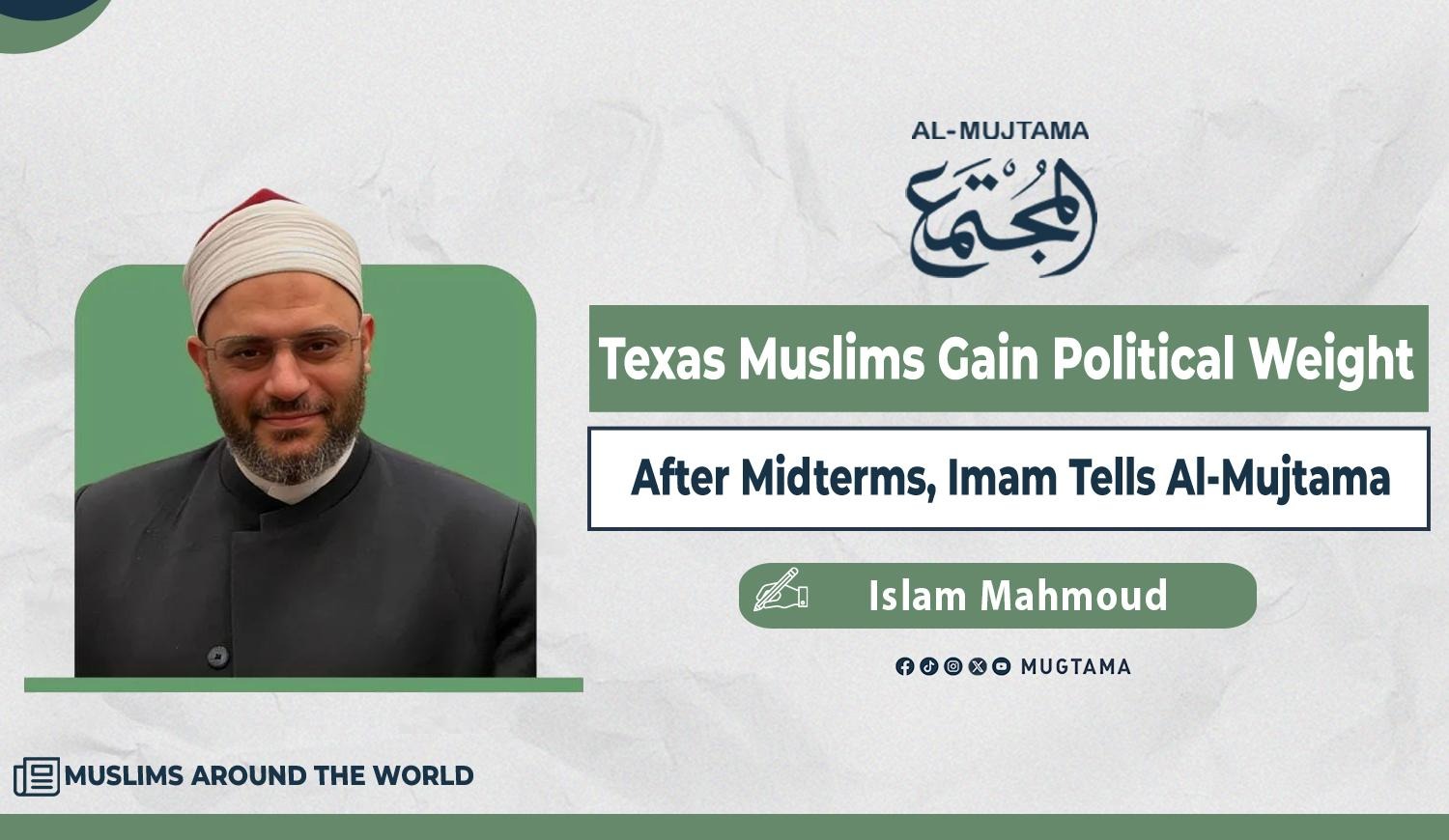
Muslims have become an integral part of the Western world beyond their traditional areas of concentration. This was highlighted by the recent US midterm elections, which demonstrated the formation of a new awareness and context for Muslims, showing that they are a significant component in any country where they reside.
Al-Mujtama reached out to Ahmed Muhammad Abu Saif, President of the
Imams Academy in Plano, Texas—an influential state that surprised everyone in
the US midterm elections after three decades of Republican control—to discuss
the impact of these developments on the Muslim community, which has gained
influence in shaping the votes of one of the greatest American states.
Significance of the Texas Election Results for the Muslim Community
For the first time after three decades
of Republican control in Texas, a Democratic governor and US senator were
elected. What does this choice mean for the Muslim community?
— The significance of the US midterm
election results for the Muslim community is not measured by knowing the
identity of the winner, nor by the number of seats that shifted from one party
to another. Rather, it is measured by what it reveals regarding people's
awareness of their rights, their ability to protect their freedoms, and their
readiness to participate in reforming the society in which they live.
The recent Texas elections were
broader than to be read merely as a victory for Democrats and a defeat for
Republicans. For Muslims, they raise a deeper question: How do we transition
from numerical presence and seasonal participation to a permanent dawah,
educational, and institutional impact?
— The victory of the Democrats in
winning the governorship and a seat in the US Senate represented a historic
shift after decades of Republican dominance. However, Muslims in Texas are not
a single political bloc, nor should they become prisoners to any party.
Muslims in Texas are not a single
political bloc.
What unites them is the demand for
justice, the preservation of religious freedoms, equality before the law, and
their right to build their institutions and contribute to the public good.
Former Governor Greg Abbott and the Muslim Community
Former Governor Greg Abbott entered
into a conflict with Islamic centers and attempted to restrict their
activities. Is his defeat a natural result of underestimating the Muslim
community?
— The relationship between former
Governor Greg Abbott's administration and some Islamic institutions witnessed
clear tension, particularly regarding the real estate project associated with
the East Plano Islamic Center (EPIC).
Many Muslims felt that the political
rhetoric accompanying the investigations transcended the boundaries of legal
accountability, creating an atmosphere of suspicion toward Islamic
institutions.
The justice we demand for ourselves is
the same justice we commit to in our judgment of others. We do not reject the
state's right to oversee and verify compliance with the law, nor do we accept
that Islamic affiliation becomes a presumption of guilt, or that state
authority is used to stoke fear against an entire religious component.
Nevertheless, it cannot be asserted
with certainty that Abbott's stance on Islamic institutions was the sole cause
of his electoral defeat. Voters were moved by a combination of multiple
factors, including the economy, education, living costs, and the general
political climate.
Internal Migration and the Expansion of Islamic Institutions
Texas witnessed widespread migration
over the past decade from California and other states due to its high quality
of life. Have Islamic centers and the Muslim community benefited from this
lifestyle transition?
— The Muslim community benefited from
the extensive internal migration to Texas over past years. Many families moved
from California and elsewhere searching for employment opportunities, housing,
and a more stable life. Consequently, the number of worshippers and students
increased, along with the need for mosques, schools, and family and youth
programs.
However, numerical increase in itself
is not evidence of maturity. The success of the community is not measured by
the number of mosques alone, but by its capacity to prepare imams, protect the
youth, care for the family, and embrace new Muslims.
The Educational Role of Mosques and Voter Registration
Did mosques and Islamic centers play a
role in preparing and guiding voters, given reports that around 1,000 voters
were registered weekly leading up to November's elections?
— The function of the mosque is to
build awareness, not to generate party loyalty. The mosque unites Muslims
despite their differing views and teaches them to choose based on values,
stances, and public interests, rather than slogans. A mosque that assists
people with registration before elections should nurture an aware citizen
throughout the entire year.
The function of the
mosque is to build awareness, not to generate party loyalty.
This was evident in voter registration
drives participated in by mosques and Islamic institutions, particularly in the
Houston area, where news reports cited assistance in registering nearly one
thousand voters weekly prior to the US midterm elections.
Election Outcomes and Lasting Moral Impact
From your perspective, do the ongoing
election results generally serve the interests of Muslim communities, or were
they primarily a punitive vote against Republican policy?
— The US midterm elections revealed
that Muslims in Texas have become more present and capable of mobilization.
However, the greatest challenge is ensuring they do not appear only at the
ballot boxes and then see their presence decline afterward.
Elections may give the community a voice, but they do not, on their own, create lasting impact. This impact is
created by a family that safeguards its children through dialogue and
role-modeling, a mosque that unites rather than divides, an imam who combines
understanding of the text with understanding of human nature, and institutions
that champion justice and serve all people.
In this way, Muslims will not merely
be an electoral bloc whose votes political parties compete for, but rather a
moral, intellectual, and humanitarian force contributing to the betterment of
society.
Call to Islam (Dawah) in the State of Texas
Tell us about the nature of dawah
(calling to Islam) in the state of Texas, and its fruits amidst the fast-paced
climate currently in the United States?
— Dawah to Islam in Texas does not
begin when a non-Muslim enters the mosque; rather, it begins before that—when
they see a truthful Muslim neighbor, a compassionate doctor, an honest
merchant, and an institution that stands with the oppressed and serves the
needy without asking about their religion or origin.
The presence of religion in the
general culture of Texas opens doors for dialogue and mutual acquaintance, but
it also places a responsibility on Muslims to present Islam in a clear language
and through observed conduct.
Addressing Challenges Facing the Muslim Youth
What are the biggest challenges facing
Muslim communities, especially in your state, and how do you overcome them?
— One of the greatest challenges we
observe is the widening distance between what some youth hear in the mosque and
what they encounter in school, university, and digital space.
It is not enough to offer a young
person an abstract ruling; rather, they need an imam who understands their
question, a family that engages in meaningful dialogue with them, and an
institution that grants them belonging, companionship, and a space to participate
and take responsibility.
Harnessing Ethnic Diversity for Community Strength
Tell us about how you manage and
coordinate among all Muslim ethnicities, and the extent of its impact on the
strength of Muslims in the state?
— The broad ethnic diversity among
Texas Muslims represents both a rich asset and a test. Unity is not achieved
merely by Muslims gathering in a single prayer, but when their brotherhood is
reflected in administrative boards, youth programs, the distribution of
responsibilities, and the selection of leadership based on competence and
trustworthiness, rather than ethnicity or language.
Converts to Islam and Pathways to Faith
Are there new numbers converting to
Islam in the state? What are the prominent reasons prompting this, and the
influential activities attracting them?
— Islamic centers witness recurring
cases of individuals embracing Islam, although the absence of unified
statistics prevents us from speaking about precise numbers state-wide. People
reach Islam through reading, human relationships, searching for meaning and
tranquility, or through a moral model they observed in a Muslim they know.
Islamic centers witness recurring
cases of individuals embracing Islam.
Dawah success is not found merely in the number of those who pronounce the Shahada (testimony of faith), but in a new Muslim subsequently finding compassionate knowledge, sincere companionship, and a faith family that assists them in building a balanced life.
