








Targeting Ujjain’s Shahi Mosque: Systematic Persecution of India’s Muslims

Since the Bharatiya Janata Party (BJP) came to power in India, an unprecedented wave of systematic restrictions against the Islamic presence and its historical and religious landmarks has been escalating. These actions occur within the framework of state-implemented policies aimed at eroding the cultural and architectural identity of Muslims, whose population exceeds 200 million. Disputes over holy sites are no longer isolated exceptions; they have transformed into a phenomenon backed by administrative, judicial, and political support. The recent attempt to demolish major portions of the historic "Shahi" Mosque in the city of Ujjain, Madhya Pradesh, represents a new blow in a long series of violations carried out under the guise of "development and public interest" to advance exclusionary agendas rooted in extreme Hindu nationalism.
The "Shahi" Mosque: A Historic Islamic Monument and Authentic Waqf Property
The "Shahi" Mosque in the city of Ujjain is
considered one of the most prominent documented Islamic landmarks and
endowments (Waqf) in the state, with its construction dating back
approximately 636 years (specifically built in 1390). The building is not
merely a place for performing prayers; it is a living architectural record
testifying to successive Islamic eras and their civilization in the Indian
subcontinent. Furthermore, it is officially registered as an Islamic Waqf,
which constitutionally and legally prohibits any infringement on its ownership
or the alteration of its structure. The mosque stands as an integrated
religious monument comprising a main prayer hall, a soaring minaret reaching a
height of 120 feet, and the historic "Mazhar Chowk Shahi" site.
Flimsy Pretexts for Demolition and Destruction
In recent years, Indian authorities have consistently devised
and deployed a range of pretexts to justify the demolition of mosques and
Islamic institutions. The primary arguments include:
1. Urban Expansion and Development Projects: Using
road layout plans and urban development as a cover to target centuries-old
Muslim religious buildings.
2. Flimsy Allegations of Violations and Encroachments:
Extremist Indian authorities make immediate accusations against historic
mosques, claiming they were built without permits or encroach on state land,
while ignoring official Waqf documentation and historical records.
3. Claims of Ancient Hindu Origins:
Authorities frequently raise false claims regarding the existence of ancient
Hindu temples beneath the architectural foundations of mosques (similar to what
occurred with the Babri Mosque and the Gyanvapi Mosque).
4. Bulldozer Diplomacy: Extremist Indian authorities
apply collective punishment by demolishing structures attached to mosques and
Islamic centers following any local tension or public protest.
Toll of Demolished Mosques, Homes, and Displaced Families
Statistics and field reports demonstrate the scale of the
comprehensive campaign targeting Islamic endowments and properties across India
over the past decade:
- Demolition
of Mosques and Endowments: Hundreds of mosques, prayer
spaces, cemeteries, and Islamic shrines have suffered complete or partial
demolition across multiple states (most notably Uttar Pradesh, Madhya
Pradesh, New Delhi, and Gujarat), whether through administrative expansion
orders or attacks by extremist Hindu groups.
- Destruction
of Homes and Collective Punishment: Human rights organizations
have documented the demolition of thousands of homes and commercial
establishments owned by Muslims under the banner of "Bulldozer Policy," where entire families' homes are destroyed based on
unproven allegations against individuals participating in protests.
- Displacement
of Families: Direct demolitions have resulted in the
displacement of thousands of Muslim families, stripping them of their
livelihoods and property without providing alternative housing or fair
compensation, thereby deepening socio-economic crises among vulnerable groups.
The Attempted Demolition of the "Shahi" Mosque in Ujjain: Flimsy Arguments and Steadfast Protest
Events in Ujjain escalated following the municipality's
announcement of a plan to widen the road to 15 meters in preparation for the
"Simhastha 2028" Hindu religious festival, as part of the Ujjain
Development Plan 2035, given the mosque's location opposite the Mahakaleshwar
Temple and near the Kshipra River. The proposed demolition plan includes
cutting off a portion of the prayer hall, demolishing the 120-foot minaret, and
removing the "Mazhar Chowk Shahi" site.
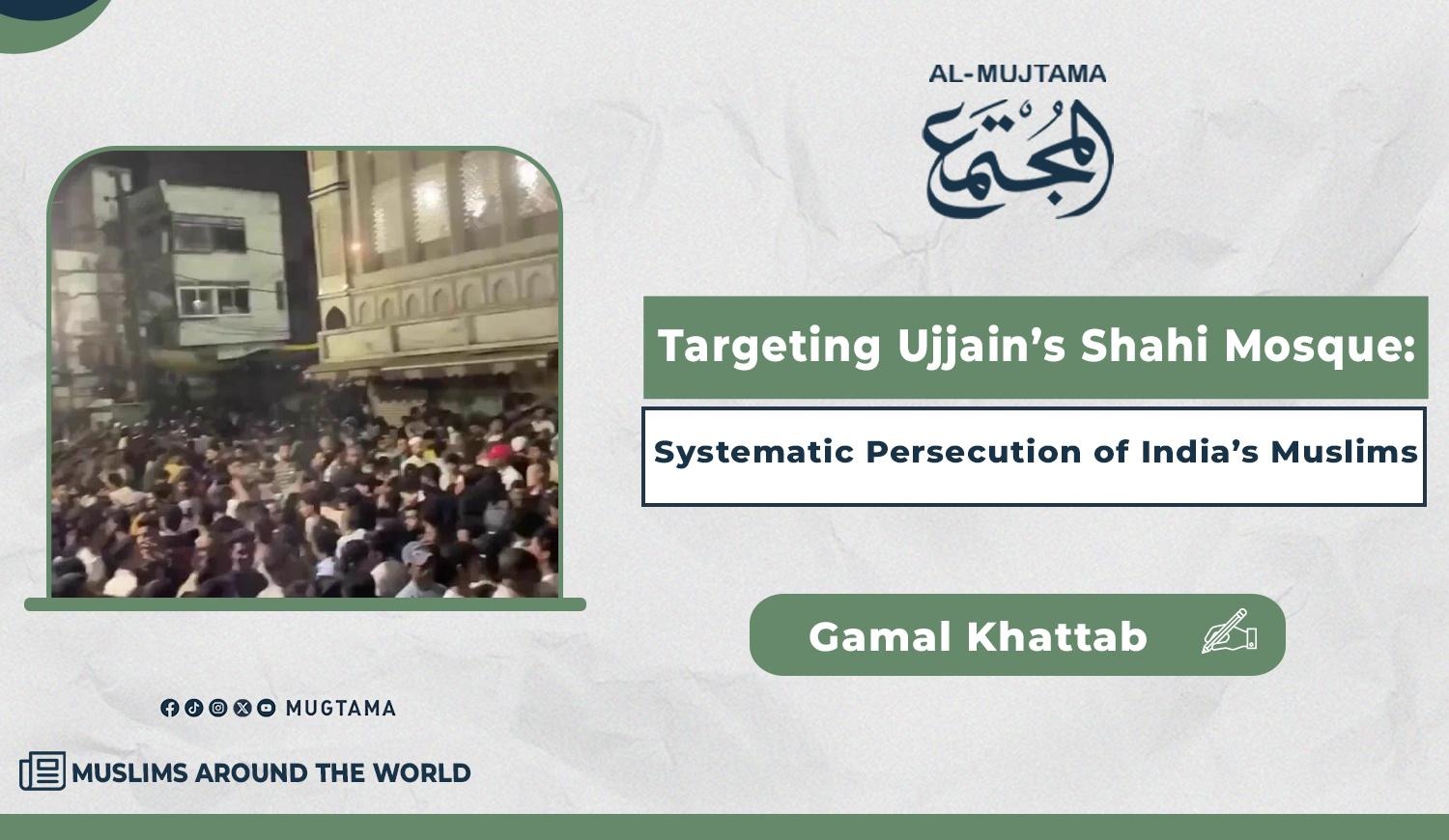
In response to this plan, widespread protests erupted. Members
of the local Muslim community gathered inside the mosque and remained overnight
to prevent the demolition, forcing the local administration and police to
temporarily suspend operations.
The spurious nature of these arguments and administrative
practices is demonstrated through several key points:
Ignoring Available Engineering Alternatives
The core issue of the expansion plan lies in concentrating
exclusively on cutting into the historic mosque rather than seeking flexible
architectural and engineering solutions. Residents and the Muslim
Representation Committee expressed deep surprise at the lack of balanced
planning, noting that authorities could have expanded the road by acquiring the
building directly opposite the mosque, thereby achieving the organizational
objective without compromising the historic and religious monument.
Nature of Waqf Properties and Religious Sanctity
The case of the mosque carries a critical legal and religious
dimension regarding the nature of Waqf property, which does not permit
surrendering places of worship or severing parts of them. The mosque's Imam and
representatives of the local community emphasized that residents had previously
shown immense flexibility by surrendering commercial shops for area
development; however, mosques registered as religious endowments possess a
legal and religious sanctity that prevents relinquishing any part of their
halls or minarets.
Judicial Course and Legal Escalation
Despite initial petitions being rejected by the High Court of
Madhya Pradesh under the pretext of "public interest" and regulatory
procedures, the mosque administration did not relent in seeking justice. The
committee proceeded to file an appeal before a higher judicial bench,
explicitly indicating their readiness to approach the Supreme Court of India to
protect the Islamic Waqf and uphold the constitutional rights of
Muslims.
Asaduddin Owaisi, president of the All India
Majlis-e-Ittehadul Muslimeen (AIMIM), supported the peaceful sit-in, warning
that these attempts are directly linked to the proposed Waqf Amendment Bill,
which aims to grant government officials powers to confiscate Islamic
endowments and properties and facilitate control over them.
Ruling Party Support for Extremist RSS Policies
Efforts to demolish the "Shahi" Mosque cannot be
isolated from the broader political context in India. This approach receives
strong backing from the ruling party—the BJP—which adopts the
"Hindutva" (Hindu nationalism) ideology championed by the extremist Rashtriya
Swayamsevak Sangh (RSS) organization.
This historic organization seeks to transform India from a
secular, multi-religious state into an exclusively "Hindu Nation" (Hindu
Rashtra) by marginalizing non-Hindu components of the nation and reclaiming
what it describes as "lost Hindu glory and sacred sites." The
judiciary and executive bodies in states governed by the party have
increasingly served as tools to execute these policies by granting formal
legitimacy to demolition orders and forced displacement.
International Silence and Neglect of Violations Against Muslims
Despite international human rights organizations (such as
Amnesty International and Human Rights Watch) and UN reports documenting these
systematic violations, international silence and political neglect from major
powers and multilateral institutions persist. Many global powers prioritize
economic interests, geopolitical alignments, and trade relations with India
over human rights, giving the Indian government an indirect green light to
continue violating international law and religious freedoms without fear of
accountability or sanctions.
Attempting to demolish parts of the historic "Shahi" Mosque in Ujjain is not an isolated incident or a purely administrative procedure; it is a new link in a chain of systematic, discriminatory practices aimed at uprooting Islamic heritage and stripping Indian Muslims of their guaranteed constitutional rights. Defending historic mosques and endowments in India is no longer merely a local issue; it is a human rights cause requiring an urgent response and a firm stance from the international community and Islamic organizations to press New Delhi to halt discriminatory policies and preserve the cultural and religious heritage currently facing destruction under flimsy pretexts.
Footnotes
- 1 The Indian Express: Report on the decision to suspend the partial demolition of the "Shahi" Mosque in Ujjain, detailing field and judicial developments.
- 2 Statements by the Mosque Administration and Representation Committee: Official statements by Imam Mohammad Ibrahim and representative Mohammad Zakir regarding the mosque's 636-year heritage and its legal/religious status.
- 3 Records of the High Court of Madhya Pradesh: Ruling by Justice Sandeep N. Bhatt (September 9) and proceedings before the division bench.
- 4 Statements by the All India Majlis-e-Ittehadul Muslimeen (AIMIM): Statements by party president Asaduddin Owaisi regarding the Waqf Amendment Bill and peaceful protests.
- 5 Human Rights Organizations Reports (Human Rights Watch & Amnesty International): Documentation on "Bulldozer Justice" and the demolition of Muslim homes and mosques in India.