








"Bulldozer": Symbol of Systematic Violations Against Muslims in India

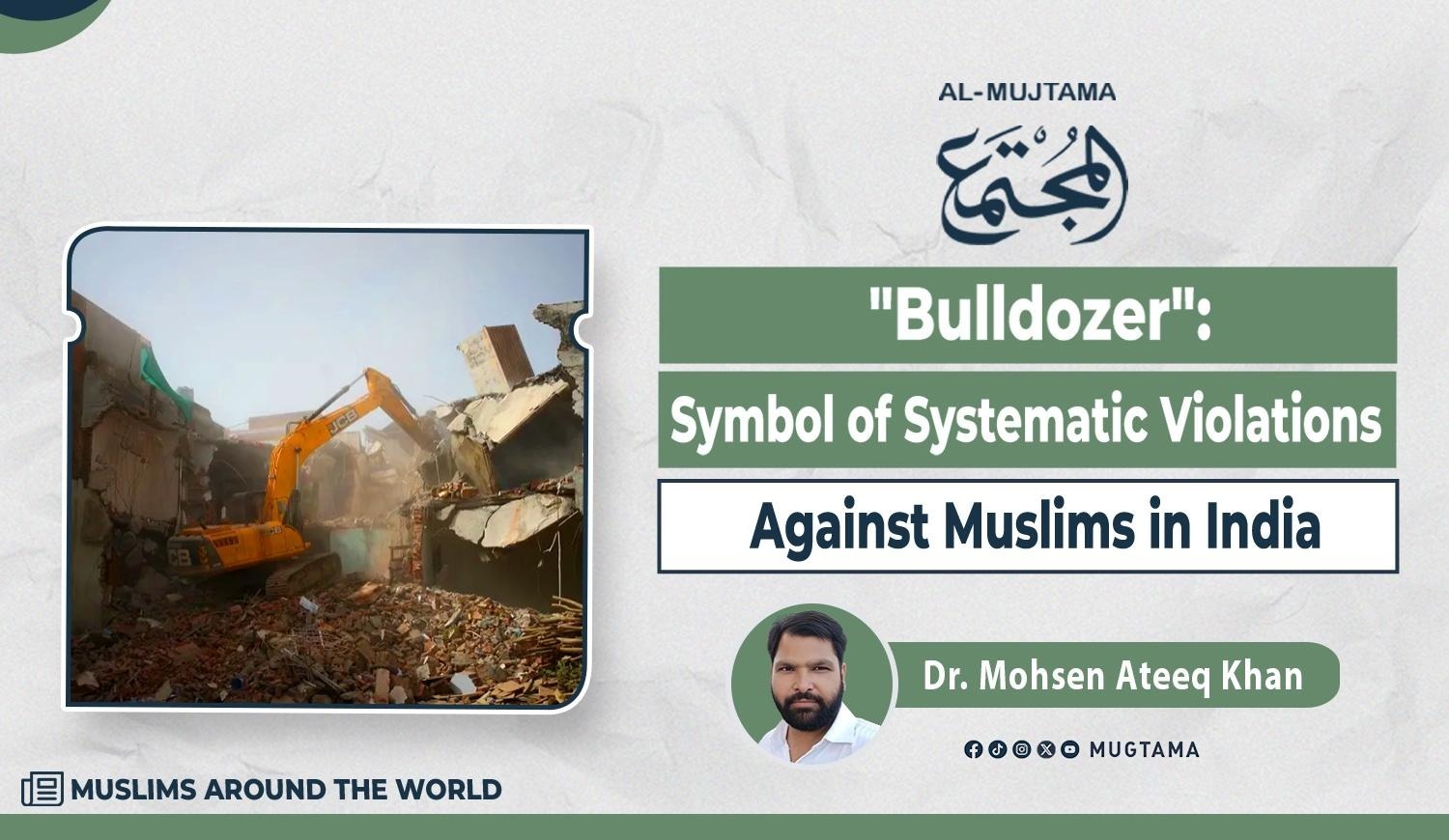
The "bulldozer" in India has transformed into one of the most prominent symbols representing the violations faced by Muslims. It has become a recurring tool for demolishing their mosques, schools, cemeteries, and homes, in striking spectacles taking place particularly in states governed by the Bharatiya Janata Party (BJP), led by Prime Minister Narendra Modi.
A glaring example of this occurred in the city of Sambhal, Uttar Pradesh, where police raided a mosque and found posters inside reading
"I love Muhammad" in English. The authorities subsequently summoned a
bulldozer and demolished the mosque without providing any clear justification
or completing standard legal procedures. While future revelations may uncover
additional details about this incident, what transpired reflects a reality that
has become all too familiar: a sense among authorities that legal justification
is unnecessary before demolishing Muslim properties, whether they are mosques,
schools, cemeteries, or residences.
Bulldozer Baba and the Weaponization of Demolitions
The bulldozer has become an inherent symbol of repressive policies
directed against Muslims. Yogi Adityanath, the Chief Minister of Uttar Pradesh,
has even earned the nickname "Bulldozer Baba" due to his frequent
reliance on this method when dealing with Muslims, even in the simplest of
matters. Adityanath, a saffron-robed Hindu monk, is known for his publicly
hostile stances toward Muslims and a series of provocative statements that have
sparked widespread controversy within India.
Adityanath’s name has been linked to bulldozers since he assumed the
state's premiership in 2017, when his government began utilizing them to remove
properties allegedly linked to criminal gangs or unlawful structures. However,
this policy gradually evolved, becoming by 2020 the emblem of a government
campaign under the banner of "enforcing law and order." Reviewing
numerous reports reveals a clear double standard in law enforcement;
authorities exhibit immense speed in demolishing Muslim mosques, schools, cemeteries,
and homes for reasons that may appear marginal and without fulfilling legal
procedures, whereas they resort to standard judicial pathways when Hindus are
involved. Consequently, Adityanath's supporters adopted the title
"Bulldozer Baba" as an expression carrying connotations of gloating
over the suffering Muslims experience at his hands.
Transcending Borders and Targeting Historic Islamic Sites
This policy has not been confined to Uttar Pradesh; it has extended to
other BJP-ruled states after gaining widespread attention. States such as
Madhya Pradesh, Gujarat, Delhi, Uttarakhand, Haryana, and Assam have witnessed
similar campaigns targeting Muslim places of worship, properties, and
historical buildings. These operations have resulted in the demolition of
thousands of homes and hundreds of mosques, schools, and cemeteries, including
heritage buildings dating back to the pre-independence era or the Mughal
period.
According to reports, Yogi Adityanath’s government launched a vast
campaign in May 2025 in the border areas of Uttar Pradesh adjacent to Nepal.
This resulted in the bulldozing of 250 Islamic religious schools (madrasas), 30
mosques, 25 cemeteries, and six Eid prayer grounds (Eidgahs) under the pretext
that they were illegal structures. The campaign spanned seven border districts:
Maharajganj, Siddharthnagar, Balrampur, Shravasti, Bahraich, Lakhimpur Kheri,
and Pilibhit.
This campaign persisted through June of the same year. The demolition of
a mosque nearly a thousand years old and a two-century-old shrine triggered a
widespread wave of anxiety regarding the targeting of Islamic religious sites
across several BJP-governed states.
These operations do not appear to be merely isolated incidents. Reports
indicate that since May, at least 23 Islamic religious structures—comprising
mosques, shrines, Eidgahs, and madrasas—have been demolished across six
different states. Furthermore, the historic Ganj Shahida Mosque in Varanasi,
estimated to be around a thousand years old, faces legal measures that could
culminate in its demolition.
These practices have been recorded in multiple states, including Delhi,
Maharashtra, Uttar Pradesh, Gujarat, Rajasthan, and Haryana. This has
reinforced accusations of selective targeting directed at Islamic religious
sites, especially since all these operations were executed without adherence to
due legal process.
The Human Toll and Desecration of Cemeteries
Statistics indicate that more than 7,400 homes owned by Muslims were
demolished during 2024 alone. Concurrently, authorities—even in some states not
ruled by the BJP—have deliberately framed punitive demolitions targeting
Muslims as part of urban development and modernization projects.
On June 19, 2024, the Uttar Pradesh government executed a large-scale
eviction campaign in the Muslim-majority Akbar Nagar area of Lucknow. This
resulted in the demolition of approximately 1,800 structures, including 1,169
homes and 101 commercial establishments, with the vast majority of these
properties being Muslim-owned.
On April 26, 2026, residents of the Manoharpura area in the city of
Mathura awoke to a shocking sight, finding violated graves, destroyed boundary
structures, and exposed shrouds above the ground in the
"Ahl-e-Muslim" cemetery. Several residents confirmed that the graves
of their parents, ancestors, and relatives were tampered with after JCB
bulldozers, operating under the supervision of local authorities, entered the
cemetery during the late hours of the night—an act described by residents as
deliberate.
This assault resulted in the desecration of nine graves within the
cemetery, which dates back to 1909. Additionally, six trees and twenty pillars
of the surrounding fence were damaged, along with green spaces and landscaping
work, as a result of the midnight bulldozing operations carried out under
orders from Mathura municipal officials.
These occurrences represent only limited examples of a long record
documenting the violations faced by Muslims in India, where successive reports
monitor state assaults on their places of worship and properties, alongside
accompanying violations of fundamental rights guaranteed by international
conventions.
Amnesty International Denounces "Bulldozer Justice"
Based on these data points, Amnesty International has strongly condemned
the policy known as "bulldozer justice," describing it as an illegal
and discriminatory practice. The organization characterized it as a form of
extrajudicial collective punishment that disproportionately targets the Muslim
minority in India.
Among the prominent conclusions reached by the organization in its
reports are:
- Retaliatory
Targeting: Through extensive research and reports published in early 2024, the
organization documented numerous punitive demolitions targeting homes,
shops, and places of worship in states such as Assam, Delhi, Gujarat,
Madhya Pradesh, and Uttar Pradesh. It emphasized that these measures were
frequently used as a means of retaliation against Muslims or to silence
them due to their opposition to policies deemed discriminatory, or because
of their participation in peaceful protests.
- Severe Human Rights
Violations: The organization asserted that these operations are often carried
out without adherence to due legal process, and without granting the
affected individuals sufficient prior notice or a genuine opportunity for
legal appeal. This leads to forced evictions, the displacement of
families, and massive losses to their livelihoods.
- Corporate
Accountability: Amnesty International also criticized heavy equipment manufacturing
companies, foremost among them JCB, noting that its machinery is widely
used in demolitions that the organization deems unconstitutional. It
called on the company to commit to its human rights responsibilities and
take serious steps to prevent its equipment from being utilized in such
violations.
- Demand for Justice: The organization demanded that
Indian authorities immediately halt all forced evictions and punitive
demolitions, and fairly compensate affected families while holding
accountable the officials responsible for ordering or executing these
unlawful measures.
The Supreme Court's Historic Ruling and Standing Guidelines
In contrast to these practices, the Supreme Court of India issued a
historic ruling in November 2024, considered one of the most prominent judicial
judgments concerning what has become known as "bulldozer justice"—the
arbitrary or punitive demolition of property outside the framework of the law.
The ruling was issued by a judicial bench headed by Supreme Court Justice B.R.
Gavai, incorporating a set of binding, nationwide guidelines aimed at ensuring
no private property is demolished except after the completion of all due legal
processes.
Among the key directives included in the ruling were:
- Prohibition of
Punitive Demolition: The Court categorically affirmed that the mere accusation or even
conviction of a person in a criminal case does not grant the executive
authorities the right to demolish their property, emphasizing that the
executive branch must not simultaneously assume the roles of judge, jury,
and executioner.
- Prior Notice: The Court mandated that competent
authorities issue a written notice to the property owner before executing
any demolition, specifying the reasons for the decision, to be delivered
at least fifteen days prior to the execution date.
- Right to Appeal: The Court also ruled that if a
final demolition order is issued, authorities must wait an additional
fifteen days before execution, so the property owner can resort to the
judiciary to challenge the decision or remove the structure themselves if
they wish to do so.
- Enhancing
Transparency and Accountability: The Court required the complete documentation of demolition
operations via video recordings, along with the preparation of an official
inspection report for each operation, and the creation of an electronic
platform where notices and procedures are recorded to ensure transparency
and facilitate oversight and accountability.
- Imposing Liability
on Violators: The judgment further stressed that any government official who
bypasses these legal safeguards, or authorizes the execution of unlawful
demolitions, will bear personal liability for their actions and may face
legal proceedings, including charges of contempt of court.
An "Undeclared Emergency" and Continued Intolerance
Despite this judicial ruling, the wave of anxiety within Islamic circles
has persisted. Several prominent Islamic bodies have described what mosques,
madrasas, and Islamic shrines across India are experiencing as an
"undeclared state of emergency." These organizations announced their
intention to approach the judiciary to demand the reconstruction of religious
structures demolished in the states of Rajasthan, Maharashtra, Uttarakhand, and
Uttar Pradesh.
In this context, Arshad Madani, President of the Jamiat Ulama-e-Hind,
stated: "The country is indeed living in an undeclared state of emergency
today. The demolition of citizens' homes and places of worship while ignoring
legal procedures and judicial rulings contradicts the foundational principles
upon which the Indian Constitution is built."
He added: "If bulldozers become the governments' means to achieve
justice instead of courts, what is the value of the rule of law and citizens'
rights? The government must not supplant the judiciary, because determining the
legality or illegality of acts is an inherent and exclusive jurisdiction of the
judicial authority alone."
For his part, the spokesperson for Jamaat-e-Islami Hind expressed deep
concern over the demolition campaigns targeting religious structures,
residential buildings, and vulnerable groups in a number of Indian states,
considering these practices a dangerous escalation against Muslims.
Furthermore, the spokesperson for the All India Muslim Personal Law
Board, Mr. Kasim Rasul Ilyas, announced that the Board has decided to prepare a
comprehensive document chronicling the various violations faced by Muslims in
the country. He explained that it will include files related to what he
described as "bulldozer terrorism," the demolition of madrasas,
assaults on cemeteries, and the deletion of Muslim names through the SIR
process, as well as incidents of extrajudicial execution (lynching), with this
document slated for publication in the near future.
Despite repeated condemnations issued by international human rights
organizations, the historic ruling of the Indian Supreme Court, and ongoing
objections from Islamic bodies, the punitive demolition campaigns targeting
Muslims using bulldozers continue at the same pace, with no sign of abating on
the horizon.
These practices have left harsh humanitarian and social consequences;
large numbers of Muslims have been deprived of their dwellings, places of
worship, and basic facilities. Many families have been left homeless and
without a source of livelihood amidst demolitions carried out outside the
framework of due legal process.
Conversely, these campaigns have turned into a source of celebration
among certain extremist Hindu groups and supporters of Prime Minister Narendra
Modi, Uttar Pradesh Chief Minister Yogi Adityanath, and members of their party.
They view the use of bulldozers as a symbol of firmness in confronting Muslims,
reflecting the scale of hatred and animosity fueling these practices.
In this context, the city of Mainpuri witnessed a striking scene on
November 9, 2024, when a number of Yogi Adityanath's supporters attended one of
his public events riding on bulldozers, in an image that has come to express
the political approach associated with him. Pop music linked to the
"Hindutva" ideology has further reinforced this symbolic presence of
the bulldozer, until it became part of the political and media discourse
accompanying those gatherings.
The employment of this symbol has not been restricted to the Indian
domestic arena but has extended to Indian communities abroad, including the
United States of America. In August 2022, during India's Independence Day
celebrations in the township of Edison, New Jersey, crowds carrying Indian
flags of saffron, white, and green lined both sides of the parade route. Among
the participants appeared a yellow bulldozer bearing a banner written in Hindi
that read "Baba Bulldozer," alongside images of Yogi Adityanath, in a
scene reflecting the transit of this political symbol beyond Indian borders.
While these events reflect the reality of the current phase, indicators
do not suggest an end to this policy in the near future, given the continued
reliance of Narendra Modi's government and the BJP on a discourse and policies
built on religious and sectarian polarization. Consequently, hardly a day
passes without the media carrying news about the demolition of a mosque, a
madrasas, a cemetery, or a home belonging to Muslims, often without convincing
justifications or the completion of the legal procedures mandated by law and
the Constitution.
Thus, the "bulldozer" has transcended being merely a machine used for removing buildings, transforming into a political and media symbol that embodies—in the eyes of many human rights organizations and Islamic bodies—a pattern of systematic violations targeting Muslims. It raises increasing questions regarding the extent of commitment to the rule of law, the protection of constitutional rights, and the safeguarding of religious freedoms in the world's most populous democracy.