






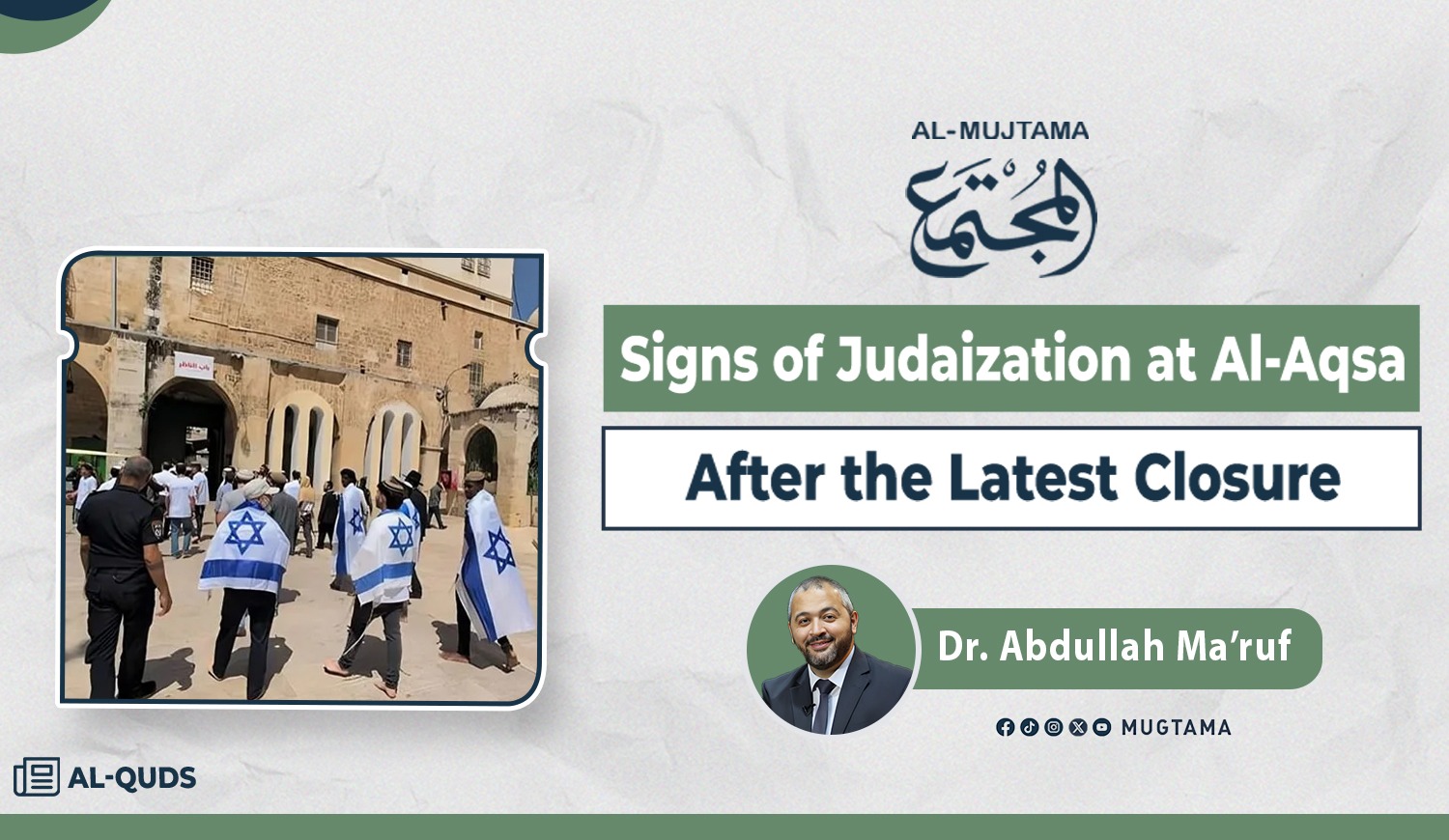
Signs of Judaization at Al-Aqsa After the Latest Closure
The
latest closure of Al-AqsaMosque was neither a routine security measure nor a temporary
wartime restriction, as Israeli authorities claimed. In reality, it was a
dangerous live test — answering one critical question: Can Israel shut down
Al-Aqsa entirely for 40 consecutive days — including 20 days of Ramadan, the
last ten nights, Laylat al-Qadr, and 5 consecutive Fridays — then reopen it at
will, without facing any proportionate political, legal, or popular
consequence?
And the
answer Israel drew from this test was deeply alarming — because it didn't
merely test its ability to shut down the mosque; it tested its ability to turn
the act of closure itself into an instrument of sovereignty.
The prolonged closure was not merely a security measure — it was
a test of Israel's ability to impose its sovereignty over Al-Aqsa.
What made
this moment most dangerous was not the closure itself, but that it passed as
something repeatable. When Al-Aqsa's opening and closing becomes subject to an
occupation police decision, we are no longer facing merely an assault on
freedom of worship — we are facing a practical redefinition of who controls the
site. This is the most dangerous seed in the Judaization process: wresting
administrative reality from the Islamic Waqf authority and replacing it with
occupying police authority — so that Israel is no longer simply a force that
raids, but transforms into a supreme executive reference that determines when
Muslims may enter, in what numbers, under what conditions, and when they are
barred entirely.
We have
repeatedly warned — before and immediately after the mosque's reopening — that
Israel's police control over the very decision to close and reopen it
represents an additional step in undermining the status quo.
Normalizing Security Control and Conditional Access
It is
precisely from this point that the signs of Judaization emerging after the
closure must be read. The first of these signs is the normalization of security
control over the mosque: during the closure, strict military measures were
imposed around Al-Aqsa, the gates of the Old City were shut, and identity
checks, the barring of young men, and assaults on worshippers continued even
after the mosque reopened. This means the reopening was not a return to
pre-closure conditions, but a shift from total closure to conditional access —
from complete prohibition to selective permission. Judaization does not always
begin with building a wall or demolishing a landmark; sometimes it begins with
converting an inherent right into a temporary permit.
Striking at the Centrality of Daily Islamic Presence
Another
sign of this Judaization is the assault on the centrality of daily Islamic
presence within the mosque. The battle is not only about prayer, but about
everything that makes Al-Aqsa a living space for Jerusalemites — religious
study circles, family gatherings, children at play, steadfast residence,
i'tikaf, and the constant human fullness that prevents the occupation from
having exclusive hold over the site.
The greater danger lies in stripping the Islamic Waqf of its
authority and turning the occupation's police into the supreme reference.
This is
not rhetorical — one of the most alarming discussions exposed during the
closure was the deployment of the concept of "desecration of holy
sites" within Israeli legislation, particularly the so-called Western Wall
Bill currently under review in the Israeli Knesset. This would allow the
targeting of normal Islamic activities inside the mosque — not as legitimate
worship, but as "secular use" that contests the Jewish definition of
the site's sanctity. At this point, Judaization is no longer merely a matter of
raids; it becomes an attempt to redefine what a Muslim is permitted to do
inside his own mosque.
From "Managing the Raids" to "Religious
Supremacy"
Furthermore,
the shift from managing raids to managing Jewish religious supremacy represents
one of the most significant manifestations of Judaization at Al-Aqsa. Years
ago, Israel sought to market settler incursions as limited, controlled, and
merely visits.
Today,
however, the trajectory is far clearer: minimizing Islamic presence to the bare
minimum, expanding raids in scope, duration, and symbolic weight, then imposing
an unspoken rule that Jewish religious considerations take precedence whenever
they conflict with Islamic ones. This intersects with ground realities in
recent months, where restrictions on Muslim numbers have been tied to files
concerning raids, i'tikaf, and the Gate of Mercy. Israel does not seek genuine
sharing of the site — rather, it seeks to use the pretense of sharing to arrive
at a single outcome: permanent Jewish supremacy, with Muslims entering their
own mosque only within the boundaries drawn by an occupation police officer.
Targeting Popular Achievements — The Gate of Mercy as a Case
Study
Also
prominent in this context is the targeting of the Gate of Mercy and previous
popular achievements, as one of the most significant manifestations of
Al-Aqsa's Judaization. The occupation's trajectory does not only move forward —
it also attempts to roll back and erase everything Jerusalemites have won
through their steadfast presence over the years.
The reopening was accompanied by restrictions and intensified
security measures — effectively converting Muslims' right into a mere
"temporary permit."
Among the
most significant manifestations of this process is the attempt to reverse the
Jerusalemite achievement at the Gate of Mercy, which had been under mounting
siege before Ramadan. Israel was treating the holy month as a "training
phase" for realities it intended to entrench afterward. The recent closure
granted Israel a golden opportunity to test this logic on a wider scale — for
what is to prevent any prayer hall, gate, or space within Al-Aqsa from becoming
a security negotiation file that Israel opens or closes at will? This is
precisely the meaning of gradual Judaization: converting what people have
settled on the ground into a file open to police review.
Reshaping Public Consciousness and Lowering the Ceiling of
Demands
Reshaping
public consciousness toward Al-Aqsa stands at the very core of Judaization's
manifestations. When the mosque is closed for 40 days and then reopened, some
may turn to celebrating the return of prayer as though the matter is over — but
the real danger is that the reopening becomes a curtain concealing the
precedents the closure has entrenched.
Israel
does not need to seize a visible new gain every time; it is sometimes enough to
make the previous crime forgettable, then build the next crime upon it. This is
why one of the most dangerous outcomes of the recent closure is that Israel
attempted to shift the debate from asking: how do we prevent the occupation
from violating Al-Aqsa? — to a far lesser question: when will the occupation
allow Al-Aqsa to reopen? When the ceiling of discussion drops this low,
Judaization has advanced a major step forward even before people have felt all
of its consequences.
Toward an "Ibrahimi Mosque" Model
In sum,
the signs of Judaization following the recent closure are not confined to raids
alone, but manifest across intertwined trajectories: imposing the right to
close and reopen, entrenching conditional access, targeting daily Islamic
presence, advancing Jewish religious supremacy, and revisiting previous popular
achievements — foremost among them the Gate of Mercy and i'tikaf.
Israel's ultimate goal is to replicate the "Ibrahimi
Mosque" model in order to achieve full control over Al-Aqsa's identity.
These are
not scattered details — they are parts of a single project aimed at
transforming Al-Aqsa from a purely Islamic mosque under genuine Islamic
sovereignty into a site where Israel controls the definition of its religious
function, the limits of its use, and the rules of access — precisely as it did
with the Ibrahimi Mosque in Hebron. After the recent closure, the question is
no longer whether a Judaization process is underway at Al-Aqsa; that much is
too clear to dispute.
The real
question now is: how far will this trajectory be allowed to advance before
everyone realizes that what was lost was not merely 40 days of prayer — but 40
days used to re-engineer the entire relationship between the occupation and the
mosque.
You may
also like:
While the World Looks Away… Gaza Is Being Slaughtered and Al-Aqsa Faces Imminent Danger!