









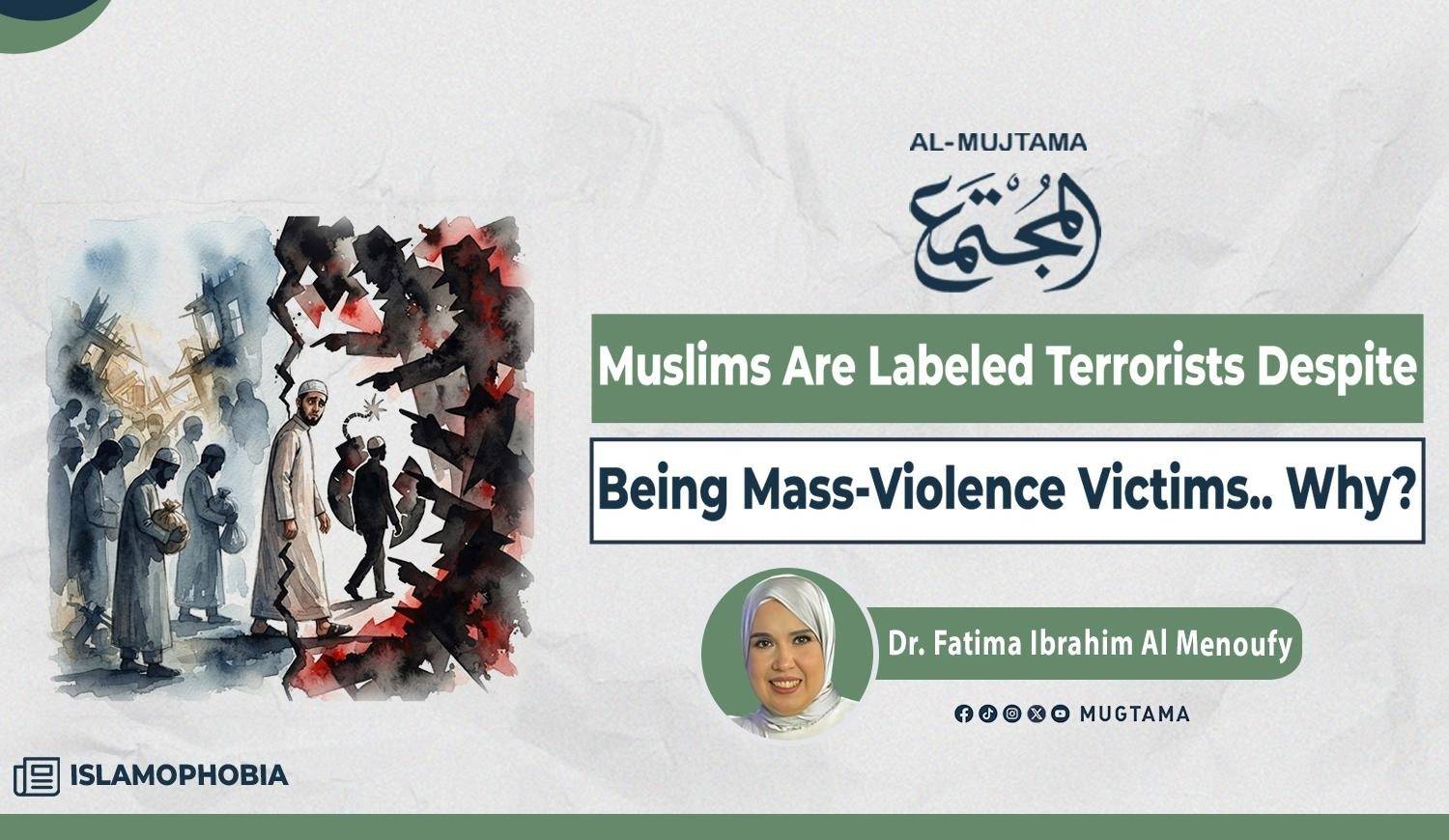
Muslims Are Labeled Terrorists Despite Being Mass‑Violence Victims.. Why?

The Atomic Bombings of Hiroshima and Nagasaki: An Unprecedented Human Catastrophe
As the world marks the 81st anniversary of the atomic bombings of
Hiroshima and Nagasaki, it is important to remember the immense human suffering
caused by those attacks and to examine how history, terrorism, and crimes
against humanity are discussed today in recent political discourse and media coverage.
On August 6 and 9, 1945, the United States
dropped atomic bombs on Hiroshima and Nagasaki. The bombings caused enormous
civilian casualties, with total deaths commonly estimated in hundreds of thousands.
The bombings followed a warning issued by U.S.President Harry Truman, who declared that if Japan did not accept the Allied
terms, it could expect “a rain of destruction the likes of which has never been
seen on this earth.”
Hiroshima and Nagasaki remain enduring
symbols of the catastrophic human consequences of nuclear warfare, and one of the darkest chapters in modern human history, while the United States remains the only country
to have used nuclear weapons in warfare.
Whatever historical judgment is made about the decision to use such weapons, the killing and suffering of the victims can never be justified or denied.
Double Standards in Attributing Violence to Islam
A troubling question deserves serious consideration: Why are terrorist
attacks committed by a relatively small number of individuals so often
described through an Islamic or Muslim identity, while the religious identities
of perpetrators responsible for mass violence or crimes against humanity are
frequently omitted or treated as irrelevant?
Terms such as “Islamist terrorism” and “Islamic extremism” are common
in political and media discussions. Yet expressions such as “Christian war
criminals” or “Jewish war criminals” are far less or never used when discussing atrocities committed
by individuals or states associated
with those religious traditions.
The issue is not to deny that religiously motivated violence has
occurred among followers of diverse faiths. Rather, the concern is whether
religious identity is applied justly and consistently when it comes to Islam.
History Contains Atrocities Committed by Actors
belonging To Christianity
Human history contains countless examples of slavery, genocide,
colonial violence, ethnic cleansing, and mass killing. These crimes have been
committed by governments, armies, political movements, and individuals
representing different religious and ideological backgrounds.
The transatlantic slave trade subjected millions of Africans and their
descendants to kidnapping, enslavement, forced transportation, and brutal
exploitation. European colonial expansion across the Americas resulted in the
dispossession, forced removal, warfare, and killing of Indigenous peoples.
The Holocaust demonstrated the devastating consequences of
state-organized racial persecution and extermination. Nazi Germany and its
collaborators murdered approximately six million Jews, along with millions of
other victims.
Under Stalin, the Soviet Union experienced extensive political
repression, executions, forced labor, deportations, famine, and other forms of
state violence. Historians debate the precise number of victims, but the scale
of human suffering was enormous and affected people from numerous nationalities
and religious communities, including Muslims and Jews.
These atrocities are generally
discussed in terms of colonialism, Nazism, Stalinism, state repression, or
political ideology. They are not normally presented as evidence that an entire
contemporary religious community is inherently responsible for them. Then why is Terrorism associated with Islam?
Muslims Have Been Victims of Mass
Atrocities Rather than Preparators
The history of violence also demonstrates that Muslims have frequently
been victims rather than perpetrators.
During the conflicts surrounding the breakup of Yugoslavia, Muslims in
Bosnia were subjected to ethnic cleansing, mass killing, and forced
displacement. The Srebrenica genocide of July 1995 resulted in the murder of
more than 8,000 Bosniak Muslim men and boys.
Muslim populations also experienced persecution, dispossession, and
forced migration under Russian imperial and Soviet rule. One of the most
devastating examples was the mass deportation of the Crimean Tatars in 1944
under Stalin.
The Crusades and the Principle of Consistency
The Crusades provide another historical example of religiously framed
violence. Christian armies committed massacres and other atrocities against
Muslim and Jewish populations during the medieval campaigns. Following the
capture of Jerusalem in 1099, large numbers of inhabitants were killed.
Recognizing these historical crimes does not justify blaming Christians
today. Contemporary Christians are not collectively responsible for the actions
of medieval Crusaders.
The same principle must apply to Muslims. Muslims today cannot be held
collectively responsible for crimes committed by individual extremists.
Genocide in Gaza
More recently, the ongoing genocide in
Gaza that has led to over 65,000 deaths, hundreds of thousands of civilian
casualties and mass destruction. In September 2025, the UN Independent
International Commission of Inquiry concluded that Israel had committed
genocide against Palestinians in Gaza.
Language
Shapes Public Understanding
Terrorism, war
crimes, genocide, and crimes against humanity are distinct legal concepts.
An act of
terrorism does not automatically constitute a crime against humanity, while
conduct that constitutes crimes against humanity may involve acts of terror
without necessarily being legally classified as terrorism in every context.
Precise language
matters because it shapes public understanding and influences how
responsibility is perceived. When terrorism is repeatedly presented primarily
as an “Islamic” phenomenon, while the religious identities of actors
responsible for other crimes against humanity are omitted, minimized, or
treated as irrelevant, the distinction between individual perpetrators and an
entire religious community can become dangerously blurred. Such framing can
contribute to Islamophobia, generalized suspicion of Muslims, and deeper social
divisions.
The above historical experiences challenge simplistic narratives that
associate Muslims primarily with violence. Muslims are and have themselves been
victims of genocide, ethnic cleansing, forced displacement, and state
repression. The fundamental principle is simple: justice must never be
selective.
No Religion Should Bear Collective Guilt.
Footnotes
- 1 Maalouf, Amin. The Crusades Through Arab Eyes. Schocken Books, 1985.
- 2 Runciman, Steven. A History of the Crusades. 3 vols., Cambridge University Press, 1951–1954.
- 3 Ham, Paul. Hiroshima and Nagasaki: The Real Story of the Atomic Bombings and Their Aftermath. Sydney: HarperCollins Publishers, 2011.
- 4 Statement by the President Announcing the Use of the Bomb at Hiroshima (August 6, 1945). Gerhard Peters and John T. Woolley, The American Presidency Project (UCSB).
