





Who Gets to Be Called Great?
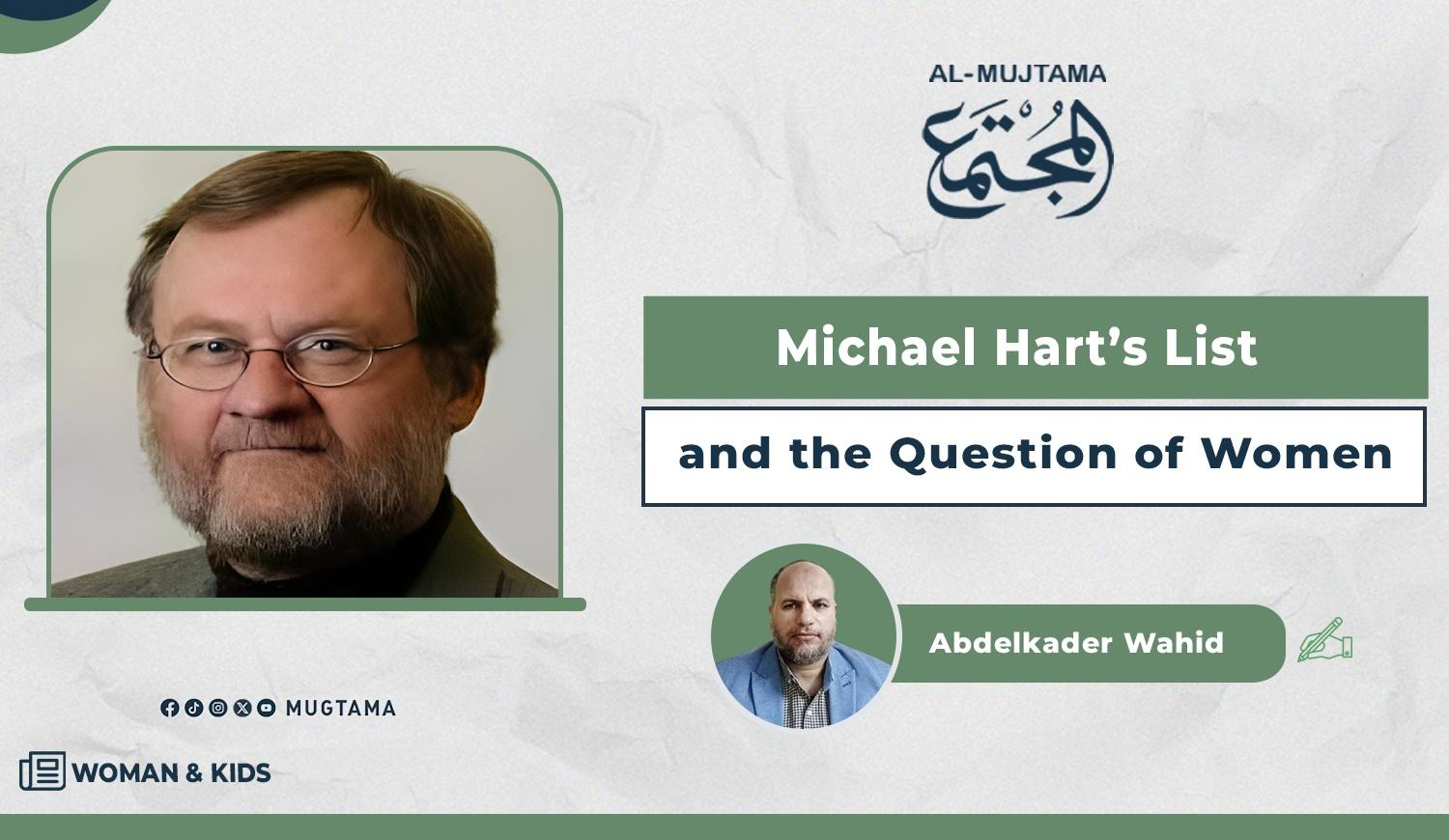
Michael Hart’s List and the Question of Women
All nations, religions, and schools of
thought have agreed on the importance of upholding a system of values.
Islam came and gave those values greater strength, cohesion, beauty, and a
binding covenant: “I was sent only to perfect
noble character.”
Among these virtues, honoring and protecting women
was a foremost priority. Once this value was firmly established, Muslim homes
became stable and secure, with safety reaching them from every direction and in
every era.
But when the Muslim community replaced
its own noble values, substituting Western values for its own principles, and
when some among its people came to believe in a system of values only when its
winds blew from the West, concepts became confused, standards became distorted,
and those who remained committed to their values found themselves like someone
holding a burning coal.
Michael Hart and the Values System
Decades ago, American author Michael
Hart surprised readers with his book The 100: A Ranking of the Most
Influential Persons in History, in which he placed the Prophet Muhammad,
peace and blessings be upon him, at the top, making him number one on his list.
This helped the book spread rapidly, with Eastern readers perhaps impressed by
the choice and Western readers perhaps surprised by it.
Hart was clever in mentioning only
three prophets: Muhammad, Moses, and Jesus, as though he wanted to satisfy the
followers of the three major religions, despite placing them at different
positions among his hundred most influential figures.
It was perhaps wise that he did not
mention the other prophets, because it is inappropriate to compare prophets
with ordinary human beings. Such comparisons constitute an injustice and an
affront to the status of prophethood. Discernment is an inherent quality of all
prophets, for they are the most perceptive human beings of every age.
Even among the prophets he did
mention, there is no clear criterion explaining why they were included. Was it
knowledge, moral value, intellectual genius, scientific ability, or social
ideas?
How, then, can one establish a
standard that places Newton above Jesus, peace be upon him, when Newton was
ranked number two and Jesus number three among Hart’s most influential figures?
Did Newton’s genius and scientific
achievements reach the point where he spoke in the cradle, brought the dead
back to life, or healed the blind and the leper by God’s permission, so that he
could be ranked above Jesus?
What is even more striking is that
Michael Hart included many religious figures, such as Buddha at number four,
Confucius at number five, and Saint Paul at number six. Yet we do not know why
he placed them ahead of Moses, God’s prophet, whom he ranked number sixteen.
Were they more religious? More
culturally knowledgeable? Did they possess a broader intellectual influence,
even though Moses had one of the greatest and most far-reaching missions in
human history after the mission of Muhammad, peace and blessings be upon him?
Did Hart not consult the Quran as a
source of knowledge and culture, and see how extensively it speaks about Moses,
peace be upon him?
If his criterion was the advancement
of values, how can figures such as Genghis Khan, ranked number twenty-one, and
Napoleon, ranked number thirty-four, be placed ahead of `Umar Ibn Al-Khattab,
whom he ranked number fifty-one?
We therefore do not know the exact
nature of Hart’s criteria, despite his acknowledgment that `Umar was a great
figure in his view. He noted that the West did not know `Umar as well as it
knew figures such as Alexander and Charlemagne. Yet despite acknowledging that `Umar
left behind achievements far more consequential than theirs, Hart still placed Alexander
ahead of him, and Genghis Khan far ahead of him.
Genghis Khan was responsible for
brutal raids that left no meaningful civilizational legacy other than
destruction and bloodshed, which eventually reached Europe when the Mongols
burned Moscow and advanced as far as Hungary.
Michael Hart and His View of Women
Leaving aside the many inconsistencies
and double standards in Michael Hart’s approach, the most striking aspect of
his book is his view of women.
Across the entire East and West,
across ancient and modern history, and throughout centuries of human
achievement and glory, only two women apparently stood out enough to make his
list, and both were placed near the end of the book.
It is genuinely striking that he
mentioned only two women among the great figures of history: Queen Isabella I,
ranked number sixty-eight, and Elizabeth I, ranked number ninety-four.
This reflects the author’s apparent
view that great achievements by women are rare. That is why he included only two women,
both of whom were queens.
His reason for including Queen
Isabella was that she encouraged Christopher Columbus to undertake his voyage
and supported him financially, after which he discovered the Americas, one of
which was the continent where Hart himself was born and lived.
This criterion has not been raised by
feminist groups or organizations concerned with women’s rights. Yet accusations
are repeatedly directed at Islamic civilization, which is constantly accused of
denying women their rights and being responsible for their backwardness.
Meanwhile, there is not even a whisper
of criticism when the standard itself is a Western one that is clearly unfair.
Instead, it becomes a refreshing breeze for their minds and ideas.
The Myth of Ancient Egyptian Feminism
What is also striking is that those
who consistently champion feminism often glorify the status of women in both
ancient and modern times and invoke the ancient Egyptian model as an inspiring
example of honoring and respecting women.
Yet if we examine ancient Egyptian
history, we find evidence in what they left behind of the marginalization of
women’s rights and their relegation to oblivion.
They often celebrate, as an
exceptional case, the policies of Pharaoh Amenhotep III (1390–1352 BCE), who
married Tiye, a commoner from Akhmim in Upper Egypt, thereby breaking with the
protocols of earlier pharaohs.
According to those protocols, the king
was expected to choose the chief royal wife and the mother of the crown prince
from among the daughters of the Pharaoh so that she could become queen of the
land.
As for Pharaoh Ramesses II, one of the
most prominent pharaohs in the historical and social life of the ancient world,
the sheer number of his statues—which filled Egypt from north to south—as well
as the large number of his wives, sons, and daughters, offers revealing
evidence of the reality of women in an era that many people like to describe as
the golden age of the pharaohs.
Here, we are speaking about women as
wives and queens of the Pharaoh. How, then, can we imagine the status of women
and the level of social treatment they received when they came from the general
population? What place did women have in this deeply ancient society?
This reality presented the ancient
Egyptian woman as a marginalized figure, standing beside and embracing the leg
of her enormous Pharaoh husband, as depicted in the images and statues carved
at Abu Simbel and elsewhere.
These historical narratives seem to
have returned in a modern form—a phenomenon in which the Orientalist Hart
became involved, whether consciously or unconsciously.
Islam’s Lasting Legacy of Honoring Women
Between the ancient and the modern,
Islamic civilization and the higher objectives of Islamic law remain elevated
through their values and principles above other civilizations in their
recognition of women, their presence in society, and their concern for women in
both tangible and spiritual terms.
Among the final pieces of advice given
by the Messenger of Allah, peace and blessings be upon him, was: “Maintain the prayer and care for your slaves.”
He also urged people to treat women
well. During his Farewell Sermon, as though sensing that his death was near, he
said: “Act kindly towards women.”
He also said: “The best of you is he who is best to his family, and I
am the best among you to my family.”
He also said: “Women are counterparts of men.”
-------------------------------------------------------------