









Mass Youth Protests Demand Resignation of India's Chief Election Commissioner
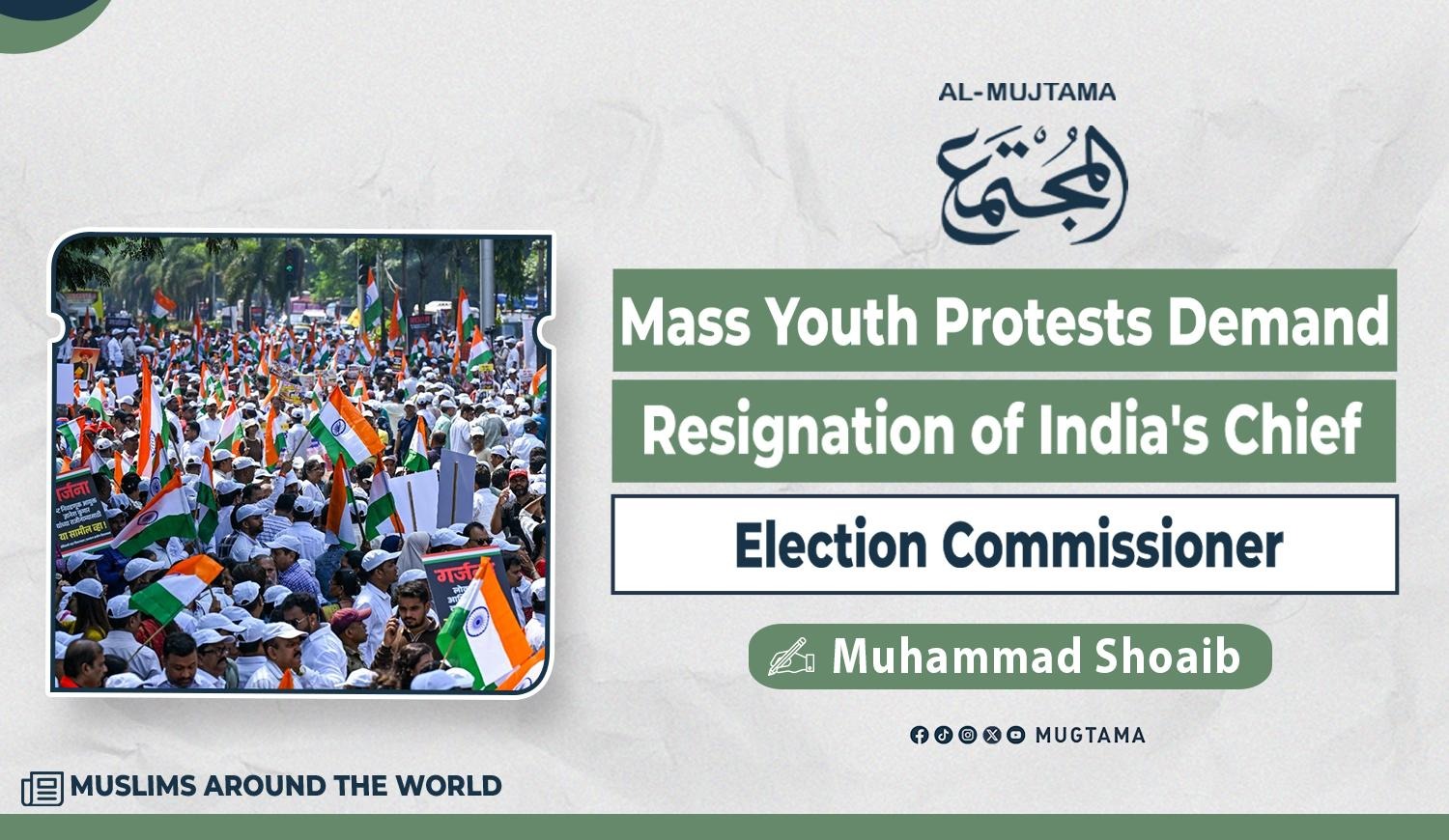
The Indian capital, New Delhi,
witnessed one of the most tense waves of protest in recent years as thousands
of demonstrators took to the streets to demand the resignation of India's Chief Election Commissioner, Gyanesh Kumar. The protests stem from
allegations regarding the voter list revision process, which critics claim has
led to the exclusion of millions of citizens from voting registers. These
demonstrations prompted authorities to impose unprecedented security measures,
turning the capital into what opponents and activists described as a
"besieged city," reflecting the escalating political tension between
the government and the opposition.
Authorities deployed more than 40,000
security personnel across the capital, setting up hundreds of metal barricades,
barbed wire, and checkpoints at the city's main entrances. Extensive
restrictions were also imposed on traffic and public transit, dozens of subway
stations were closed, and internet services were severed in sensitive areas to
prevent the coordination of protest movements.
According to circulating reports,
police detained at least 7,000 people during the day of protests, including
prominent political figures, students, journalists, and lawyers, marking one of
the largest mass arrest campaigns linked to political protests in India in
recent times.
The protests were called by the "Cockroach Janata Party" (CJP), a youth political organization that began as an
internet satirical movement before gradually transforming into a widespread
protest movement drawing large numbers of young people angered by political and
economic conditions, unemployment, and government exams.
The Capital Under Siege
Authorities enforced exceptional
security measures in the Jantar Mantar area, which serves as the primary site
for political protests in New Delhi. Entrances to the area were sealed with
security barriers, while police barred buses and vehicles arriving from
neighboring states from entering the capital.
The measures included closing dozens
of subway stations, while train services heading to New Delhi and Hazrat
Nizamuddin stations were suspended during the early morning hours in
anticipation of widespread disruptions.
Loudspeakers were also deployed at the
city's entrances to broadcast continuous warnings in Hindi and English,
alerting citizens to the prohibition of gatherings, processions, marches, and
road blockages under existing security laws.
Despite these measures, groups of
protesters managed to reach the demonstration sites after walking long
distances on foot. However, most were detained immediately upon arrival, as
police had prepared a fleet of buses to transport detainees to pre-arranged
temporary detention centers.
Protests Spread to Indian States
The protests were not confined to the
capital; they extended to several major states and cities across the country.
In Bengaluru, students and
activists organized a sit-in to demand the dismissal of the Chief Election
Commissioner, while Mumbai witnessed the arrest of hundreds during similar
gatherings. Demonstrations also erupted in Chennai, Kolkata, Patna, Hyderabad,
and Chandigarh, featuring participation from student organizations and
opposition political parties raising identical slogans demanding the protection
of electoral integrity.
Observers believe the geographical
expansion of the protests indicates a transformation of the issue from an
administrative dispute over voter lists into a national political crisis
affecting trust in democratic institutions and election management mechanisms.
Arrest of Prominent Political Figures
Among the most notable features of
these protests was the detention of several well-known political personalities,
including former chief ministers Mamata Banerjee, Arvind Kejriwal,
Pinarayi Vijayan, and Manik Sarkar, some of whom were later released.
The arrests also swept up leaders from
leftist parties and prominent opposition figures, in addition to activists,
journalists, and civil society representatives.
The arrest campaign sparked widespread
controversy in political and human rights circles, especially following reports
of journalists being detained while covering the events, having their equipment
confiscated, and facing movement restrictions near protest sites.
Furthermore, hundreds of lawyers were
arrested during sit-ins outside the Supreme Court and Patiala House
Court, where they were demanding clarifications from the Election Commission
regarding the procedures adopted in the voter registry revision process.
Detention of CJP Leadership
During the early morning hours, the
founder of the Cockroach Janata Party, Abhijit Debki, was arrested immediately
upon his arrival at New Delhi airport from Mumbai to participate in the
protests.
A number of his aides and party
leaders were also detained, prompting the organization to accuse authorities of
attempting to paralyze the protest movement before it could launch.
Debki appeared in a video recording
stating that they intended to participate in a peaceful protest, but the police
treated them as if they were criminals. He added that the party would not back
down from its demands despite the arrests and security measures.
Hours after his arrest, the party
announced that its leadership had been relocated to various sites and
communication with them had become difficult, further intensifying criticism
directed at the authorities.
The Opposition Accuses the Government of Choking Democracy
The widespread arrests ignited a wave
of sharp criticism against Prime Minister Narendra Modi's government.
Congress President Mallikarjun Kharge
stated that authorities have transformed India from the "mother of
democracies" into a "silent democracy," accusing the government
of using arrests and oppression to silence opposition voices.
For his part, Arvind Kejriwal remarked
before his detention that current events demonstrate the expansion of
authoritarian tendencies within the country, considering that the arrest of
activists right as they step off planes reveals the extent of official anxiety
over the growing protest movement.
Additionally, the opposition
"INDIA" alliance announced its intention to organize further protests
in the capital to defend what it described as citizens' right to vote and to
protect the constitution.
Accusations Regarding Voter List Revisions
The crisis centers around the
"Special Intensive Revision" project of voter registers overseen by
the Election Commission.
Opposition parties accuse the
commission of deleting the names of a massive number of eligible voters during
the revision process, with the heaviest impact falling on certain social and
religious groups, including Muslims.
Opponents argue that these revisions
could directly impact the results of upcoming elections and provide an
advantage to the ruling party.
Concerns mounted following press
reports detailing divisions within the Election Commission itself regarding the
implementation mechanism of the revision and the removal of massive numbers of
names from the electoral rolls.
In contrast, the Election Commission
and the ruling Bharatiya Janata Party denied all these allegations, asserting
that the procedures aim to update registers and ensure the integrity of the
electoral process rather than manipulate it.
The Rise of the "Cockroach Janata Party" Movement
The Cockroach Janata Party has emerged
in recent months as one of the most striking political phenomena in India.
The movement originally began as an
internet satirical campaign following remarks deemed insulting to unemployed
youth, where some were compared to "cockroaches" and
"parasites." The satire quickly transformed into an organized protest
movement that successfully attracted a broad segment of youth angered by
political and economic conditions, unemployment, and government exam scandals.
The party subsequently launched
protest campaigns against government exam leaks, unemployment files, and
corruption, before directing its efforts toward demanding the resignation of
the Chief Election Commissioner.
The party organized several massive
protests over past months, including a march involving thousands toward
parliament that ended in clashes with police and widespread arrests.
Calls for Continued Escalation
Despite arrests and security measures,
party leadership affirmed that the movement will not stop.
Party leader Ajinkya Shinde announced
that protesters will once again head toward Jantar Mantar in new rounds of
protests, emphasizing that public pressure will continue until the demand for
the resignation of the Chief Election Commissioner is met.
Environmental and educational activist
Sonam Wangchuk also hinted at launching a hunger strike if all detainees are
not released within a short period, warning that the country is heading toward
a serious democratic crisis.
A Crisis Beyond the Person of the Chief Election Commissioner
Analysts view the current protests as
extending beyond the individual of Gyanesh Kumar or a technical dispute over
voter rolls, representing instead an expression of escalating political
polarization in India ahead of upcoming electoral milestones.
While the government insists that
security measures are necessary to maintain public order and that reviewing
electoral registers is a purely legal and administrative procedure, the
opposition views current events as an attempt to control the democratic process
and reduce the ability of political rivals to compete.
With protests continuing and expanding beyond the capital, India appears headed toward an open political and legal confrontation whose impacts may extend to upcoming elections and the future of public trust in electoral institutions in the world's most populous democracy.
