







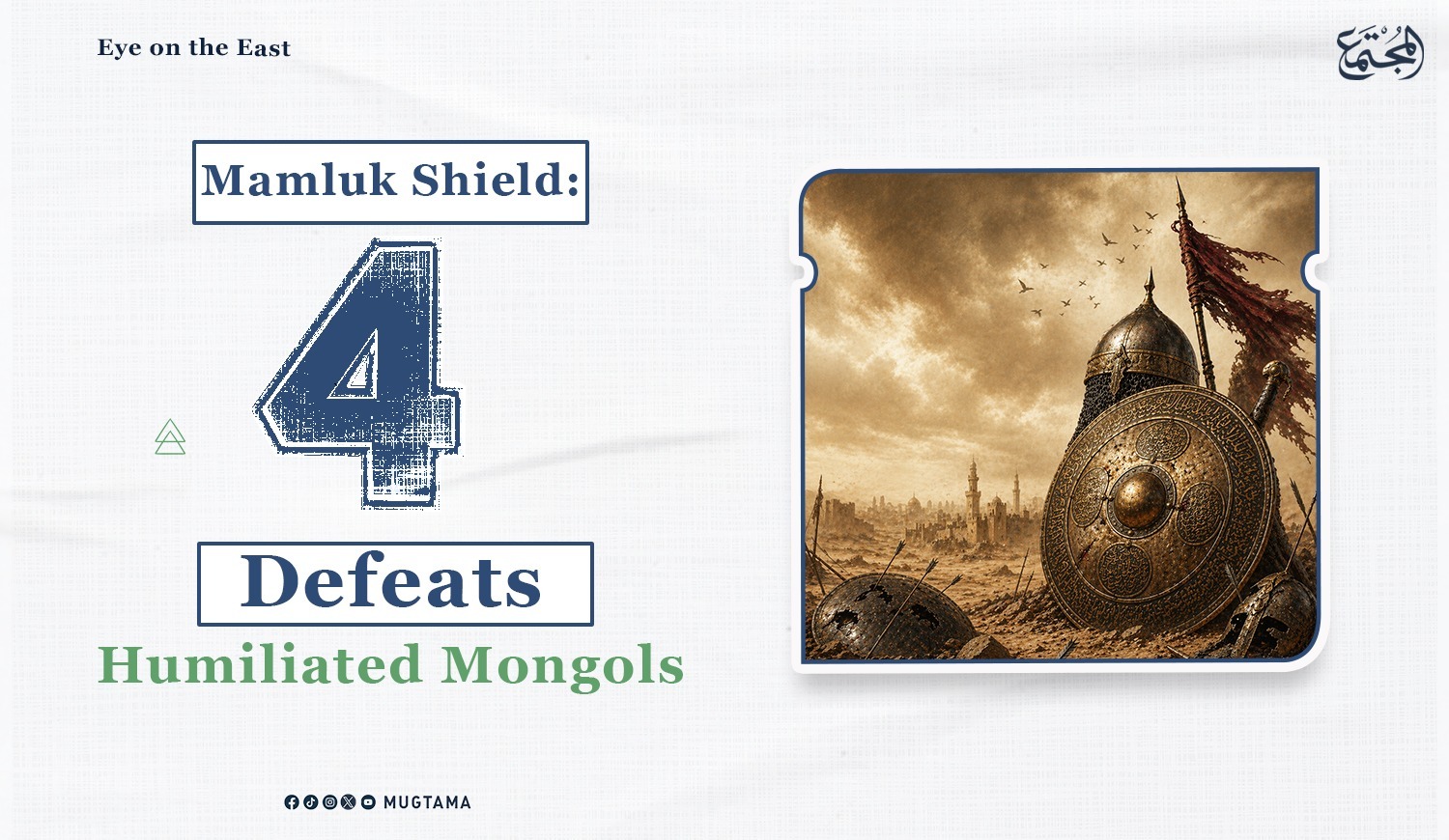
Mamluk Shield: 4 Defeats Humiliated Mongols
Before
diving into the battles, we must understand the nature of a force unlike any
the world had ever seen. The Mamluks were not a royal dynasty that inherited
power through bloodlines — they were a unique military elite whose story began
with young boys brought from the steppes of Asia and the mountains of the
Caucasus.
Within
the walls of Cairo's citadels, they underwent rigorous physical and
intellectual training, transforming from military slaves into the greatest
warriors of their age. The Mamluk system was built on merit, not heredity —
rank was earned through battlefield excellence, and the throne belonged only to
the strongest and wisest. This combination of military discipline and
institutional loyalty turned them from mere guardians of commanders into
defenders of civilization and masters of the East for over two and a half
centuries.
When
Baghdad fell in 1258, the world believed the sun of Islamic civilization had
set forever before the Mongol hurricane that had already swept through China,
Russia, and Eastern Europe.
Cities
and kingdoms crumbled one after another before the Mongol onslaught, and all
believed the end had come — until that hurricane collided with the unyielding
rock of the Mamluks, who did not merely shatter Mongol ambitions at the gates
of the East, but forced the Khan's empire to taste the bitterness of defeat and
humiliation in every single encounter.
Here
are Four battles in which the Mongol
fangs were broken at the gates of the East:
1.Battle of Ain Jalut: The Shock That
Shook the Mongol Throne
After
the fall of Baghdad, Hulegu sent a letter to Sultan Sayf al-Din Qutuz in Egypt, dripping with arrogance and threats.
Among its words: "We are the soldiers of God on His earth, created from
His wrath, unleashed upon those who have incurred His anger… do not prolong
your words, and hasten your reply."
Qutuz
did not merely reject the ultimatum — he took a point of no return to lift
Muslim morale and shatter the wall of fear. He ordered the execution of the
four Mongol envoys and had their heads hung above Bab Zuweila in Cairo,
declaring to the entire world that the era of submission was over.
The
battle took place on Friday, the 25th of Ramadan, 658 AH — September 3, 1260.
Qutuz chose this timing as a blessing from the holy month, and the fighting
lasted until the Friday prayer.
The
confrontation unfolded in the region between Nablus and Bisan in northern
Palestine, at a site known as Ain Jalut — named after a natural spring in the
area. Historical and religious accounts note that this very ground once
witnessed the legendary duel between the Prophet David and the giant Goliath, lending
the battle a powerful symbolic dimension: once again, the faithful few were
standing against an overwhelming force — and once again, they would prevail.
The
Mamluk army was led by an elite of formidable commanders:
- Sultan Sayf al-Din
Qutuz — the supreme commander, forever remembered for his legendary battle
cry: "O my Islam!"
- Emir Rukn al-Din
Baybars — commander of the vanguard, and the mastermind behind the
brilliant baiting strategy that lured the Mongols into a deadly trap.
On
the Mongol side, the army was commanded by Kitbuqa, Hulegu's deputy — a
seasoned general who nonetheless fell victim to his own arrogance and his fatal
underestimation of Mamluk strength.
The
battle opened with a masterful stratagem devised by Baybars — he feigned
retreat, drawing the Mongol army deep into the plain where the rest of the
Mamluk forces lay hidden among the hills. When the Mongols found themselves
encircled, Qutuz descended into the battlefield himself, hurling his helmet to
the ground and crying out:
"O my Islam! O God, grant victory to Your servant Qutuz!"
The
outcome was a crushing defeat — Mongol commander Kitbuqa was slain on the
battlefield, and the remnants of his army fled northward toward Bisan, where
the Mamluks pursued and drove them out of the Levant entirely. But beyond the
military victory, Ain Jalut shattered something far greater: it was the first
time since the campaigns of Genghis Khan that the Mongols had suffered a
decisive and humiliating defeat, ending forever the myth of the unconquerable army.
2.Battle of Abulustayn (1277): When the
Lion Hunted His Prey into Anatolia
After
the Seljuks of Rum were broken at the Battle of Köse Dağ in 1243, they became
mere vassals crushed beneath Mongol occupation — their leaders humiliated and
their people burdened with crushing taxes. From the depths of that humiliation,
the Seljuk princes found no savior to turn to but the Mamluk Lion, Baybars. Their
leading emir, Mu'in al-Din Suleiman Pervane, sent secret letters pleading for
liberation from the Mongol yoke. Baybars, who had long awaited the right moment
to strike a decisive blow against Mongol influence in the north, mobilized his
great army and marched from Damascus, overcoming every geographical obstacle in
his path.
The
battle was fought on the plain of Elbistan, a strategic region in what is today
the province of Kahramanmaraş in southeastern Turkey — a gateway connecting the
Turkish plateau with northern Greater Syria. The battle took place on the 10th
of Dhu al-Qi'dah, 675 AH — April 16, 1277 — on the plain of Elbistan in the
heart of Anatolia.
The
Mongols believed the mere weight of their reputation would terrify the Mamluks,
but they encountered a military machine unlike anything they had faced before.
Baybars dismounted from his horse to fight shoulder to shoulder with his men,
igniting a fire in their hearts that could not be extinguished. The Mamluks
launched a devastating assault that annihilated the Mongol forces and their
allied contingents. Mongol commander Tudawun was slain alongside most of his
wing commanders, and the survivors fled in disgrace — the Lion had hunted his
prey deep in their own territory.
Baybars
was not content with victory on the battlefield alone — he moved immediately
toward Kayseri, the Seljuk capital, where the people received him as a heroic
liberator. In a moment of profound historical weight, he entered the palace and
celebrated his triumph by sitting upon the Seljuk throne, formally assuming the
title of Sultan of the Two Lands and the Two Seas, Servant of the Two Holy
Mosques, and Sultan of the lands of Rum. Across Anatolia, Friday sermons were
delivered in his name and coins were struck bearing his seal — a clear and
resounding message to Hulegu and his successors: "The Mamluks are here
— and here is where your dreams end.
3.The Second Battle of Homs (1281): The
Epic of Legendary Resilience
If
Ain Jalut was the battle for survival, then the Second Battle of Homs(1) was
the battle to confirm dominance. The Mongols assembled the largest army in the
entire history of their conflict with the Mamluks, with a single objective: to
sweep through the Levant once and for all.
The
battle took place on the 14th of Rajab, 680 AH — October 29, 1281 — on the
plain stretching south of the Syrian city of Homs, in the shadow of its great
citadel. It bears the name Second Battle of Homs to distinguish it from a smaller
earlier engagement at the same site in 1260, but this was an incomparably
larger and more dangerous collision. The Mamluk army was commanded by the
seasoned Sultan al-Mansur Qalawun, flanked by the senior emirs of Egypt and the
Levant, while the Mongol host was led by Möngke Temür, brother of Khan Abaqa
ibn Hulagu, with forces that included Armenian and Georgian contingents
alongside Crusader cavalry.
In
the most critical moment of the battle, the true mettle of Qalawun was
revealed. He stood immovable at the heart of his army and refused to yield a
single step. He ordered his Mamluk cavalry to launch a concentrated assault
directly at the Mongol center where Möngke Temür himself stood. The Mamluks
fought with such ferocious and almost reckless courage that they carved their
way through to the very heart of the Mongol command — and Möngke Temür himself
was left gravely wounded on the field.
4.Battle of Shaqhab (1303): The Great
Epic
After
the defeat at Wadi al-Khazandar(2) and the entry of Ghazan's armies into
Damascus, the city endured bitter days of looting and destruction. Despite
Ghazan's claim to Islam, his army's conduct stood in stark contradiction to the
faith's values, plunging the people into despair.
It
was in this darkness that Ibn Taymiyya stepped forward. He went personally to
Ghazan's camp and addressed him in a tone no one had dared use before,
demanding he stop the bloodshed of Muslims — a boldness that left even Ghazan
himself astonished. Ibn Taymiyya then traveled to Cairo to
meet Sultan al-Nasir Muhammad ibn Qalawun and the Mamluk emirs, urging them
with forceful words to march to the Levant's defense, delivering his famous
ultimatum: "If you turn away from the Levant and abandon its
protection, we shall find it a sultan who will guard it and seek victory
through others than you."
He
then issued his landmark fatwa declaring it obligatory to fight the Mongols
despite their outward profession of Islam, on the grounds that they did not
abide by its laws. But Ibn Taymiyya did not stop at words — he donned his armor and
descended into the trenches at Shaqhab himself, moving among the soldiers,
promising them victory and swearing oaths to God upon it, lifting the army's
morale to the heavens.
The
battle took place on the 2nd of Ramadan, 702 AH — April 20, 1303 — on the
plains of Shaqhab, south of Damascus.
The
fighting raged with ferocity for three consecutive days beneath the Ramadan
sun. The Mamluks displayed legendary endurance against wave after wave of Mongol
assaults, until they finally shattered the Mongol center and scattered their
ranks. When commander Qutlushāh grasped the scale of the catastrophe, he fled
with whatever remained of his army toward the mountains.
The
Mongol army was annihilated, with only a handful escaping — a blow so
devastating that Khan Mahmud Ghazan himself died shortly after, consumed by
grief. With this battle, all serious Mongol attempts to invade the Levant came
to a permanent end, and the region remained secure under Mamluk rule for
centuries to come. The victory also cemented the standing of Sultan al-Nasir
Muhammad ibn Qalawun as one of the greatest rulers in Mamluk history,
establishing his absolute dominance over the most powerful empire of his age.
The
Mamluks were not merely the rock upon which Mongol ambitions from the East were
shattered — they were simultaneously delivering the final blows to the remnants
of the Crusader presence in the West. While their swords were deciding the
great battles of Ain Jalut and Shaqhab, their banners were rising over Acre,
Antioch, and Tripoli, until the last Crusader soldier was driven from the
Levant forever in 1291 at the hands of Sultan al-Ashraf Khalil ibn Qalawun
You may also like:
From Badr to Ain Jalut: How Leaders Inspired Victory through the Prophet’s Military Tactics
Battle of Marj al-Saffar (Shaqhab (Ramadhan 702 AH
7 Scenes from the Day of Furqan
6 Most Important Moments in the Battle of the Trench
4 Islamic Empires That Led the World
===============================================
Footnotes:
1. There was also the First Battle of Homs (659 AH /
1260) — a confrontation that took place just months after Ain Jalut, when the
Mongols attempted to restore their shattered prestige by invading northern
Syria. The Mamluk emirs and their Levantine allies, led by the princes of Hama
and Homs, met them head-on and crushed their army under commander Baidu, making
this victory a decisive confirmation that the age of Mongol expansion in the
region had come to its end.
2. There was also the Battle of Wadi al-Khazandar (699 AH
/ 1299), known as the Third Battle of Homs — a confrontation in which Sultan
al-Nasir Muhammad ibn Qalawun's army was forced into a strategic withdrawal
before the overwhelming numerical superiority of Khan Mahmud Ghazan's forces.
Despite the harshness of this setback and the Mongols' temporary entry into
Damascus, it proved to be the spark that united the home front and ignited a
popular and scholarly movement led by Ibn Taymiyyah — paving the road to the
historic and epic triumph at Shaqhab.