






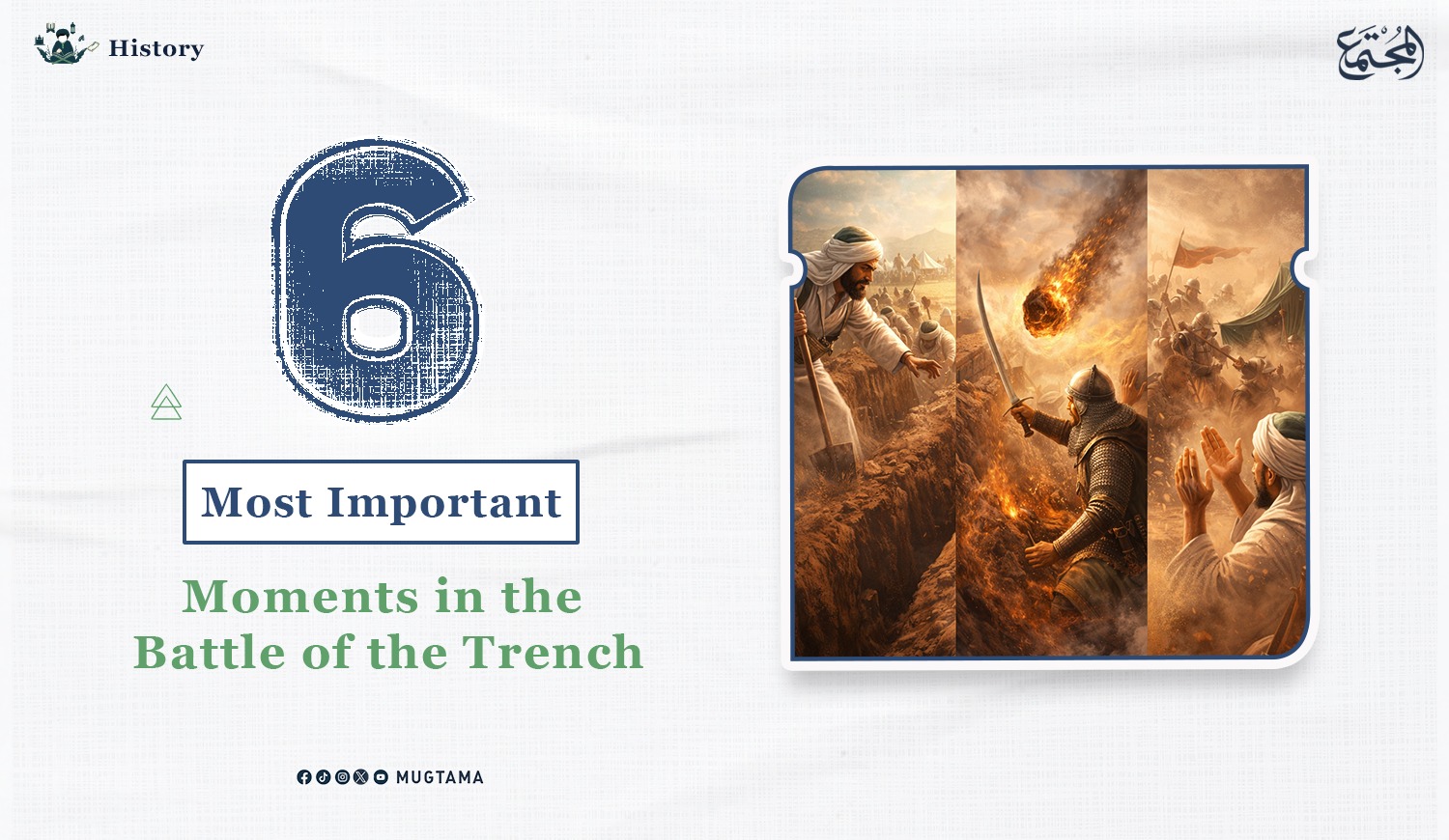
6 Most Important Moments in the Battle of the Trench
There is
no god but Allah alone, He fulfilled His promise, granted victory to His
servant, strengthened His soldiers, and defeated the confederates alone…” Words
we repeat joyfully in the Eid prayer, echoing from the minarets and delighting
the hearts. Yet have we ever reflected on that moment when “victory” seemed
impossible by human standards?
Behind
these sweet chants lies the story of the “Day of the Earthquake”; the day when
all of Hijaz besieged the city of the Messenger of Allah (PBUH), and the
scattered tribes united in an alliance seeking to uproot Islam. In those cold
nights, while hearts were reaching their throats, the Muslims were not only
facing armies, but confronting the “end of the world” as they knew it.
This
decisive battle took place in Shawwal of the fifth year after Hijrah. In the
Prophetic biography, it is known by two names: “Battle of the Trench,”
referring to the innovative defensive method employed, and “Battle of the
Confederates,” pointing to the massive military alliance formed by Quraysh,
Ghatafan, the Jews of Banu al-Nadir, and other Arab tribes in a final attempt
to uproot the Muslims.
The
situation was indescribably severe: not a single enemy, but a siege from
outside, betrayal from within, and a harsh winter climate. The Qur’an
immortalized it in the most eloquent depiction of human terror and divine
trial: (They massed against you from above and
below; your eyes rolled [with fear], your hearts rose into your throats, and
you thought [ill] thoughts of God.(10) There the believers
were sorely tested and deeply shaken(11) ) (Al-Ahzab)
The defeat of the Confederates was not a
passing incident; it came as the result of six strategic and field factors that
determined the battle in favor of the Muslims and ended the myth of the great
tribal alliances.
1.The brilliance of Salman and the idea of the trench
When the
intelligence reports arrived about the advance of ten thousand fighters, the
Prophet (PBUH) offered the supreme model of combining perfect reliance on Allah
with the greatness of taking practical measures. He quickly mobilized the
energies of his companions and consulted them. Here, the brilliance of Salman
al-Farisi emerged, as he proposed digging a “trench” along the exposed northern
side of the city. This surprised the Arabs with a military tactic unknown in
their history, transforming the battle from an unequal direct clash into a
strategic siege that paralyzed the movement of the Confederates’ horses and
neutralized the effect of their numerical superiority.
2.The Prophet’s Pickaxe: Tidings of Victory
Amidst
the peak of exhaustion, hunger, and biting cold, as the companions struggled
against the unyielding earth, a massive boulder—impenetrable to all
tools—blocked their path. At that critical juncture, the strike was more than
just a physical blow; it was a strategic revitalization of the nation’s spirit.
The Prophet took the pickaxe and struck the rock three times; with every blow,
a flash of light burst forth, illuminating the surroundings.
Amidst a
suffocating siege, the Prophet did not merely promise survival; he foretold the
fall of the Persian, Roman, and Yemeni empires. This was the 'spiritual fuel'
that fortified the believers. While the world saw a city on the brink of
annihilation, the Leader was instilling a global vision in his
companions—transforming a desperate 'struggle for survival' into a 'certainty
of empowerment.
It was
here that the 'internal hypocrisy' erupted. The Holy Quran captures this (the hypocrites and the sick at heart said, ‘God and His
Messenger promised us nothing but delusions!) (Al-Ahzab:12)
3.Internal Cohesion and the Unmasking of Hypocrisy
The
hypocrites did not stop at casting doubt on victory; they escalated to
dismantling the internal front by fabricating flimsy excuses to abandon the
Trench. While the defenders faced an external siege, this faction claimed their
homes were 'vulnerable and exposed,' seeking to desert their posts and leave
the city’s defenses compromised.
The Holy
Quran unmasked this "media fabrication" and the evasion of duty in
the verse: (Some of them said, ‘People of
Yathrib, you will not be able to withstand [the attack], so go back!’ Some of
them asked the Prophet’s permission to leave, saying, ‘Our houses are exposed,’
even though they were not- they just wanted to run away) (Al-Ahzab:13)
This was a defining moment; it demonstrated
that the conflict was not merely a military engagement, but a battle of
awareness and resilience. While the hypocrites searched for an escape, the
believers grew more steadfast, resulting in a more unified and purified
front—one capable of confronting an even graver crisis: the betrayal of Banu
Qurayza.
4.The Betrayal of Banu Qurayza: A Stab in the Back
While every able-bodied man was mobilized to
man the defenses at the Trench to the north, the heart of Medina—sheltering
women, children, and the vulnerable—lay on the opposite side, in the shadow of
Banu Qurayza’s fortresses. By treaty, these strongholds were the city’s
'Southern Shield.' Yet, at a decisive turning point, that shield was
transformed into a dagger.
The gravity of the threat was manifested in
Banu Qurayza’s tactical reconnaissance of the residential quarters. A pivotal
clash occurred at the Fari' fortress, where Safiyya bint Abd al-Muttalib—the
Prophet’s aunt—courageously intercepted a spy attempting to infiltrate the
stronghold. This single act of defiance encapsulated the sheer terror and the
immense responsibility shoulder by those left behind to protect the defenseless
while the main army was stationed at the Trench.
At this juncture, the Muslims were no longer
facing a single adversary; they were caught 'between the jaws of a pincer.'
With the Confederates pressing from above and betrayal encroaching from below,
they faced their most grueling and decisive trial.
5.Intelligence and Psychological Warfare: Shifting the Tide
Nuaym ibn Masud whose conversion remained a
closely guarded secret, approached the Prophet to offer his services. The
Prophet’s decisive response established a new paradigm for crisis management:
'You are but one man; sow distrust among them as much as you can, for war is
strategy.' This instruction marked the beginning of a sophisticated
psychological operation that would dismantle the enemy coalition from within.
With sharp intellect and precise maneuvering,
Nu’aym played the role of a 'double agent,' masterfully executing a
two-pronged strategy:
- Sowing Distrust: He
convinced Banu Qurayza that their allies might abandon them to face the
Muslims alone, advising them to demand 'high-ranking hostages' from
Quraysh as a guarantee of loyalty.
- Eroding Confidence:
Simultaneously, he misled Quraysh into believing that the Jews regretted
breaking their pact and intended to hand over those hostages to the
Prophet as a gesture of reconciliation. This brilliant deception
effectively paralyzed the enemy's decision-making process.
Trust between the allies evaporated before
the actual battle even commenced. The 'Confederates' shifted from a
single, cohesive force into fractured, discordant factions, with each party now
viewing the other through a lens of deep-seated suspicion.
6.Divine Victory: God Alone Routed the Confederates
Once trust between the allies had
disintegrated through the cunning of Nuaym ibn Masud divine intervention
provided the final, decisive blow. On a frigid winter night, as human endurance
reached its absolute limit, a violent wind swept through the enemy camp. It did
not merely uproot tents and overturn cauldrons; it was accompanied by invisible
angelic hosts that struck terror into the hearts of the Confederates. The Holy
Quran immortalized this moment—the echo of which we still carry in our
celebratory chants (Takbirat)in the verse: (You who believe, remember God’s goodness to you when mighty
armies massed against you: We sent a violent wind and invisible forces against
them. God sees all that you do.) (Al-Ahzab:9)
Faced with this unseen and overwhelming
power, the coalition shattered. Abu Sufyan, the confederate leader, issued his
final order of retreat: 'O people of Quraysh, depart, for I am departing!' As
dawn broke, Medina stood liberated, the siege of ten thousand warriors finally
broken.
‘Henceforth, we shall march against them, and
they shall no longer march against us.’
These prophetic words were more than just an announcement of the end of a
bitter siege; they signaled the birth of a new balance of power in the Arabian
Peninsula. The Battle of the Trench was never just a physical trench dug into
the earth; it was an eternal lesson etched into the very consciousness of
history.
You may also like:
7 Scenes from the Day of Furqan
Abu Bakr Al-Siddiq’s Strategy in Countering the Ridda Wars: Lessons for Contemporary Challenges
Leaking the Code: Abu Basir and Respect for International Agreements