







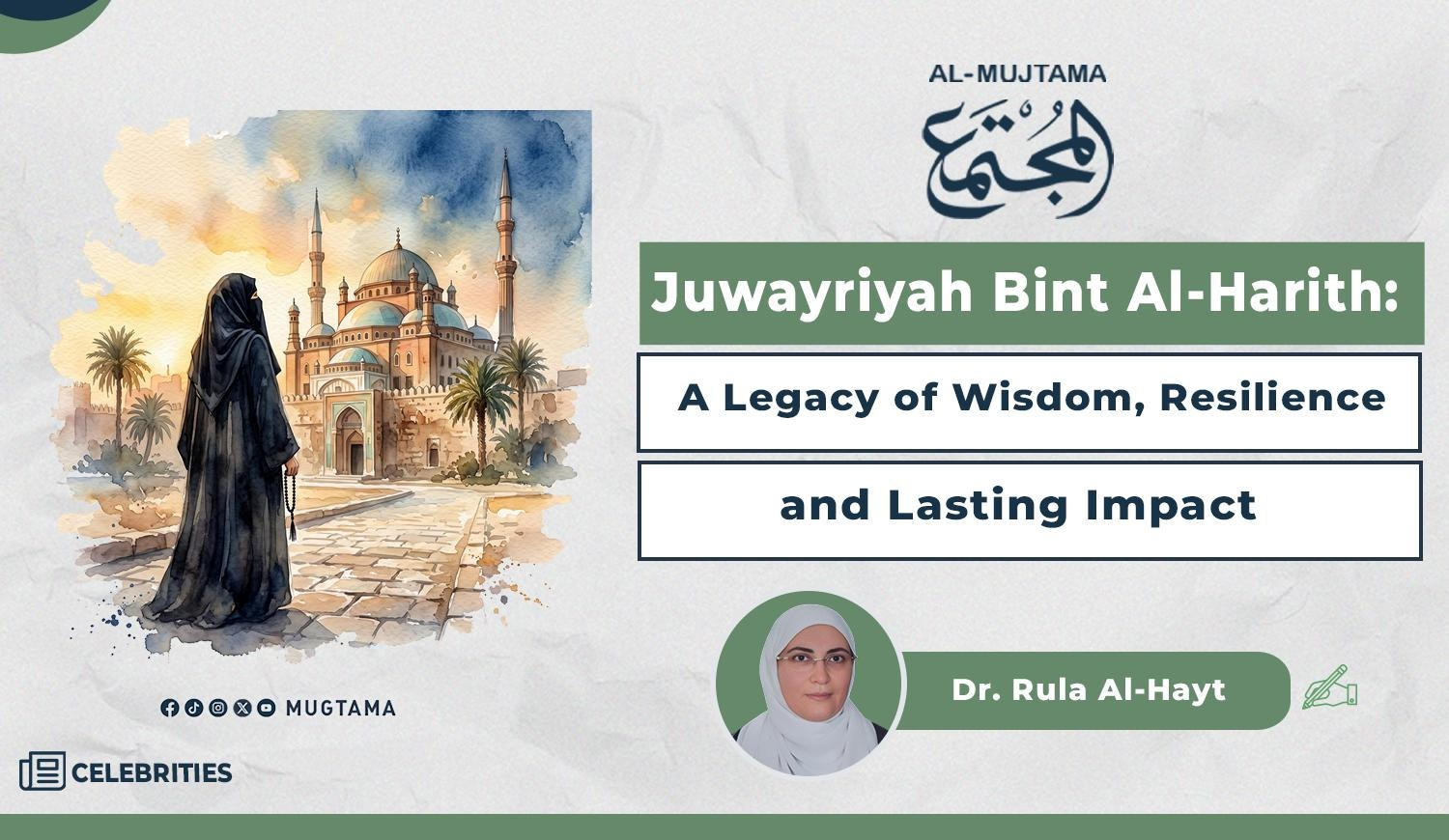
Juwayriyah Bint Al-Harith: A Legacy of Wisdom, Resilience, and Lasting Impact

A woman of sound judgment and profound
wisdom, born into a household of leadership and honor and raised in comfort and
prosperity. She held a position of high standing and influence among her
people. Indeed, she was described by `A’ishah, may Allah be pleased with her,
as the woman who brought the greatest blessing to her people.
She was Juwayriyah Bint Al-Harith,
Mother of the Believers, may Allah be pleased with her. Her life left an
enduring mark that changed the course of history, and she was like a beacon
inspiring future generations to learn how to create a positive impact on society.
Juwayriyah Bint Al-Harith Ibn Abi
Dirar was born into a household of leadership and honor. Her father was the
chief of Banu Al-Mustaliq and the leader of his people.
As for her life with the Prophet,
peace and blessings be upon him, it was not merely a story of a blessed
marriage. Rather, it was a profound strategic and human journey of
transformation.
From Captivity to the Honored Status of
Mother of the Believers
Initially, her life changed from the
height of honor among her people to the hardship of captivity. Yet she soon
rose to one of the highest positions a woman could attain: the status of
“Mother of the Believers.”
In the fifth year after the migration,
her father led a force to fight the Muslims. The Battle of Banu Al-Mustaliq,
also known as Al-Muraysi`, took place and ended with the defeat of her people
and her capture.
The daughter of a prominent leader
became the property of the Companion Thabit Ibn Qays Ibn Shammas. Yet she did
not surrender to her new circumstances. Instead, she requested a contract for
her freedom, an agreement under which an enslaved person could purchase their
freedom in exchange for a specified amount of money paid to their owner over an
agreed period, usually in installments.
It was called “Mukatabah” a contract
for freedom because the owner and the enslaved person would write an agreement
specifying the amount and the payment period.
Juwayriyah, may Allah be pleased with
her, went to the Prophet, peace and blessings be upon him, seeking his help in
fulfilling the terms of her agreement.
Historians describe her as a woman of
sound judgment and profound wisdom. The Prophet, peace and blessings be upon
him, offered her something better than what she had requested: he offered to
pay the amount required for her freedom and marry her. She accepted and
sincerely embraced Islam with conviction and certainty.
The Prophet’s marriage to Juwayriyah,
may Allah be pleased with her, was a profoundly significant social and
political event. When the Companions learned of the marriage, they hurried to
release the members of Banu Al-Mustaliq whom they held captive, saying, “They
are the relatives of the Messenger of Allah, peace and blessings be upon him.”
As a result, one hundred families from
her people were set free.
`A’ishah, may Allah be pleased with
her, said about this event: “We never saw a woman who brought greater blessing
to her people than her.”
The Conversion of Banu Al-Mustaliq
This event did not merely free bodies;
it also freed minds.
The entire tribe of Banu Al-Mustaliq
embraced Islam, transforming from enemies who had fought the Muslims into loyal
members of the emerging Islamic state.
After marrying the Prophet, peace and
blessings be upon him, he changed her name from Barrah to Juwayriyah because he
disliked self-praise and did not want people to say, “Someone has come out from
Barrah.”
The name Barrah carried the meaning of
being righteous or virtuous and could therefore imply self-praise.
Juwayriyah’s Devotion, Worship, and
Legacy
As for her life after marrying the
Prophet, peace and blessings be upon him, she was known, may Allah be pleased
with her, for her patience and devotion and for frequently remembering Allah.
We can perhaps glimpse this through a
narration reported by Ibn Abbas, may Allah be pleased with him. The Prophet, peace and blessings be upon him, passed by
her while she was in the masjid, supplicating, then he passed by her again when
it was almost midday. He said to her: “Are you still here?” She said: “Yes.” He
said: “Shall I not teach you some words which you can say? Subhan Allah adada
khalqihi, subhan Allah adada khalqihi, subhan Allah adada khalqihi; subhan
Allah rida nafsihi, subhan Allah rida nafsihi, subhan Allah rida nafsihi;
Subhan Allah zinata 'arshihi, Subhan Allah zinata 'arshihi, Subhan Allah zinata
'arshihi; Subhan Allah midada Kalamatihi, Subhan Allah midada Kalamatihi,
Subhan Allah midada Kalamatihi (Glory be to Allah the number of His creation,
glory be to Allah the number of His creation, glory be to Allah the number of
His creation; glory be to Allah as much as pleases Him, glory be to Allah as
much as pleases Him, glory be to Allah as much as pleases Him; glory be to
Allah the weight of His throne, glory be to Allah the weight of His throne,
glory be to Allah the weight of His throne; glory be to Allah the number of His
words, glory be to Allah the number of His words, glory be to Allah the number
of His words).'” (Narrated by At-Tirmidhi)
Lessons From Juwayriyah’s Life for Young
People Today
The life of Juwayriyah contains
educational and guiding lessons that the younger generation needs today to
confront the challenges of the digital age and rapidly changing circumstances.
1. Psychological Resilience
and Rising After Setbacks
Young people today face shocks and
failures in education or employment that may push them toward despair. Juwayriyah
teaches us that losing social status and falling into captivity did not break
her spirit. Instead, she responded positively and rationally, taking action to
change her circumstances and secure her freedom.
2. Social Responsibility and Creating
a Lasting Impact
Juwayriyah did not think only about
her own individual salvation. Her presence became a reason for the liberation
of an entire community.
This teaches the new generation not to
be selfish, but to seek fields of study, professions, and projects that serve
their country and society.
3. The Value of Wisdom and
Intellect Over Physical Beauty
Juwayriyah, may Allah be pleased with
her, was distinguished by sound judgment and the ability to negotiate and
clearly present her case before the person with authority—the Prophet, peace
and blessings be upon him.
This encourages young women to invest
in awareness, culture, and the development of their intellectual character
rather than being drawn into the superficial appearances promoted by social
media platforms.
4. Intellectual and Spiritual
Productivity
She was not content simply to be the
wife of the leader of the Muslim community. She became a source of knowledge
and Prophetic hadith and an example of spiritual discipline.
Her life reminds young people of the
importance of balancing worldly success with nourishing the soul through noble
values and worship.
Juwayriyah, may Allah be pleased with
her, spent the remainder of her life in Madinah, spreading knowledge and
setting remarkable examples of generosity and service until she passed away in
Rabi` Al-Awwal in 56 AH, according to the stronger historical opinion. She was
buried in Al-Baqi` after a life filled with blessing and goodness.
Reviving her story today is not merely an exercise in recounting history. It is a way of bringing forward a model of wise and influential female leadership that we need to help build an aware and stable generation.
-------------------------------------------------------------