









Israeli Elections Highlight Realities of the Arab-Israeli Conflict
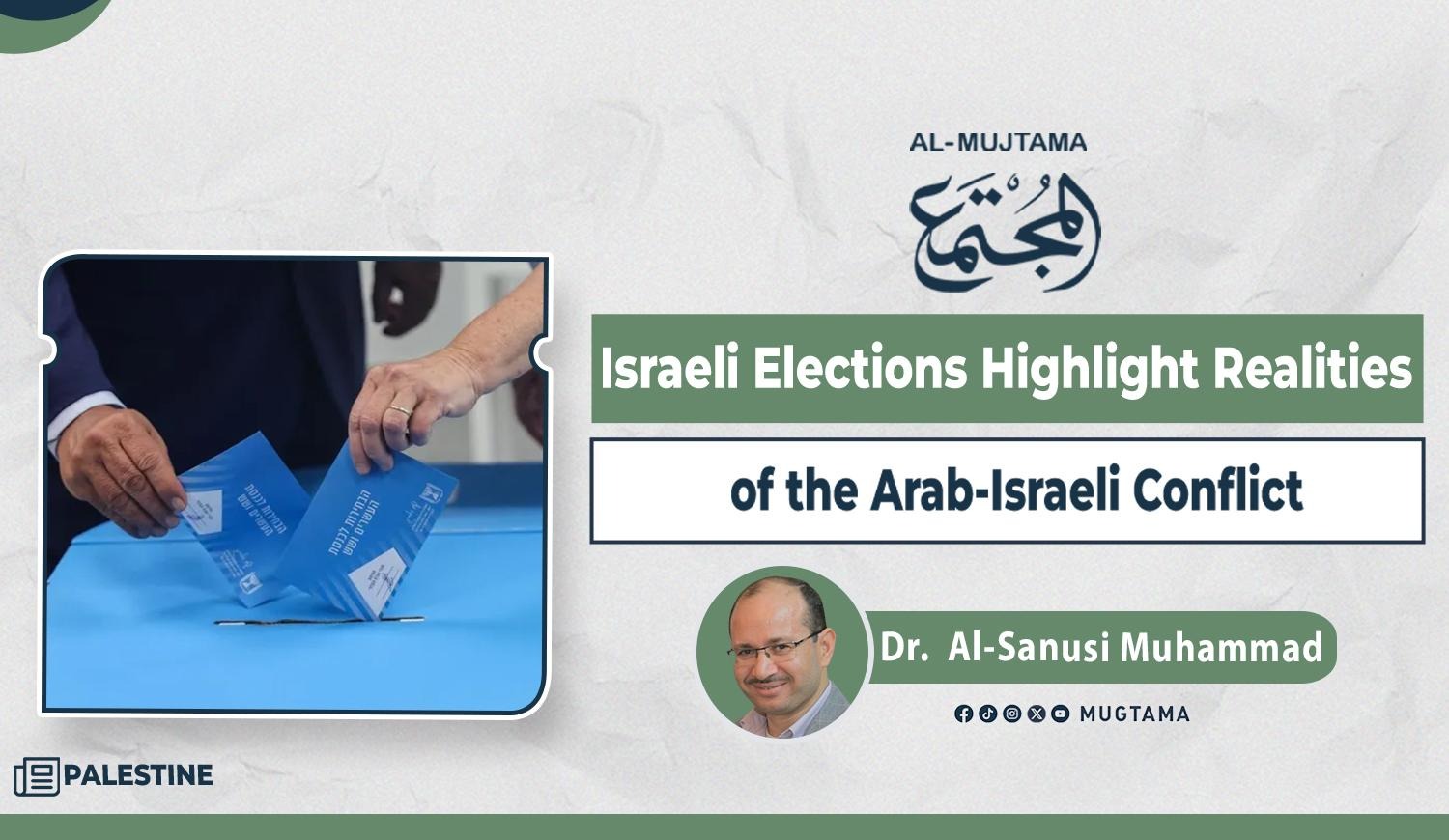
As in every electoral season, Arab public opinion followed the Israeli elections held in late October with great interest and closely tracked the electoral process. However, this time, Arab monitoring shifted in nature, with implications worth reflecting on.
In the past, Arab interest focused on who would win the
elections, alongside a desire to see the ruling party defeated, in the hope
that the newcomer might bring some promise of pushing the peace process forward
and resuming negotiations—which would inevitably stall or stumble as soon as
they began. This yearning for peace was fueled by two factors:
First: The success of the Zionist entity in exporting a
specific image to us as Arabs and Muslims—and perhaps to the rest of the
world—regarding its internal disputes as being tied to the possibility of peace
with the Arabs. According to this exported image, there is an extreme right
wing that is rejectionist or intransigent, and a moderate left wing with which
an understanding can be reached and common ground for peace established. If the
right wing happened to hold power at the time of the elections, the hopes of
observers remained pinned on the possibility of a left-wing victory.
The differences between the programs of Israeli
parties are primarily concentrated in matters related to their internal
affairs.
Second: Certain Arab governments that became involved in
normalization with the entity promoted this image of a right versus left, and
extremism versus moderation, dynamic within the entity. This was done partly to
justify their own stance, and partly to condition public opinion into an
attitude of awaiting election results and remaining patient through delays—or
even seeking ways to support the left, with whom agreement was presumed to be
easier!
The reality is that this reading failed to sufficiently
distinguish, regarding the internal factions of the entity, between
disagreements over managing the conflict and disagreements over its foundations
and objectives. Consequently, reliance on an Israeli alternative remained
present, even though accumulated political experience offered little to justify
it.
Israeli Elections: Exposing the Illusion of an Alternative Between Right and Left
The "Al-Aqsa Flood" operation and the subsequent
Zionist war of extermination against the Gaza Strip tore away the veil from the
truth, placing everyone before the scene stripped of any cosmetic touch-ups.
The truth is that the Zionist entity is racist and extremist; its crimes
against Palestinians and the broader region are too atrocious to be beautified,
and its positions regarding Arabs are far too clear to be categorized into
right and left, or extremism and moderation. The differences between the programs
of Israeli parties are primarily concentrated in matters related to their
internal affairs—issues such as the conscription of the Haredim, judicial
independence, or the scope of the Prime Minister's powers. When it comes to
Palestinian rights and Arab interests, however, the area of agreement among
them is vastly wider than the area of disagreement.
The reality exposed during the aggression—with its widespread
killing of civilians, destruction of cities, hospitals, and infrastructure,
alongside policies of starvation and displacement—no longer permits confining
responsibility to the Netanyahu government or his far-right partners. What
unites broad segments of the Israeli political system is far greater than what
divides them, and party disputes do not prevent them from converging on core
tenets concerning Israeli security, military superiority, settlement expansion,
and the rejection of Palestinian national rights.
In addition, the objections raised against Netanyahu by his
opponents were not directed at rejecting his goals or reviewing his policies
targeting Palestinians. Rather, they focused on his failures to anticipate the
events of October 7th, his handling of the war, the issue of detainees, the
government's responsibility for security failures, and Netanyahu's political
future. While these are significant issues in internal Israeli conflict, they
do not signify that the opposition possesses a different vision for the future
of Palestinians or is prepared to recognize their rights.
The problem lies not in who leads the government
in Tel Aviv, but in the absence of an Arab project capable of protecting
rights.
It suffices to point to the Knesset vote in February 2024,
where a 99 to 9 majority rejected the unilateral recognition of a Palestinian
state. Furthermore, alliances seeking to form an alternative to Netanyahu's
government do not necessarily present an alternative policy toward
Palestinians. Although several opposition leaders gathered in September 2026
around a political project aimed at changing the government, this was not
accompanied by a joint proposal acknowledging the right of Palestinians to establish
their state, nor by any fundamental review of Israeli policies in the occupied
territories.
Here it becomes unmistakably clear that it is no longer enough
to know who rules Israel; it has become far more essential to understand what
the competing forces agree upon, the boundaries their differences do not cross,
and their stance on our issues.
If the game of right versus left—which they attempted to
export to us—failed over past decades to convince public opinion of a genuine
opportunity for peace desired by certain factions within the entity, this
narrative has become even more exposed following the war of extermination in
Gaza. Even governments that were on the verge of entering the so-called
normalization process now find themselves in an embarrassing position due to
the criminal conduct of the entity.
Israeli Elections in Arab Awareness: A Shift in Reading the Conflict
Perhaps the most prominent reflection of Arab tracking of the
Israeli elections this time is the decline of reliance on the possibility of
change emerging from within the Israeli political system. This is accompanied
by a entrenched awareness that changing the equations of the conflict is
fundamentally linked to the stance of Arabs and Muslims regarding the cause of
Palestine, recognizing the efforts aimed at its liquidation or marginalization,
and acknowledging the rapprochement, mutual understanding, and serious action
required to counter that.
This transformation carries significant cognitive weight. It
shifts focus from individual figures to the ideas and interests governing their
positions, and from following electoral competition to analyzing the political
structure within which these elections take place.
Instead of asking which party might be less extreme, the
question becomes what the shared common ground between parties truly is, and
which issues they agree upon despite their differences. Instead of waiting for
Israeli policy to change with a change of governments, it becomes necessary to
build the Arab stance on a firm understanding of the nature of conflicting
challenges and interests.
The time has come for us to transition from
awaiting an Israeli alternative to recognizing what unites the factions across
the landscape and the essence of the Zionist project.
Consequently, the problem lies not in who leads the government
in Tel Aviv, but in the absence of an Arab project capable of protecting rights
and interests, and dealing with regional and international shifts with a degree
of effectiveness and independence.
The cognitive maturity we require is not limited to
recognizing the reality of Israeli positions; it extends to liberating
ourselves from the narratives marketed to us about them, and refusing to allow
political calculations—even Arab ones—to obscure the realities and core tenets
of the conflict.
We believe the time has come to transition from awaiting an
Israeli alternative to recognizing what unites the factions across the
landscape and the essence of the Zionist project—moving from pinning hopes on
changing governments to possessing the capability to influence the reality of
the conflict.
The objective is not to wait for Israel to elect someone who understands our rights, but rather to possess the sources of strength that render these rights present in the region's equations, enabling us to defend our legitimate rights and deter the usurping entity whose ugly face elections have failed to beautify.
