






7 Reasons Pushing Netanyahu's Government Toward Early Israeli Elections
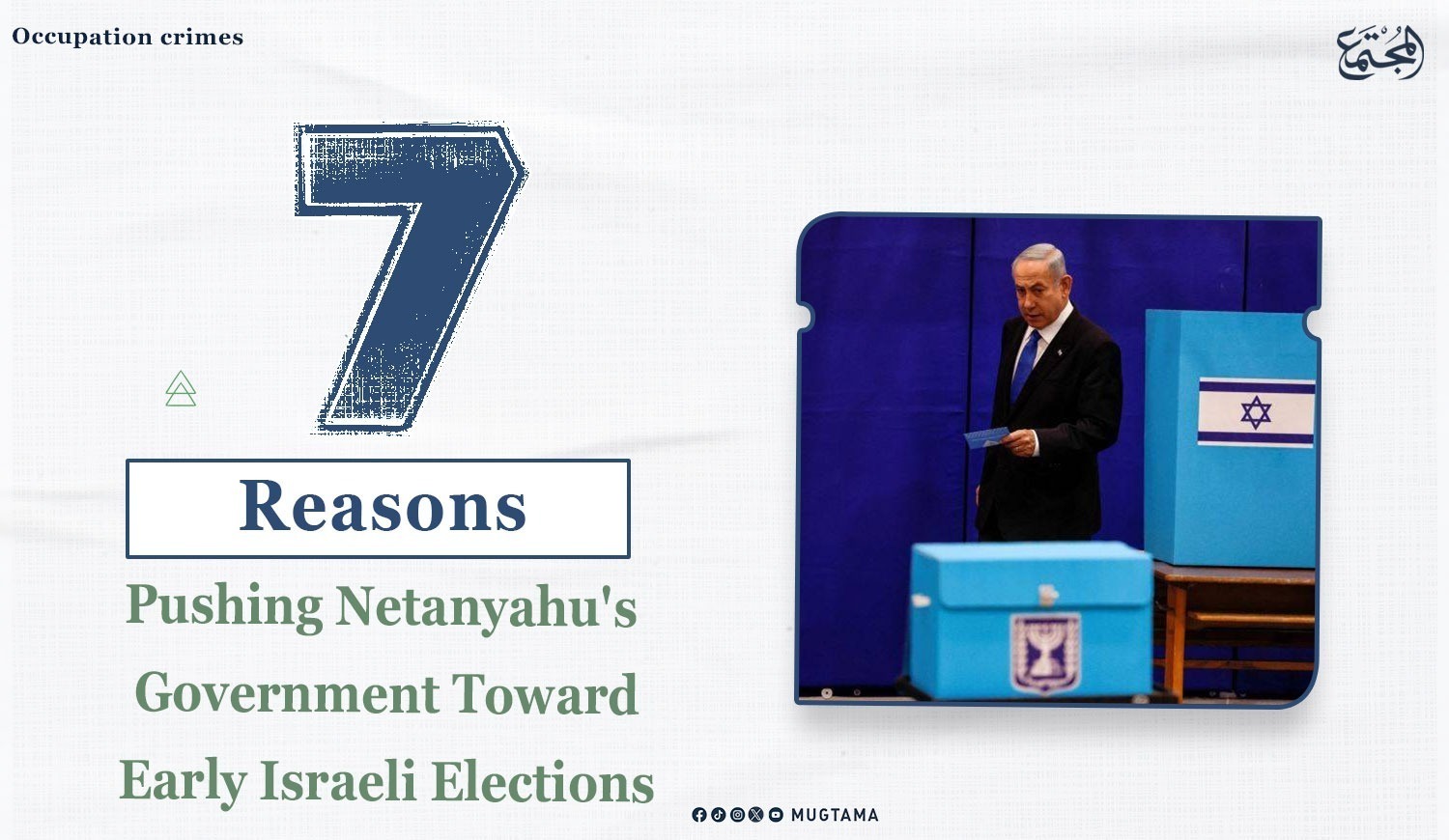
In a move
reflecting the scale of political turmoil within the occupation state, the
Knesset approved by a wide majority a proposal to advance the election date,
amid escalating divisions within the ruling coalition and mounting public and
political pressure on Benjamin Netanyahu's government.
The
proposal passed against a charged backdrop that has gripped the Israeli
political scene since the outbreak of the war on Gaza, and the domestic crises
that followed — spanning security, the economy, and social fragmentation —
alongside growing criticism of the government's management of the war and the
Haredi military conscription crisis, which has emerged as one of the most
explosive fault lines within the coalition.
Analysts
suggest that the push for early elections cannot be separated from Netanyahu's
political calculations and his attempts to reshape the domestic landscape in
ways that serve his hold on power — particularly as his popularity continues to
decline and divisions deepen within the right-wing camp itself.
The move
also reflects a growing awareness among factions within the government that
allowing the current crisis to persist without renewing their political mandate
could threaten the cohesion of the ruling coalition.
Among the
most prominent reasons driving Netanyahu and his right-wing government toward
early elections:
1. Escaping the Fallout of Security and Political Failure:
Netanyahu
has faced unprecedented criticism since October 7, following the massive
security failure that exposed the fragility of both the military and
intelligence apparatus. As a result, he may be seeking early elections before
the circle of political and public accountability widens further — attempting
to reinvent himself through a security-driven and populist narrative that
capitalizes on the atmosphere of war and fear.
2. The Haredi Conscription Crisis and the Threat to the
Government's Survival:
The issue
of Haredi Jewish conscription has transformed into a political time bomb within
the ruling coalition, as pressure has intensified inside the occupation state
demanding that military service be imposed on ultra-Orthodox Jews —
particularly given the ongoing war and the army's growing need for additional
soldiers.
In
contrast, hardline religious parties fiercely reject any encroachment on the
longstanding exemptions granted to seminary students, and have repeatedly
threatened to bring down the government should legislation mandating Haredi
conscription be passed.
This
issue has placed Netanyahu between the pressure of the military establishment
and the Israeli public on one hand, and the pressure of his religious allies on
the other — making early elections an increasingly viable option to avoid an
implosion of the divisions within the government.
3. Capitalizing on the State of Right-Wing Mobilization:
Factions
within the Zionist right believe that the continuation of the war, and the
surge in nationalist sentiment and radicalization it has fueled within Israeli
society, may offer the right wing an opportunity to consolidate its electoral
strength — particularly given the weakening of opposition forces and their
failure to present a unified vision.
4. Reshaping the Ruling Coalition:
Netanyahu's
government is witnessing escalating tensions among its component parties —
particularly between the religious and far-right nationalist factions — over
the management of the war, the conscription law, and the shape of the next
phase in Gaza. Netanyahu may therefore see early elections as an opportunity to
forge a more stable coalition, one less susceptible to political blackmail.
5. Derailing Accountability and Investigation Processes:
Calls are
growing within the occupation state for the formation of official investigative
committees into the failures that preceded the war — a development that poses a
direct threat to Netanyahu's political future. Advancing the election date may
therefore represent an attempt to reshuffle the deck and delay any process that
could hold him accountable for what transpired.
6. Getting Ahead of a Popular and Economic Collapse:
The
prolonged war has left significant economic and social burdens within the
occupation state, amid declining public trust in the government and rising
levels of popular anger. The government may therefore be seeking to hold
elections before the economic crisis deepens further and becomes a decisive
factor working against it in any subsequent electoral contest.
7. Using the War as an Electoral Card:
Netanyahu
has long relied on a narrative of security and existential threat in his
political campaigns, and the current war appears to be deployed as a tool to
remobilize the Israeli public behind him — positioning himself as the man of
the moment capable of managing the confrontation, despite the widespread
criticism directed at him.
Ultimately,
the question of advancing elections in the occupation state appears to be far
more than a routine democratic exercise — it is part of a profound struggle
over power and political survival within a state living through one of its most
turbulent periods in years.
While
Netanyahu attempts to leverage the war to reassert his position, the Israeli
political arena remains open to multiple possibilities — amid deepening
internal divisions and the uncertainty surrounding the war's ultimate outcome.
You may
also like: