









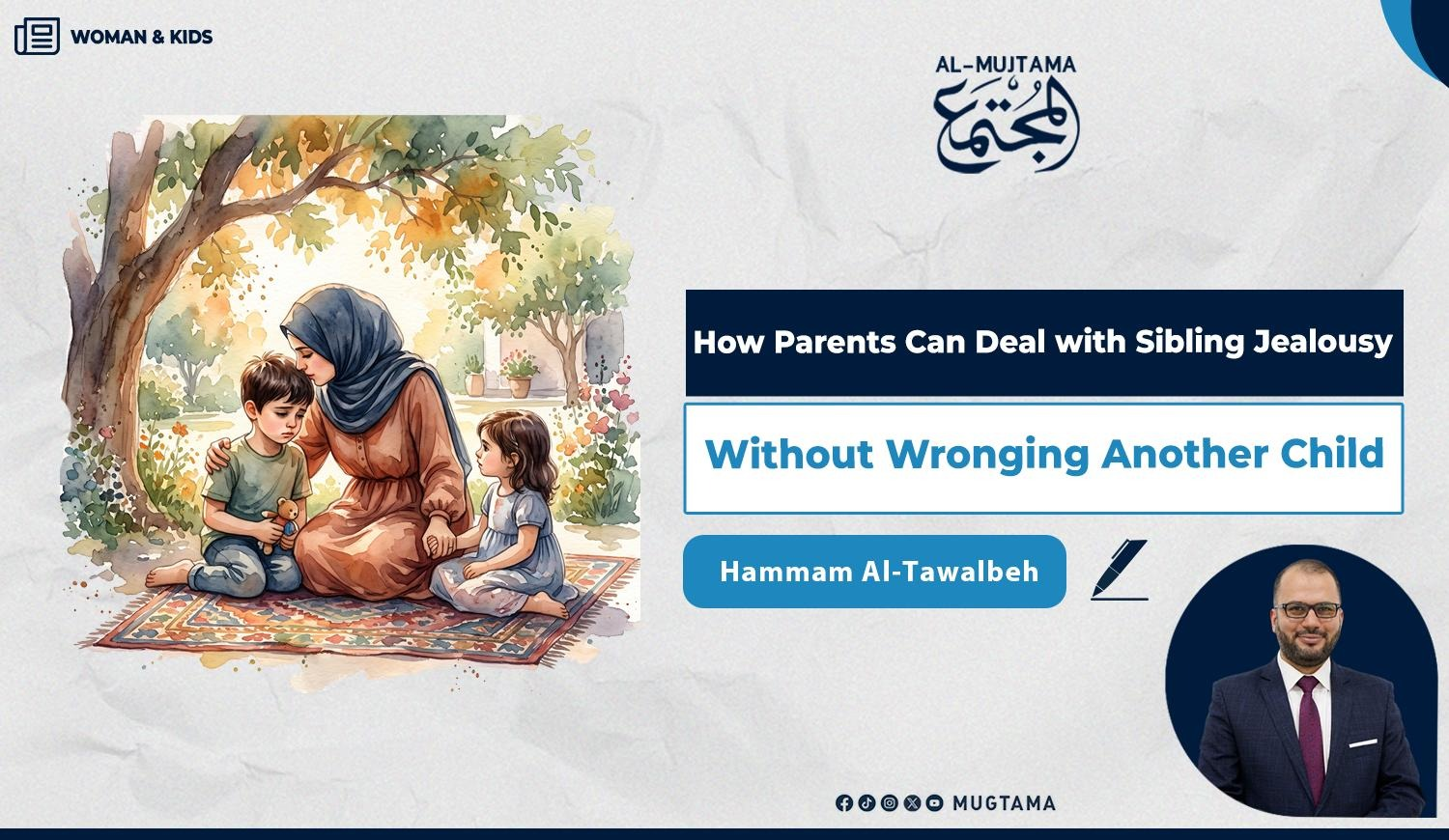
How Parents Can Deal with Sibling Jealousy Without Wronging Another Child
There are
injustices that take place inside homes but are never recorded in complaint
books because they are committed in the name of love, and those responsible
believe they are doing the right thing.
A child
gets angry, and his parents rush to appease him. He cries, and his request is
granted. He objects, and the decision is reconsidered. Meanwhile, his calm
sibling is told to be understanding and give in because he is older, more
mature, or better able to exercise patience.
This
pattern continues until the first child learns that anger is a way to get what
he wants, while the second learns that his calmness may be the reason he loses
his rights. Thus, while parents believe they have extinguished the flames of
jealousy, they may have ignited a fire in another child’s heart—one that is
more hidden and longer-lasting. One of the most dangerous parenting mistakes is
putting out one child’s jealousy
by burning the heart of their sibling.
When Jealousy Erupted in the Household of a
Prophet
The Holy
Quran presents us with a deeply meaningful family scene in the story of Prophet
Yusuf (peace be upon him), when his brothers said: {Surely
Joseph and his brother ˹Benjamin˺ are
more beloved to our father than we, even though we are a group of so many.}
[Yusuf 12:8]
The
brothers felt that, in their perception, their standing in their father’s eyes
did not match the love he showed Yusuf and his brother. Their comparison turned
into a sense of being wronged, and their jealousy eventually descended into
plotting harm. They went so far as to say: {Kill
Joseph or cast him out to some ˹distant˺ land
so that our father’s
attention will be only ours.} [Yusuf 12:9]
It was as
though they imagined that removing their brother would earn them the love they
desired, and that their father’s heart had room for only those who remained
alone in the field.
Prophet Ya`qub
(peace be upon him) did not wrong his sons. The Quran recounts their perception
without affirming that it was correct. However, the story reveals the danger of
jealousy when it is fueled by comparison and
transforms from a need for attention into a desire to exclude someone else.
This is
where the parent’s responsibility begins: reassuring each child of their place
in the family and teaching them that their sibling’s share of love does not
diminish their own, and that closeness to parents cannot be secured by hurting
one’s brothers or sisters.
Fairness Does Not Mean Treating Every Child
Identically
Allah the
Almighty says, {Indeed, Allah commands justice,
grace.} [An-Nahl 16:90]
Fairness
in parenting does not mean giving children exactly the same things in every
circumstance. Children differ in age, temperament, and needs. Rather, fairness
means taking these differences into account without diminishing anyone’s
rights.
The
Prophet (peace and blessings be upon him) said regarding fairness among
children: “Be afraid of Allah, and be just to
your children.” (Narrated by
Al-Bukhari and Muslim)
Supporting
a child who is going through a difficult phase is an act of compassion, but
compassion does not justify wronging another child. Giving one child additional
care because of a particular need is understandable. However, constantly making
their sibling pay the price for that need simply because they are calmer and
less demanding is by no means fair.
The Child Who Suffers in Silence
Not
everyone who remains silent is content, and not everyone who gives in is
convinced that it is right.
The poet
Al-Mutanabbi once said:
“The
injustice inflicted by those closest to us is more painful
To a person than the strike of a sharpened sword.”
Children
do not recognize love through words alone; they also read it through actions.
Whose voice is heard? Who is believed when they complain? And whose rights are
sacrificed whenever tension arises at home?
A quiet
child may learn that standing up for their rights is selfish, and that
preserving their parents’ love requires swallowing their pain. As these
situations are repeated, they may develop a sense of being overlooked and a
loss of emotional security.
This does
not mean that every difference in treatment is an injustice, or that every
feeling of jealousy proves that injustice has occurred. Rather, the goal is to
understand children’s emotions, examine the facts, and protect everyone’s
rights.
From Awareness to Action
Maintaining
a fair balance within the family cannot be achieved through good intentions
alone. It requires daily practices that allow children to experience fairness
in their everyday lives.
First:
Listen to the quiet child as attentively as you listen to the angry one.
A calm,
private conversation may reveal things that noisy family gatherings do not. A
simple question such as, “Is there anything that upset you today that you were
unable to talk about?” may open a door that has remained closed for a long time.
Second:
Acknowledge feelings without rewarding unacceptable behavior.
When a
child becomes angry because their sibling received something they wanted,
acknowledging their feelings does not require changing the decision or taking
away what was given to their sibling. A parent might respond: “I understand
that you feel upset, and I will listen to you, but we will not solve this
problem by taking away your sibling’s right.”
In this
way, parents combine emotional support with clear boundaries.
Third: Pause
before asking one child to give in.
Asking
the quiet child to give in may seem like the quickest way to restore peace.
However, one question can reveal possible bias: “If the other child were the
quiet one, would we still ask them to give in?”
A child’s
patience should never become an excuse for burdening them with responsibilities
that their siblings are not expected to bear.
Fourth:
Hear both sides before making a judgment.
Whenever
a conflict occurs, each child needs an opportunity to explain what happened
without interruption or prior accusation. Once the facts are clear, parents
should judge the behavior, not the child’s character. The goal is to correct
the mistake, not to reinforce a negative image of the child who made it.
Fifth:
Explain differences in treatment clearly.
One child
may need additional help with schoolwork, medical care, or more time with their
parents. Fairness does not require giving all children identical things.
However, it is helpful to explain the reasons for different treatment in a way
that suits their ages, while emphasizing that different needs do not mean
different worth or different levels of love.
Sixth:
Turn apologies into tangible acts of repair.
If a
child damages their sibling’s belongings or takes something away from them, an
apology alone may not be enough. Making things right may require returning the
item, compensating for the damage, or agreeing on a way to prevent the
situation from happening again.
The aim
is to teach children to take responsibility for
their actions, not to make them feel that they are worth less.
Seventh:
Regularly review your parenting practices.
A calm
review at the end of each week can help parents identify recurring patterns. Is
the same child repeatedly being asked to give in? Have they been lenient toward
one child’s mistake while being strict with their sibling in a similar
situation? Has the child who complains the least received enough attention?
Correcting
unintended bias is a sign of maturity in parenting, not a loss of parental
authority or standing.
These
practices do not guarantee the absence of jealousy or disagreement, as both are
part of family life. However, they make it possible to deal with them more
consciously and fairly. Most importantly, they communicate a clear message to
every child: Your feelings are heard, your rights are protected, and your
sibling’s share of love does not diminish your place in the family.
A Peaceful Home Must Never Come at the
Expense of a Child
A child
who raises their voice needs someone to listen, and a child who remains silent
needs someone to notice them. The first should not be left a prisoner of
jealousy, and the second should not be left a prisoner of patience.
Fairness
means giving each child what they need without diminishing the dignity or
rights of the other. Never make one child a means of maintaining peace at home
at their sibling’s expense. A peaceful household built on one child’s emotional
brokenness is not a parenting success. Nor is it an act of compassion to give
one child a sense of security while planting in their sibling’s heart the
feeling that they do not deserve the same.
-------------------------------------------------------------
