








Houthi Siege of Taiz: Human Crisis and Cultural Erasure
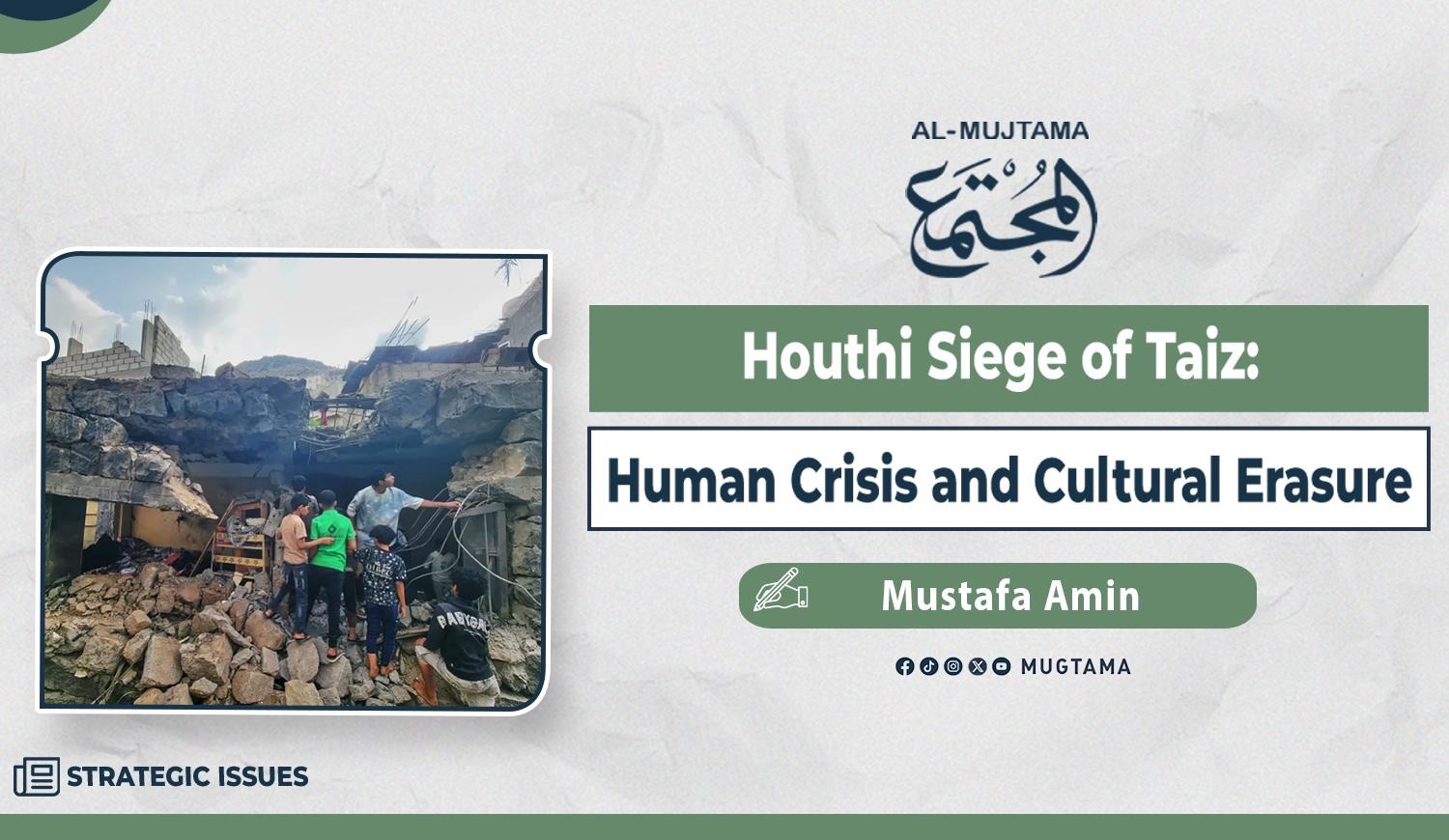
Taiz Governorate is experiencing rapid escalation and a dangerous implementation of a tight siege policy, extending a repeated narrative adopted by the leadership of the Houthi militia and its media since the 2015 siege to refute the existence of any siege on the city.
Despite the public denial renewed
by the leader of the group, field and UN facts refute these claims. The United
Nations officially confirmed the closure of all main entries and roads leading
to Taiz, as well as the blocking of commercial and humanitarian supplies due to
military operations and field restrictions.
Paralysis of the Health Sector and Catastrophic Threat to Medical Services
The complete severe cutoff of the
city’s lifelines has resulted in a dangerous deterioration of the health
system, bringing it to the brink of complete collapse according to official and
UN data and statements.
The Governor of Taiz announced that
only 20% of the city’s hospitals are still functioning, while hundreds of
medical facilities have completely stopped providing their services, demanding
urgent international intervention to open safe routes.
The Spokesperson for the UN
Secretary-General (Stéphane Dujarric) explained that nearly 250,000 people have
been deprived of basic healthcare, including more than 186,000 children and
23,000 pregnant women, with 12 hospitals facing the risk of closure or service
reduction, prompting the organization to coordinate a 90-day emergency plan.
Infant Incubator
Crisis: The Yemeni-Swedish Hospital warned
through the "Siege Affairs Office" of the shutdown of newborn
incubators due to preventing the entry of fuel and supplies, which led to
reducing the operational capacity of incubators from 40 to only 10 incubators.
Collapse of Maternity
Centers: The (14th of October) Maternal and
Child Health Center recorded a sharp decline in accommodating childbirth cases
from 20–30 cases per month to only 5 cases, due to the stoppage of support from
international organizations and the shortage of diesel, amid the spread of
severe acute malnutrition and anemia among pregnant women and children.
Sanitation File and Systematic Environmental Warfare
The Houthi militia utilized the
environmental file as an additional tool to suffocate the city, causing a waste
accumulation crisis and the blockage of rainwater drainage channels.
Environmental Reality
and Escalation: Waste accumulated in
rainwater streams and streets of Taiz after the militia prevented sanitation
trucks from heading to the designated landfill in Al-Saleh Gardens.
Emergency Press
Release: The Governorate’s Health and
Environmental Affairs Committee, chaired by Dr. Ilan Abdulhaq, held an
emergency meeting announcing the limited capacity of the temporary preventative
landfill, and approved transferring waste to "Al-Saleh Gardens"
starting Tuesday morning, November 3, 2026, holding the Houthis fully
responsible for any obstruction.
Field Documentation and
Interception: Dr. Ilan Abdulhaq,
accompanied by workers and equipment, headed to the field landfill to expose
the narrative of non-blockade. Houthi elements intercepted them and prevented
them from unloading trucks at the landfill, forcing them to dump loads out of necessity
in the slaughterhouse yard, documenting a field statement proving the direct
prevention.
Disruption of the Educational Process and Deprivation of Students
Military developments and the
blockading of districts reflected directly on the education sector, as the
Governor of Taiz stated that half a million students have been deprived of
continuing their education.
Forced Fluctuation of
Decisions: October 2026 witnessed emergency
instability to protect students' lives. The Education Office announced the
suspension of classes on October 4 and 5, followed by the decision of Taiz
University to suspend classes in colleges inside the city from October 4 to 8,
while authorizing branches to take appropriate action.
Open Suspension: Despite attempts to resume classes on October 5 in
the districts of (Al-Qahirah, Al-Mudhaffar, Salah), the escalation forced the
Education Office on October 10, 2026, to announce the suspension of classes
across all districts of the governorate until further notice, threatening
exams, curriculum coverage, and graduation.
Economic Displacement and Deterioration of the Humanitarian Situation
Reports from the International
Organization for Migration (IOM) highlighted the severe living conditions faced
by the governorate.
More than 300,000 people were
forced to displace due to the Houthi escalation, the majority of them during
the past two months.
At the same time, prices of
essential commodities and basic goods inside the city of Taiz rose sharply,
multiplying 3 to 5 times.
Blocking roads and isolating areas
made access to food out of reach, amid a acute shortage in humanitarian
response funding.
For his part, the Chief of Mission
for the International Organization for Migration in Yemen, Abdusattar Esoev,
confirmed that displaced people are forced to flee carrying nothing but their
clothes, in dire need of shelter, food, and clean water.
Ideological Changes and Efforts to Alter Religious Identity
Houthi military and environmental
actions are paralleled by systematic moves in the Taiz countryside and the
Western Coast to alter the community's religious and social identity.
Replacement of Imams
and Preachers: Documentation of
replacing 21 registered imams and preachers in the areas of (Jabal Habashi,
Al-Mawasit, Ash-Shamayatayn) with preachers loyal to the group who are required
to deliver sectarian and political content.
Modification of Rituals
and Worship Practices: Introducing the
"Slogan" (Al-Sarkhah) after Friday prayers and imposing the phrase
"Hayya 'ala Khayr al-'Amal" in mosques located in predominantly
Shafi'i areas (such as the village of Dhi al-Bilas in Bani Ahmad).
Mobilization and
Community Confrontation: Organizing
mobilization campaigns inside mosques (as occurred in the Al-Makisheh area in
Qadas, which was followed by the arrest of nearly 20 citizens after a car
belonging to the mobilization team was burned).
Confiscation of
Facilities and Subjugation of Endowments:
Storming the Umm al-Mu'minin Khadijah Center for Quran Memorization in Mawza'
and converting it into a rest area, while subjecting mosques to the supervision
of the Sana'a Endowments Authority, which announced allocating 60 million Rials
to equip 300 mosques in the Western Coast to solidify its control.
Future Repercussions: The group's shift from military control to
religious intervention portends sharp sectarian polarization, weakening local
authority figures, and increasing tensions that threaten social peace and
long-term coexistence.
(Quoted from the
Director of Yemen Affairs at Al Jazeera on his Facebook page)
Comprehensive data confirms that the city of Taiz is experiencing one of its severe waves of field constriction and humanitarian blockage, as mechanisms of medical, environmental, and educational siege integrate with social and religious pressures, placing more than two million people before imminent dangers that require a firm response from the international community and humanitarian organizations to lift the siege and save basic services.
