




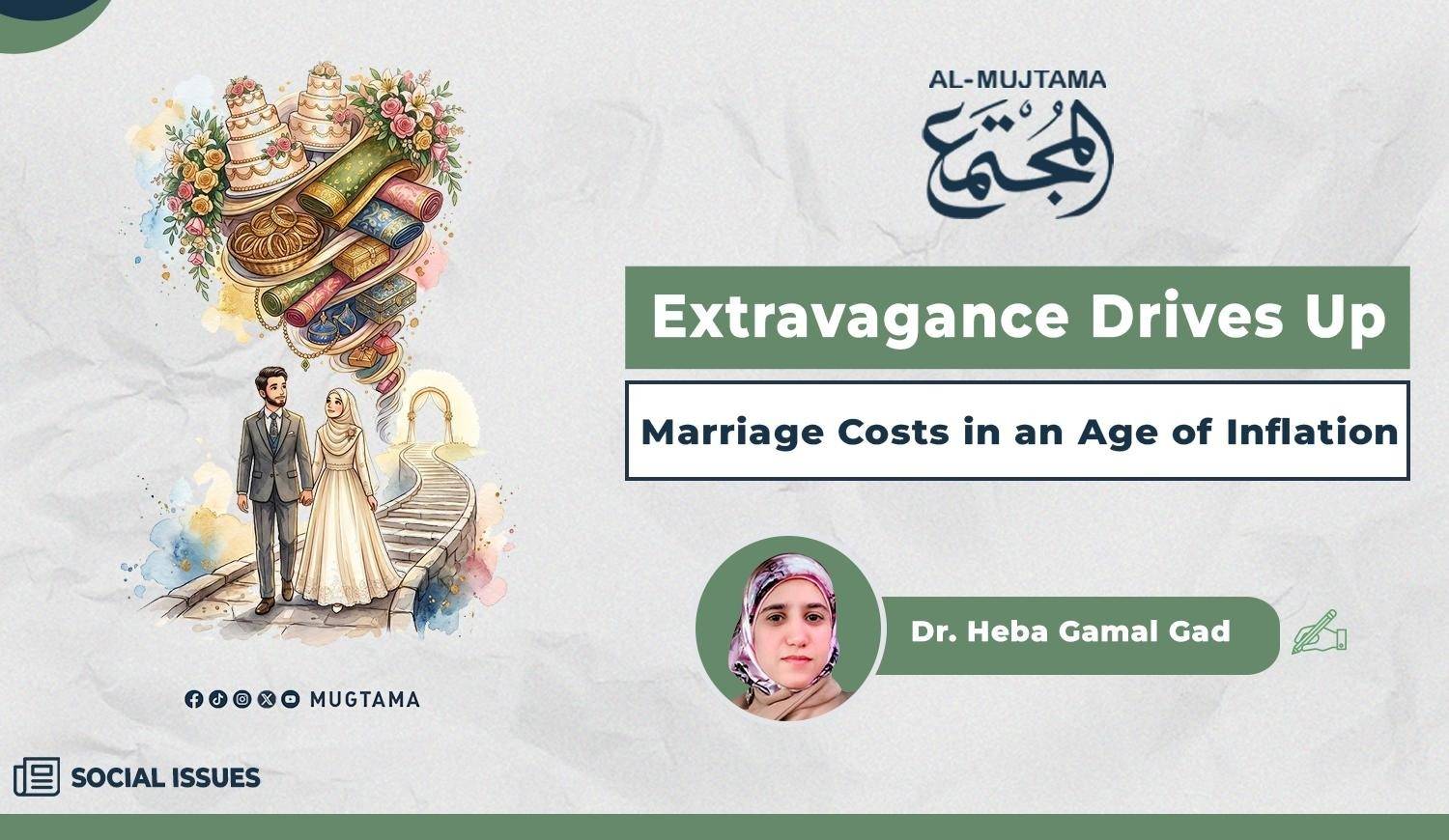
Extravagance Drives Up Marriage Costs in an Age of Inflation
At a time when
crises are escalating, currencies are collapsing, and the cost of wars is being
paid with human lives, we find ourselves facing a painful and paradoxical
reality. While the Arab world continues to suffer from devastating conflicts in
multiple countries, and its economies struggle under the weight of severe
inflation that is crushing the middle and lower classes, a culture of luxury
and extravagance in furnishing homes and preparing for marriage continues to
dominate the minds of many people.
Marriage in our
societies is no longer viewed simply as a sacred bond founded upon affection,
tranquility, and mutual support. Instead, it has increasingly become a stage
for social display and competition, where people imitate imaginary billionaires
and wage financial battles through loans and debt.
Meanwhile, the
wars that plague the region have imposed a harsh economic reality, leaving
families trapped between the hammer of soaring marriage expenses that exceed
the means of many young people and the anvil of rising living costs that
steadily drain household budgets, all while the flames of conflict continue to
spread across the world.
Luxury:
A Social Epidemic
Luxury has
become a social epidemic in modern societies, undermining young people's
ability to establish stable families. In many Arab communities, marriage has
become a reflection of social status, and people increasingly judge families
based on the scale and appearance of wedding celebrations.
Fear of
society's scrutiny and criticism drives many families to exhaust their savings,
borrow money, and even take out loans from banks and relatives to finance
weddings whose long-term stability remains uncertain. Yet the financial burden
often lingers for years, regardless of the marriage's outcome.
The
Economics of War and Their Impact on Marriage Costs
The wars raging
across the Arab world are not merely distant military conflicts; they are
direct economic forces that affect people's ability to live and thrive. War and
escalating regional tensions create unstable economic conditions that
ultimately impact the daily lives of ordinary citizens.
When conflicts
erupt in the region, supply chains are disrupted, shipping and insurance costs
rise, and oil and gas markets—upon which many Arab economies heavily depend—are
affected. As a result, the price of nearly everything increases: gold, which
remains a central component of many Arab weddings; imported household
appliances used to furnish marital homes; and construction materials needed to
establish a new household.
The inflation
resulting from these conflicts is not merely an economic statistic reported in
financial bulletins. It is a painful reality reflected in the declining
purchasing power of young people and the rapidly rising cost of marriage
requirements, which far outpaces income growth. What was once sufficient to
furnish a home only a few years ago has now become unattainable for many.
The Gap
Between Social Expectations and Young People's Means
This is not a
call to abandon compatibility or balance in marriage. Rather, it is a call for
reason and moderation.
The true
tragedy lies in the widening gap between what society expects from a successful
marriage and what young people can realistically provide under difficult
economic circumstances. This gap generates numerous social and familial
tensions.
On one hand,
many young women are exposed to a culture of extravagance through films,
television dramas, and social media platforms that glorify luxury and excess.
Their expectations can sometimes become detached from economic reality. On the
other hand, many young men attempt to fulfill these aspirations through
burdensome loans that weigh them down before married life even begins, creating
broader social challenges.
Ironically,
these expectations often intensify during periods of economic hardship. In
times of crisis, people tend to cling more tightly to outward displays of
status as symbolic compensation for difficult realities. Lavish weddings become
a means of self-affirmation in the face of uncertainty. Unfortunately, this
pursuit of appearances comes at a high cost.
Serious
Social and Economic Consequences
The persistence
of extravagance during an era of war-driven economic hardship has serious
consequences that extend far beyond the difficulty of getting married.
Social Consequences
1.
Delayed
marriage, as young people are forced to spend years saving for
wedding expenses, creating various social challenges.
2.
Higher
rates of early divorce, as married life begins under the
pressure of debt and financial stress, weakening the marriage's ability to
withstand difficulties.
3.
Family
disputes and strained relationships, as
disagreements over marriage expenses between the families of the bride and
groom can sometimes lead to lasting divisions.
4.
Irregular
migration, as some young people risk their lives seeking
opportunities abroad in hopes of securing a decent future and affording
marriage.
Economic Consequences
1.
Excessive
household debt, which may take years to repay and
reduces families' ability to save or invest.
2.
Diversion
of family savings toward consumption rather than
productive investments that could contribute to national economic growth.
3.
Worsening
housing challenges, as many couples insist on securing
luxurious accommodation rather than beginning with modest housing that can be
improved over time.
4.
The
erosion of the middle class, as families spend beyond their
means to maintain social status, eventually becoming burdened with debt and
unable to meet essential obligations.
A
Contradiction of Priorities in Times of Crisis
Perhaps the
most troubling aspect of the current Arab reality is the stark contradiction
between individual priorities and the pressing needs of the wider community.
While some Arab
countries remain trapped in civil wars and widespread destruction, and while
millions of refugees and displaced people struggle without the most basic
necessities of life, many of us remain preoccupied with wedding details,
extravagant celebrations, and the latest trends in jewelry and luxury goods.
This
contradiction reflects a profound crisis of values. A society that spends
thousands of dollars on a single night while its children suffer from
malnutrition, its youth face unemployment, and its people are displaced by war
is a society that must fundamentally reassess its priorities.
Toward a
Culture of Simplicity in Marriage
The alternative
already exists. It is neither novel nor radical. Rather, it is a return to the
teachings of Islam and to the values of our heritage, both of which encourage
ease and moderation in marriage.
The Prophet
Muhammad (peace
be upon him) said: “The best marriage is the one that is easiest.” This is
not merely religious guidance; it is also a comprehensive social and economic
vision that recognizes that strong families are built not upon debt, but upon
affection, mercy, contentment, and mutual support.
Arab societies
can take practical steps toward making marriage more accessible:
1.
Media
campaigns that highlight successful examples of simple
marriages and expose the harmful effects of consumerism and extravagance.
2.
Community
initiatives, such as marriage assistance funds
and cooperative support programs for young couples.
3.
Legislation
and regulations that place reasonable limits on
dowries and excessive marriage expenses, as some Arab countries have done in
the past.
4.
A
cultural shift in gift-giving, encouraging
practical contributions toward establishing a household rather than expensive
gold and luxury items.
5.
A
return to modest wedding celebrations, held in homes
or simple venues rather than extravagant settings designed for display and
competition.
Conclusion
At its core,
marriage is meant to be a source of tranquility, affection, and mercy. It is
not a competition in luxury, nor a burden of debt and social pressure.
As Allah says: {And one of His signs is that He created for you spouses
from among yourselves so that you may find comfort in them. And He has placed
between you compassion and mercy. Surely in this are signs for people who
reflect.} [Ar-Rum 30:21]
In a time
marked by economic hardship, regional instability, and growing uncertainty,
returning to these values is not merely a religious ideal—it is a social and
economic necessity.
Read Also:
-
Meaning of Marriage in Islam
-
Marital Compatibility in Islam
-
10 Common Mistakes That Destroy Marriages
-------------------------------------------------------------