







Building Psychological Safety for Children in a World of Conflict
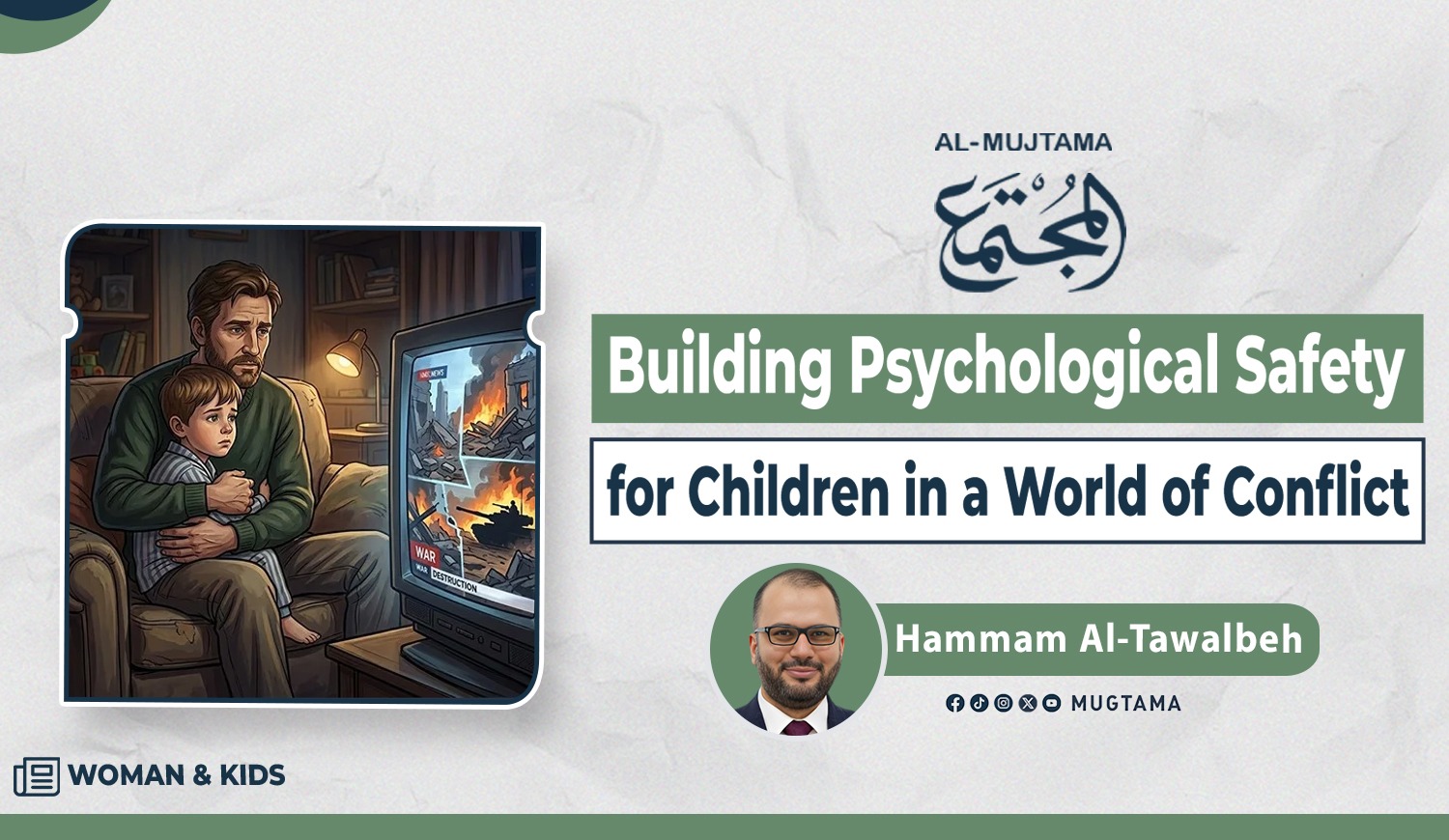
A mother
sits holding her phone, watching with astonishment the rapid acceleration of
regional events. She does not realize that her quickened breaths and her
tightly clenched hand are sending uncoded signals of fear to her little
daughter, who silently observes her from the corner of the room.
We often
think we are protecting our children as long as we do not speak to them about
war. But the truth is that our children read the news of the world in the
expressions of our faces before they ever read it in the headlines.
In an age
where screens have become open windows into the most detailed scenes of
conflicts and wars, children are no longer shielded from the fragments of
anxiety produced by these regional and global tensions. Protecting childhood
from these effects has become one of the most important educational and moral
responsibilities for building the psychological resilience that enables our
generations to live with balance and stability. From here begins the
responsibility of the family in building a child’s psychological immunity.
First: Parents — The Anchor in the
Middle of the Storm
The
psychological protection of our children begins with us as parents. A child
possesses a sensitive radar that detects the vibrations of fear in the
expressions and voices of his parents. Family tranquility remains the first
refuge and the best means of protection, because a child draws his sense of security from the stability of his parents—not from the
stability of the outside world.
Our
Creator, Glorified be He, directed us toward patience and steadfastness, saying,
{O you who believe! Seek help through patience and
prayer. Indeed, Allah is with the patient.} [Al-Baqarah 2:153]
Second: Smart Filtering and Reassuring
Honesty with Children
Here it
is necessary to distinguish between the stages of childhood. Children under the
age of ten need full protection from shocking scenes that may deeply disturb
their awareness and whose effects they may not overcome even as they grow
older.
Adolescents,
however, require thoughtful discussions that correct their concepts and
acknowledge their feelings. Our homes must remain a haven of safety for
everyone.
The
Prophet (peace
be upon him) said: “You
have a duty to your body and to your eye.” (Narrated by Al-Bukhari)
If your
child asks about what is happening around him, answer with honesty
that does not frighten and simplicity that does not distort the truth. When a
child asks a difficult question such as: “Why are children dying there?”
do not evade the question. Instead say with sincerity and care: “There are
people who are suffering, but we are doing what we can to help them through
prayer and good deeds. Your role is to grow up strong and spread justice and
goodness among people.”
Transform
tragedy into a message and a purpose, and instill hope in his heart. The
Prophet (peace
be upon him) loved good optimism.
Third: The Power of Routine in Building
a Child’s Sense of Safety
When the
world outside becomes turbulent, discipline inside the home must increase.
Daily routine is the language through which a child understands that life
continues and that safety still exists.
Maintain
regular meal times, playtime, and the bedtime story. Remember, dear educator,
the concept of security mentioned by our noble Prophet (peace be
upon him): “Whosoever
begins the day feeling family security and good health; and possessing
provision for his day is as though he possessed the whole world.” (Narrated by At-Tirmidhi)
To dispel
feelings of helplessness,
transform their anxiety into positive action, such as making supplication or
contributing to simple acts of relief and charity, according to the general
principle of faith: “The believers in their
mutual kindness… are just like one body.”
Fourth: Teenagers — Managing Intense
Awareness
Dealing
with adolescents is different because they have their own sources of
information and independent thinking. Here the role of rational dialogue
becomes essential as a beloved and effective method of guidance.
Do not
forbid them from following events; rather, teach them media literacy skills and
how to distinguish between authentic news and rumors. Give them sufficient space to express their anger,
and guide this human energy toward deep historical awareness, rather than
allowing them to drown in the trending waves of media panic that exhaust their
psychological energy without granting them real understanding of events.
Fifth: Emotional Release Through Playing
and Drawing
Children
usually express themselves through symbols rather than direct statements. If
you see your child drawing fires or airplanes, do not stop him. Instead,
participate in the play and help the story end safely in his imagination, or
with the triumph of good.
This type
of psychological release helps children express their fears rather than
suppress them, preventing those fears from later turning into anxiety, tension,
or physical symptoms.
Sixth: When Should Parents Sound the
Alarm?
Despite
all the educational efforts made by parents, sometimes the shock may exceed a
child’s ability to cope. Therefore, observe warning signs that require
professional intervention, such as:
- The return of old
behaviors like bed-wetting
- Severe sleep
disturbances
- Social withdrawal
- Constant complaints
of physical pain without a medical cause
In such
cases, consulting a child psychological specialist becomes an urgent necessity.
Protecting
a child from the fragments of anxiety does not mean blinding him to reality.
Rather, it means providing him with a psychological life jacket.
A child
who grows up in a home filled with tranquility learns that the world—despite
all its turmoil—can be faced with a steady heart and a conscious mind.
Let us be
the tranquility that shelters these hearts, and let our homes become oases of
reassurance that send into the world a strong generation capable of facing the
challenges of its nation with a calm heart and a spirit that refuses to be
broken.
For Further Reading:
- 5 Harmful Phrases That Destroy a Child’s Self-Worth
- Homeschooling: A Psychological Safety Net for Children
- Developing Social Spirit in Muslim Children
-------------------------------------------------------------