








Arab Contributions to European Civilization
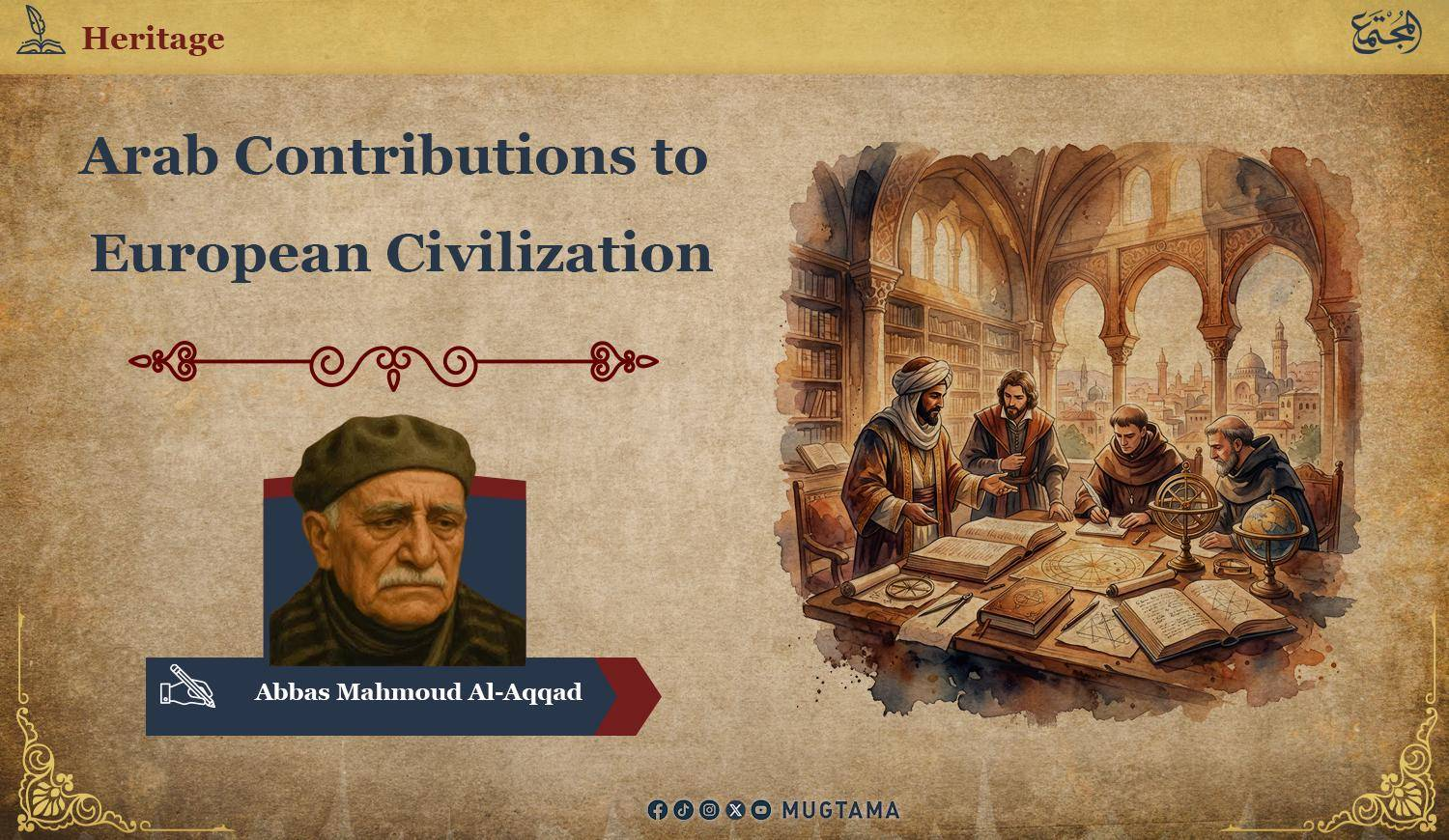
Arab
research in medicine was closely linked to research in chemistry. Europeans
benefited greatly from Arab contributions
to this newly emerging field, and their debt to Arab chemical studies may even
have been greater than what they gained from their medical studies. This stands
as evidence of the Arabs’ significant contributions to Europe.
Alkalis
are known in modern chemical terminology by their Arabic-derived name,
“Alkali.” Silver water, one of the most important acids used in chemical
experiments, was not described in any book before the works of Jabir Ibn
Hayyan. He was also instrumental in introducing Europeans to ammonium chloride,
aqua regia, potash, oil of vitriol, and certain poisons. His book The
Seventy and The Composition of Chemistry were translated into Latin
in the early twelfth century. His works remained authoritative references in
this field among Europeans until the late seventeenth century, and his book Al-Istitmam
was translated into French in 1672.
The works
of Ar-Razi were translated just as those of Jabir Ibn Hayyan had been. From
these writings, Europeans learned to classify chemical substances into
vegetable, animal, and mineral substances. They also acquired a classification
of minerals that was the most precise known during the Middle Ages.
Perhaps European
history was influenced by no Arab discovery in mineralogy as profoundly as it
was by the discovery of gunpowder and its use in siege projectiles and weapons
of war.
Arab Contributions to Physics and the Study
of Gravity
In the
physical sciences, Arab scholars determined the specific gravities of many
elements and precious substances. They also transmitted the Greek view of
gravity and the explanation of weight. According to this view, heavy bodies are
attracted toward their natural element at the center of the Earth, while
spiritual bodies are drawn toward their origin in the heavens.
However,
Al-Biruni questioned this explanation and posed a question to Ibn Sina that
reveals his inclination toward the view that all bodies are attracted toward
the center of the Earth. He asked: “What is the correct position between the
two opinions? One group maintains that water and earth move toward the center,
while air and fire move away from it. The other maintains that all of them move
toward the center, but that the heavier bodies move toward it faster than the
lighter ones.”
Newton and the Law of Gravity
These
ideas paved the way for Newton to discover the law of gravity and explain
weight on the basis of modern scientific principles.
Al-Biruni
also deserves recognition for pioneering the study of fluids in natural springs
and at high mountain elevations, as well as the laws governing their movement
under conditions of equilibrium and elevation.
Among the
pioneers of these subjects in the Arabic-speaking world were the sons of Musa Ibn
Shakir, authors of The Book of Ingenious Devices, which is considered
one of the foundational works of mechanics, predating its later development in
the age of machines.
Arab Contributions to Natural History, Botany,
and Pharmacology
Despite
the relatively rudimentary nature of the research achieved in natural history
before the eighteenth century, Arab writings served as valuable references in
these sciences for Europeans and non-Europeans alike.
Arab
scholars gathered scattered information from earlier works on animals and
plants, expanded upon it, and added to it. They drew knowledge from India,
Chaldea, Greece, and the Nabataeans, while also relying on direct observation
in their own lands and beyond.
One example
was Diya’ Ad-Din Al-Malaqi, known as Ibn Al-Baytar. Born in Malaga, he traveled
throughout the Islamic world and reached the farthest regions of the Byzantine
lands in search of herbs and different varieties of plants.
Al-Kamil,
a ruler of the Ayyubid dynasty, appointed him chief herbalist in Egypt.
Herbalists in that era performed roles that today would correspond to those of
both botanists and pharmacists.
Ibn Al-Baytar
authored The Book of Simple Drugs, in which he compiled the finest of
knowledge that the scholarship of his time had accumulated in these fields.
Baghdad, Cairo, and Cordoba
The book European
Civilization: Political, Social, and Cultural, written by philosophy
professors James Westfall Thompson, Franklin Charles Palm, and Van Nostrand,
states that over the course of two centuries, practically all the scientific
heritage left by the Greeks was translated into Arabic. Baghdad, Cairo,
Kairouan, and Cordoba became brilliant centers for the study and teaching of
science. Knowledge of this Greco-Arabic culture began to make its way into
Western Europe in the late eleventh and twelfth centuries.
This
transmission did not take place as a result of the Crusades, as one might
initially assume. Rather, it came through Sicily into Italy, and from Muslim
Spain into Christian Spain, and then into France.
Men of
keen intellect competed to travel to Palermo and Toledo to learn Arabic and
study Arab sciences. Remarkably, most of these men were English, including
Adelard of Bath, Daniel of Morley, Roger of Hereford, and Alexander Neckam.
Adelard
of Bath’s treatise on natural science was the first scientific work produced by
Western Europe during the Middle Ages. Some students spent several years in
Spain before devoting the rest of their lives to the task of translating Arabic
scientific books into Latin.
Gerard of
Cremona, who died in 1187 at the age of seventy-three, translated seventy-one
different books from this body of literature. Plato of Tivoli produced a
comparable volume of translations.
In this
way, by the beginning of the thirteenth century, Europe had acquired the entire
body of Greek and Arab scientific knowledge. The teaching of science in the
emerging universities had become an established and accepted practice.
The
greatest scholars of that era included the English Franciscan Roger Bacon (1214–1292),
whose stature was no less than that of Albertus Magnus. Both taught at the
University of Paris.
Before
the middle of the thirteenth century, this body of knowledge had appeared in a
massive compilation by Vincent of Beauvais, entitled The Mirror of Nature.
It contained everything human knowledge had encompassed in that generation,
including medicine, natural phenomena, astronomy, geography, meteorology,
discussions of the Earth’s layers and minerals, plants, living organisms,
anatomy, and more.
How Arab Scientific Knowledge Helped Shape
the European Renaissance
The
important aspect of the influence these cultural encyclopedias had on Europe is
not simply a matter of counting how many pieces of information they contained,
how much knowledge the Arabs acquired, or how much Europeans subsequently took
from them.
What
truly matters is that Europeans received the torch of science from the hands of
the Arabs and used its light to emerge from darkness. They then went on to
achieve the remarkable scientific enlightenment that paved the way for the
latest developments in modern science.
Had the
Arabs not carried that torch east and west, it would have been exceedingly
difficult for Europeans to kindle its light anew. And even if they had
succeeded, they would, at best, have taken three centuries to reach a level
that human endeavor had taken dozens of centuries to attain.
-------------------------------------------------------------