









About Islam and Christianity
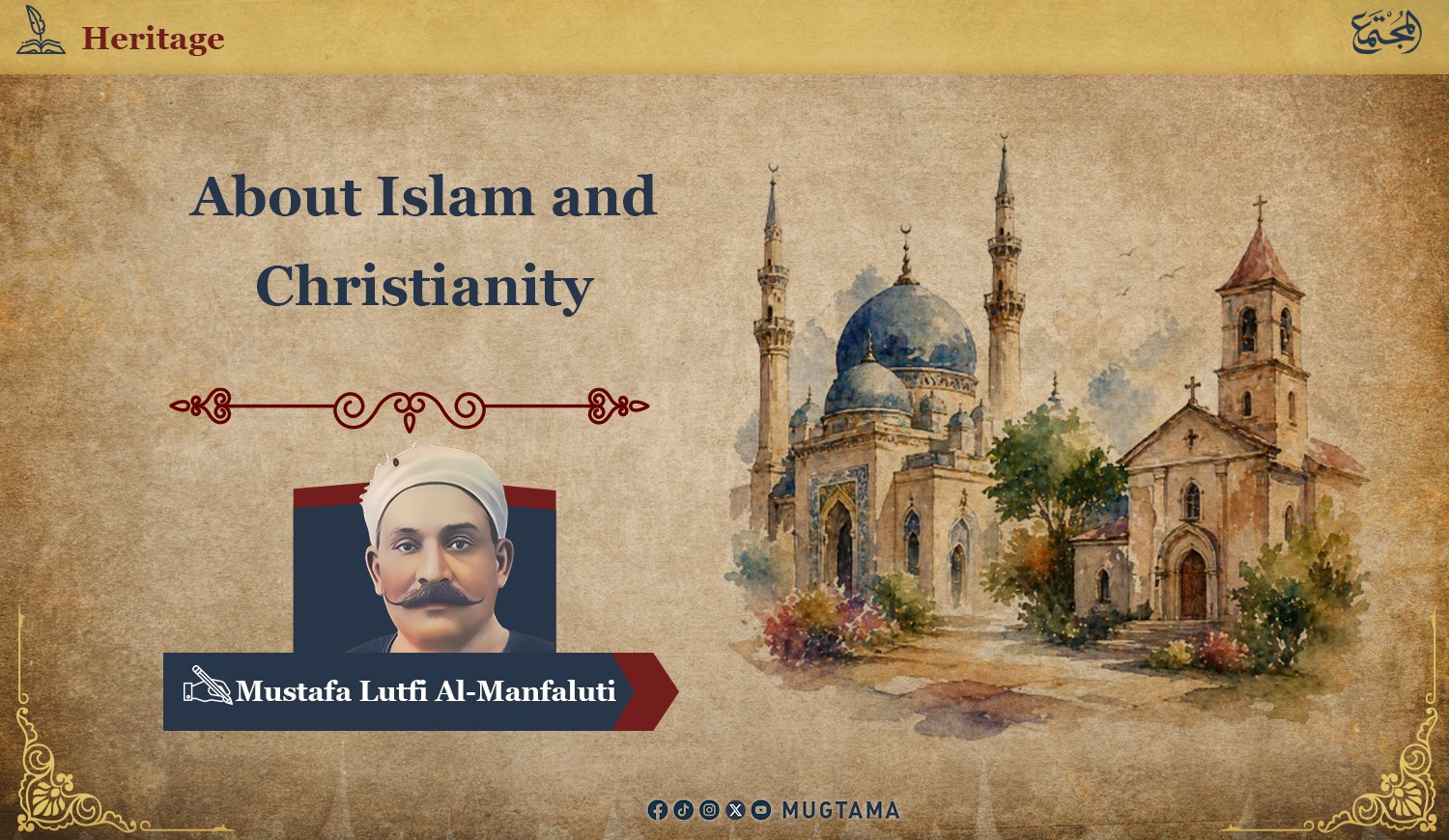
A Critique of Medieval Religious Hegemony
In which era of history was the
Christian religion ever the wellspring of science or the dawn of civilization
and urban development?
Was it during the era when the
millstones of bloody war ground between the Orthodox and Catholics at one time,
and between Catholics and Protestants at another—in such a horrific and brutal
manner that the very garment of humanity was blackened, and both heaven and
earth wept?
Or was it in the age when the will of
the Christian was but a reflection of the will of an ignorant priest? An age
where he knew only what was taught to him and understood only what was fed to
him—where he was granted no freedom even to judge his own faith or disbelief,
his own humanity or bestiality. He would almost imagine himself possessing a wagging
tail and a long snout, walking on all fours, if only the priest told him: 'You
are a dog,' or declared: 'You are not a human being.
Or was it in the era when the
Christian believed that it is easier for a camel to pass through the eye of a
needle than for a rich man to enter the Kingdom of Heaven?
Or was it in the era when the High
Priest forbade the Christian from reading any book other than the Holy Bible,
or from receiving an education in any school outside the Church?
Or was it in the era when the 'tailed
star' (comet) appeared, striking terror into the hearts of Christians, who then
submitted petitions of complaint to the Pope, until he 'banished' it from the
heavens—and so it turned tail and fled?!
Or was it in the era when the Abbasid
Caliph, Harun al-Rashid, gifted a striking water-clock to King Charlemagne?
When the Christian people saw it and heard its mechanical chimes, they fled in
terror, believing it was inhabited by jinn and demons!
Or was it in the era when the
Inquisition was established to prosecute those accused of practicing science?
In a short span of time, it sentenced three hundred and forty thousand people
to death by burning or crucifixion.
Or was it in the era when the
Christian populace burned a beautiful young maiden after flaying the flesh from
her bones, merely because she occupied herself with mathematics and philosophy?
How Modernity Expelled the Church
This, O historical philosopher, is
what we know of the history of science, gnosis, civilization, and urban
development during the Christian eras. We do not know whether that version of
Christianity—which possessed such a character and such a level of
'tolerance'—was, in your view, true or false. However, we wish to judge
Christianity by the conduct of Christians, even if we haven't grasped its true
essence, just as you judged Islam by the conduct of Muslims without knowing its
true nature and core.
Yet, our deduction is sound, while
yours is flawed. Modern civilization did not enter Europe until it had
displaced Christianity to take its place—much like water that cannot enter a
cup until it has expelled the air, for the two cannot coexist. If any trace of
Christianity remains today in the huts of the common folk in Europe, it remains
only because civilization has overlooked it and allowed its survival. It is
kept not as a religion to be revered and glorified, but as a psychological
deterrent used by governments to curb the impulses of the ignorant masses.
Therefore, there is no link between
Christianity and Western civilization that allows the latter to be used as
evidence for the former. Had there been any such connection, they would not
have been parted for fifteen centuries—during which Europe wallowed in a state
of barbarism, brutality, and ignorance beyond what the mind can conceive. In
those times, neither its Christianity benefited it, nor did its priesthood
avail it.
Islam and Civilization: A History of
Harmony
As for Islamic civilization, it rose
with Islam in the same sky, from the same horizon, and at the same time. It
then marched alongside it, shoulder to shoulder, neither denying the other’s
authority nor being denied by it.
The worshipper in his mosque, the
jurist in his lesson, the scholar in his library, the mathematician in his
school, the chemist in his laboratory, the judge in his court, the orator in
his assembly, the astronomer before his astrolabe, and the writer among his
inkwells and papers—all were harmonious brothers and loving friends. They did
not quarrel, they did not kill one another, they did not brand each other as
infidels, nor did any of them transgress against the other.
O historical philosopher: If one must
deduce the cause from the effect, then modern Western civilization is a trace
of yesterday’s Islam, while today’s Islamic decline is a blow dealt by early
Christianity. Here is the explanation:
Islam came bearing for the human race
everything it needs for the hereafter and this life, for the worldly and the
spiritual, and for both the individual and the collective good. It refined
man’s creed after it had been corrupted by polytheism, the debasement of idol
worship, and the bowing of heads before religious leaders. It guided man to
faith in the divinity of one God, associating nothing with Him. Furthermore, it
guided him to liberate his mind and direct his gaze toward the kingdom of the
heavens and the earth, to grasp the truths of the universe and its laws, and to
increase in faith in God’s existence, power, and perfect orchestration. Thus,
his conviction would be a deep-seated psychological and heartfelt certainty,
ensuring he would not be a mindless tool in the hands of whims, to be
manipulated at will.
The Islamic Model of Civil Life
Then, Islam guided him toward
spiritual stations that remind him of his Lord and awaken him from his heedlessness,
purging his soul of evil and wicked thoughts whenever they sought a way in;
these are the acts of worship. It then granted him freedom of speech and
action... It made him realize his own worth after he had been ignorant of it,
teaching him that in humanity, there is no distinction between the poor and the
rich, the lowly and the exalted, or the weak and the strong. Before God and the
Truth, the king and the commoner, the noble Hashimite and the Black slave are
equals. Command and prohibition, decreeing the lawful and the forbidden,
benefit and harm, reward and punishment, mercy and forgiveness—all lie in the
hand of God alone. No one contests His authority, not even the prophets,
messengers, or the closest angels.
Furthermore, it addressed his morals,
guiding him to their virtues and repelling him from their vices, even teaching
him the etiquette of eating, drinking, sleeping, walking, sitting, speaking,
and greeting. It entered his home with him, teaching the son how to honor his
father, and the father how to have mercy on his child. It taught the brother to
be kind to his brother, the husband to cherish his wife, and the wife to obey
her husband, fostering compassion and kinship among relatives.
It then looked into his social
affairs, mandating Zakat—which, if collected and distributed as ordained, would
leave no miserable or poor person in the world—and encouraged voluntary charity
and the support of the weak by the strong. It established laws for worldly
transactions, including buying and selling, mortgages, gifts, loans, trade,
leasing, farming, endowments, wills, and inheritance, so that every individual
knows their rights and no one is wronged.
It also decreed worldly penalties to
prevent aggression—whether through insults, murder, theft, violating
sanctities, public sin, incitement of sedition, or rebellion against a ruler.
Finally, it addressed political affairs, defining the Caliphate and its
conditions, the judiciary and its attributes, and the limits of authority. It
laid down how Muslims should treat those of different faiths, whether distant
or residing among them, defining the grounds for war and the terms for peace.
In short: the Islamic religion has
omitted nothing, small or large, without accounting for it. It has not left man
to walk a single step in the arena of this life, from the cradle to the grave,
without extending a guiding hand, illuminating his path, and directing him to
the straight way.
Islam: The Sun of Western Awakening
This radiant sun rose in the Arab sky,
filling the universe with light and brilliance. People differed in their
response to it—some acknowledging its presence, others denying its
existence—yet they were all equal in benefiting from its light and being
illuminated by its radiance, albeit to varying degrees and in diverse ways.
This shining sun rose, and its white
rays traveled toward Europe by way of Spain, Southern Italy, and France. A
small number of the Westerners' keenest minds caught sight of it; they were
stirred from their slumber and awakened from their lethargy. They witnessed the
beauty of Islamic doctrines, the laws and order of the universe, and the
principles of freedom and equality. This compelled them to compare their own
stagnant and weak Western society with the sharp and awakened Eastern society.
They asked themselves: 'Is it possible
for a human being to live free upon this inhabited world, neither enslaved by a
king nor robbed by a priest? Is it possible for a person to spend even one
night of their life calm in their bed, tranquil in their rest, terrified
neither by the rack of torture nor the executioner's sword? Can the soul
possess the freedom to observe the order and nature of the world, and to study
and practice the cosmic sciences? Is it possible for the dawn of civilization
to rise upon this Western society, erasing the darkness that has persisted so
long that it has clouded our vision, until we can barely see one another?
Islam: The Hidden Architect of European
Modernity
These recurring thoughts within the
minds of those keen intellectuals were the first steps Europe took on the path
toward civilization and urban development—all thanks to Islam and its laws.
These individuals encountered such ideas through their interactions with
Muslims in Europe, the study of their texts, and the observation of their
culture and civilization. They then began teaching these principles in secret,
instilling them into the hearts of their students bit by bit, enduring immense
hardship in their dissemination. This struggle between enlightenment and
ignorance persisted for several centuries, until it culminated in the French
Revolution—the final blow to past brutality and ancient barbarism.
O historical philosopher: You surely
know this truth full well, for it is the very least a historian ought to know.
You also know that if Islamic civilization was vast enough to elevate others,
it is even more capable of sustaining itself. Yet, religious fanaticism has so
deeply permeated your soul that it was not enough for you to deny the favor of
the benefactor who enriched you; you went so far as to deny that he possessed
any merit even within himself!
Islam Exonerated: Debunking the Myth of
Religious Backwardness
I have no need to explain to you
Islamic civilization, nor to list the names of its scholars and philosophers
and their works in physics, chemistry, astronomy, botany, zoology, mineralogy,
medicine, philosophy, ethics, and urban development. Nor do I need to enumerate
its schools, academies, and observatories in both the East and the West, or
describe its flourishing cities, its bustling metropolises, its prosperity, its
pride, and its might. You know all of this, if indeed you are the historian you
claim to be.
However, I do not deny the weakness
and apathy that have afflicted Muslims in recent centuries, nor the frailty and
dissolution that have struck their collective unity. Yet, the cause is not
Islam itself, as is commonly imagined. Rather, it was a 'contagion' that spread
to them at the hands of certain individuals—Christians or those masquerading as
such—who donned the garb of Islam, adopted its outward appearance, and entered
its lands.
They gained influence over the hearts
of weak kings and ignorant princes, providing them with a measure of power and
authority. Through this, they were able to propagate their sickly doctrines and
superstitious beliefs among Muslims, eventually corrupting their original
tenets and creed. They incited strife among them and prevented them from
drawing from the true spirit and strength of Islam. Consequently, their state
became what it has become.
You may also like:
Our Civilization: From Illness to Renaissance
Islam as a Complete System for Humanity
=========================================
