





7 Ways Islam Builds a Culture of Solidarity
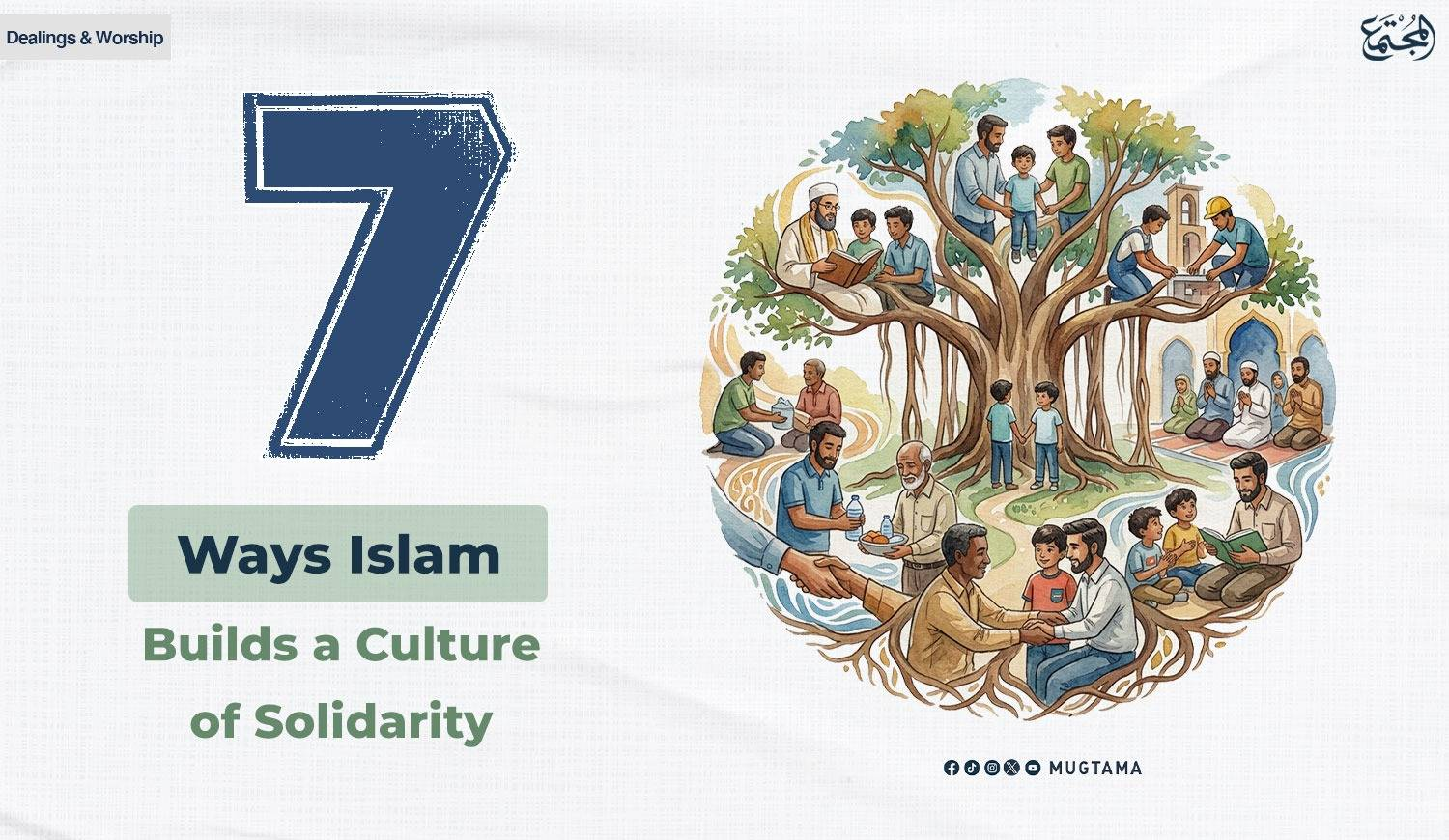
In a culture increasingly shaped by individualism,
people are often encouraged to protect their own interests, build their own
lives, and look after themselves first.
But what happens when people begin to face life’s difficulties
alone?
In England, 6.6% of adults reported feeling lonely often or always in 2024/25, while 9% reported
high levels of indirect loneliness, such as feeling isolated, left out, or
lacking companionship.
The problem is not limited to loneliness. Across the European Union, 93.3 million people—21% of the population—were
at risk of poverty or social exclusion in 2024. In the United States,
meanwhile, 18.3 million households experienced food insecurity during 2024.
These figures point to a reality that wealth and technological
advancement cannot solve on their own: people need people.
Islam addresses this need through a concept that goes far
beyond occasional charity. Social solidarity creates a culture in which people recognize that the well-being
of others is not someone else’s problem.
Allah says, {Cooperate with one
another in goodness and righteousness.} [Al-Ma’idah 5:2]
So what does this principle look like in practice—and how does
Islam challenge the logic of “me first”?
1.
Sharing What You Have When Someone Else Needs It
One of the clearest expressions of solidarity is the
willingness to share what you have rather than treating everything you possess
as exclusively yours.
The Quran praises the people of Madinah who welcomed the
Muslim emigrants from Makkah and gave them preference even when they themselves
were in need: {They give ˹the emigrants˺ preference over themselves even
though they may be in need.} [Al-Hashr 59:9]
This was not merely an ideal. The Prophet (peace be upon him) said:
“When the people of Ash`ari tribe ran short of
food during the holy battles, or the food of their families in Medina ran
short, they would collect all their remaining food in one sheet and then
distribute it among themselves equally by measuring it with a bowl. So, these
people are from me, and I am from them.”
(Sahih Al-Bukhari 2486)
It is a radically different philosophy from “This belongs to
me, and whatever happens to you is your problem.”
Solidarity can begin with something as ordinary as a meal—and
with the simple decision not to eat alone when you have enough to share.
2.
Helping Someone Escape the Burden of Debt
Need does not always look like hunger. Someone may have food
on the table and still be trapped beneath debts that threaten their stability,
their family, and their future.
Islam therefore includes those burdened by debt among the
legitimate recipients of zakat: {for those in debt}
[At-Tawbah 9:60]
This turns wealth into a means of relieving hardship rather
than simply accumulating power.
Helping someone overcome a crushing debt is not merely giving
them money. It can mean giving a family room to breathe, allowing someone to
rebuild their life, and restoring a person’s ability to stand on their own
feet.
In Islam, another person’s financial crisis is not
automatically someone else’s problem.
3.
Making Sure the Vulnerable Do Not Stand Alone
In highly individualistic societies, losing a parent, spouse,
or primary provider can leave a person facing enormous challenges with little
support.
Islam approaches vulnerability differently. The Quran
repeatedly commands believers to care for orphans
and those in need, while the Prophet (peace be upon him) gave extraordinary
importance to caring for widows and the poor.
He said: “The one who looks
after and works for a widow and for a poor person, is like a warrior fighting
for Allah’s Cause or like a person who fasts during the day and prays all the
night.” (At-Tirmidhi 1969)
The principle is broader than financial assistance. Solidarity
can mean education, protection, companionship, childcare, employment
opportunities, or simply becoming a reliable source of support for someone who
has lost theirs.
4.
Standing Together When Crisis Strikes
A society’s true character often becomes visible when normal life breaks down.
A disaster, war, epidemic, economic crisis, or natural
catastrophe can expose the limits of individual effort. What one person cannot
carry alone, a community may be able to carry together.
Islamic history offers powerful examples of this principle.
During the famine known as the Year of the Ramadah under Caliph `Umar Ibn Al-Khattab,
responding to widespread hunger became a collective responsibility, with
resources mobilized to relieve those suffering.
Crises do not only reveal how much people are suffering. They
reveal whether people are willing to carry one another through that suffering.
5.
Giving Knowledge and Skills, Not Just Money
Not every form of need can be solved with money.
A young person may need someone to teach them a skill, guide
them toward employment, share professional experience, or open a door they
could not reach alone.
This is another dimension of solidarity in Islam: through
knowledge, time, experience, and opportunity.
The Prophet (peace be upon him) said: “When a man dies, his acts come to an end, but three,
recurring charity, or knowledge (by which people) benefit, or a pious child,
who prays for him (for the deceased).” (Sahih
Muslim 1631)
Knowledge that benefits others is therefore not treated as
something insignificant. Its value can continue long after the person who
shared it is gone.
Teaching someone a profession may ultimately be more
transformative than giving them money once. Helping someone gain a livelihood
may be more lasting than simply meeting one immediate need.
6.
Supporting a Person Emotionally Before Supporting Them
Financially
Some forms of need never appear on a bank statement.
A person who has lost someone they love, experienced failure,
entered a crisis, or simply feels alone may not need money as much as they need someone who will listen, reassure them, and remind them that they are not
alone.
This dimension of solidarity was visible from the earliest
days of Islam.
When the Prophet Muhammad (peace be upon him) returned
frightened after his first encounter with revelation, his wife Khadijah (may Allah
be pleased with her) did not dismiss his fear. Instead, she reminded him of the
good he had consistently done for others: “Be
happy. I swear by Allah that He shall never humiliate you. By Allah, you join
ties of relationship, you speak the truth, you bear people's burden, you help
the destitute, you entertain guests, and you help against the vicissitudes
which affect people.” (Sahih
Muslim 160)
Sometimes a person needs someone else to remind them of their
own worth when they can no longer see it themselves.
That, too, is solidarity.
7.
Turning Wealth Into Security for Society
Islam does not treat wealth as an entirely private matter
disconnected from the needs of society.
Zakat
redistributes a defined portion of wealth to those entitled to receive it.
Voluntary charity expands that circle of giving, while the Islamic institution
of waqf, or charitable endowment, historically allowed wealth to provide
long-term benefit through education, healthcare, food provision, and other
public needs.
The Quran explicitly identifies categories eligible for zakat,
including the poor, the needy, those in debt, and stranded travelers: {Alms-tax is only for the poor and the needy, for those
employed to administer it, for those whose hearts are attracted ˹to the faith˺, for ˹freeing˺ slaves, for those in debt, for Allah’s cause, and
for ˹needy˺ travellers. ˹This is˺ an obligation from Allah.} [At-Tawbah 9:60]
The point of Islamic solidarity is therefore not simply to
encourage occasional generosity. It is to develop a culture in which wealth,
ability, knowledge, and influence carry responsibilities toward others.
From “Me First” to “My Brother First”
Islam does not tell people to stop caring for themselves. Nor
does it condemn legitimate self-interest.
What it challenges is the idea that the self should become the
center of everything—that a person should take whatever they can for themselves
and then regard the struggles of everyone else as someone else’s
responsibility.
The Prophet (peace be upon him) gave a principle that captures
the spirit of solidarity: “By the One in Whose
hand is the soul of Muhammad, none of you has believed until he loves for his
brother what he loves for himself of goodness.” (An-Nasa’i 5017)
This is more than a call to individual kindness. It is a
different vision of society.
When a Muslim feeds the hungry, helps someone escape debt,
supports an orphan or widow, shares knowledge, comforts the distressed,
responds to disaster, or uses wealth to create security for others, they are
not performing acts that sit on the margins of Islamic life.
They are living out one of its central principles: A society
should not be made up of individuals protecting only their own share. It should
be a community in which people feel one another’s burdens—and refuse to leave
anyone to carry them alone.