









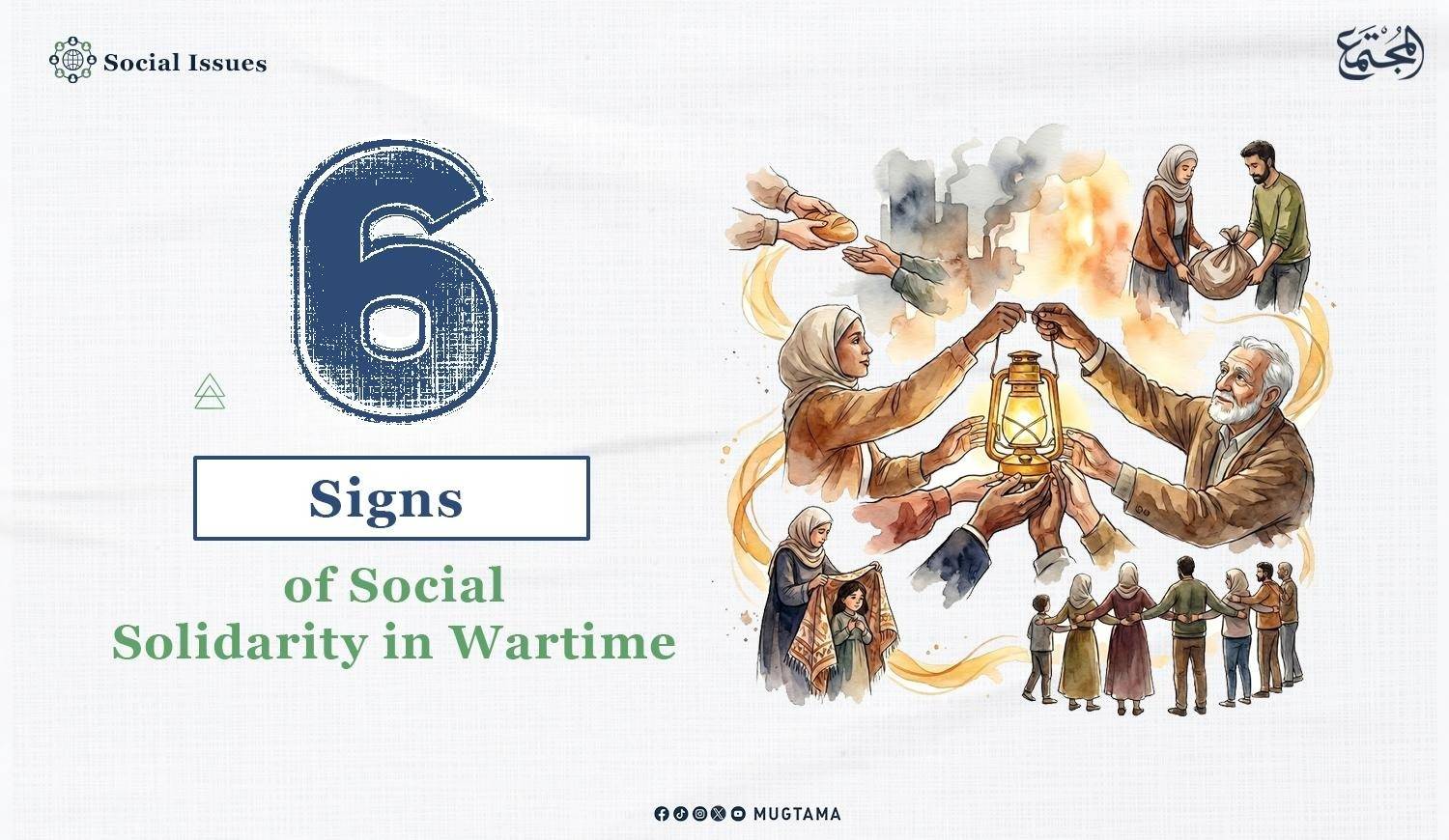
6 Signs of Social Solidarity in Wartime
No era
throughout history has ever been free from trials and hardships afflicting the
Muslim nation. Such is the nature of life on this earth. Allah Almighty says: {And We test you ˹O humanity˺ with good and evil as a trial, then to
Us you will ˹all˺ be returned.} [Al-Anbiya 21:35]. Hardships and tribulations are not evil in
themselves; rather, they often carry immense goodness within them. They may
elevate a person to the highest ranks, or cast him down to the lowest depths.
They also distinguish the truthful from the false claimant in faith. Allah
says: {Do people think once they say, “We
believe,” that they will be left without being put to the test?} [Al-`Ankabut
29:2].
The greatest
danger of widespread crises is that they may bring out the worst within
societies. Certain foundational values begin to fade, the collective religious
conscience weakens, and the noble principles that distinguish Muslim
communities begin to disappear. In their place emerge values such as
selfishness, greed, fear over sustenance, and anxiety about death. The Prophet (peace
be upon him) said: “I asked God for three things, two of which He
granted me but one of which He refused me. I asked Him not to destroy my people
by famine and He granted me that, I asked Him not to let an enemy from another
people rule over them and He granted me that, and I asked Him not to let them
experience one another's violence but He refused me that.” (Muslim).
Despite the
widespread turmoil affecting the Muslim nation, there remain signs and
indicators showing that this society is still spiritually sound and capable of
overcoming the corruption brought about by fear, tension, and anxiety during
difficult times. The following are some of those signs, especially as the Ummah
passes through one of the darkest periods in its history.
1. The Continuation of
Cooperation and Solidarity During Hardship
One of the
clearest signs that people still hold firmly to the teachings of Islam and
noble character during times of crisis is the spirit of cooperation, mutual
support, and solidarity—particularly in dealing with urgent daily needs. For
example, groups of young people organize themselves to distribute food to the
needy, assist the sick and injured in conflict zones, and support struggling
families. Such positive spirit is a powerful indication that society remains
connected to Allah. Allah says: {Cooperate with
one another in goodness and righteousness.} [Al-Ma’idah 5:2].
2. Respecting Laws and Order
in Daily Conduct
In recent
years, during the earthquakes, fires, and floods that struck the United States,
global television networks broadcast widespread scenes of looting and theft
amid the absence of police and the inability to secure all affected areas. This
reflects the absence of an internal moral restraint and self-accountability
preventing people from violating the rights and property of others when legal
enforcement disappears.
The Associated
Press reported details of some of these incidents: looting and theft spread
throughout downtown Washington, Los Angeles, and other areas, as certain gangs
exploited the protests following the death of George Floyd and turned them into
organized acts of violence. Protesters stormed a branch of Capital Bank, and
empty jewelry boxes were seen scattered outside Mervis Diamonds. (1)
In many Muslim
countries, particularly in the Arabian Gulf during times of war and crisis,
people’s conduct has largely remained honorable and beyond suspicion. This
reflects a living faith and an awakened collective conscience. A Muslim is not
merely restrained by security forces, but rather by deep faith that monitors
his actions even in the absence of external oversight.
3. Resisting Corruption
Regardless of Its Scale
Hardships may
push some weak-hearted individuals toward violating laws and ethical
boundaries. Yet there remain clear signs of resistance against corruption:
rejecting bribery, reporting abuses, and launching community initiatives to
combat violations and exploitation. These actions may appear small to some, but
they are evidence of a society’s health and its attachment to its identity and
historical values despite temptations and the absence of legal accountability.
The Prophet (peace
be upon him) said: “He who acted dishonestly towards us is not of us.”
(Al-Bukhari). Scholars explained this narration as a severe warning
against deceit in all matters, especially in transactions and dealings. (2)
4. Preserving Human Dignity
in Word and Action
Even under
psychological and economic pressure, many people continue to uphold respect,
courtesy, and the ethics of Islam in their interactions. They become more
compassionate toward others. Despite fear and instability, they remain
committed to simple acts of goodness: disposing of trash properly, helping
those in need, and speaking kindly.
Allah says: {Speak kindly to people.} [Al-Baqarah 2:83] — meaning: speak gently
and graciously to them. This also includes enjoining good and forbidding evil
with wisdom and kindness, as explained by Al-Hasan Al-Basri. (3)
The Prophet (peace
be upon him) said: “There is a (compulsory) Sadaqa (charity) to be
given for every joint of the human body (as a sign of gratitude to Allah)
everyday the sun rises. To judge justly between two persons is regarded as
Sadaqa, and to help a man concerning his riding animal by helping him to ride
it or by lifting his luggage on to it, is also regarded as Sadaqa, and (saying)
a good word is also Sadaqa, and every step taken on one's way to offer the
compulsory prayer (in the mosque) is also Sadaqa and to remove a harmful thing
from the way is also Sadaqa.” (Al-Bukhari and Muslim).
5. Voluntary Community
Initiatives
Among the signs
of a healthy society is the emergence of volunteer initiatives such as helping
the poor, organizing awareness campaigns, and supporting students and others
who need educational assistance. These efforts are not driven by financial
gain, but by sincere desire for goodness inspired by the words of Allah: {But whoever volunteers to give more, it is better for
them.} [Al-Baqarah 2:184].
The Prophet (peace
be upon him) said: “If anyone relieves a Muslim believer from one of
the hardships of this worldly life, Allah will relieve him of one of the
hardships of the Day of Resurrection. If anyone makes it easy for the one who
is indebted to him (while finding it difficult to repay), Allah will make it
easy for him in this worldly life and in the Hereafter, and if anyone conceals
the faults of a Muslim, Allah will conceal his faults in this world and in the
Hereafter. Allah helps His slave as long as he helps his brother.” (Muslim).
He (peace
be upon him) also said: “Never does a Muslim plant trees or cultivate land
and birds or a man or a beast eat out of them but that is a charity on his
behalf.” (Al-Bukhari).
Al-Ghazali
said: “Seek the intention for an action before the action itself. As long as
you intend goodness, you remain upon goodness.” One of the spiritual seekers
used to go around asking scholars: “Who can direct me to a deed by which I may
remain constantly engaged in service to Allah? I dislike for any hour of the
night or day to pass except that I am among those working for Allah.” He was
told: “You have found what you seek. Do as much good as you are able, and
whenever you grow weak or stop, maintain the intention for it, for intending
good is like performing it.” (4)
6. Preserving Islamic Morals
and Worship
One of the
signs of goodness within society during times of hardship is that Muslims
remain committed to acts of worship and religious obligations despite the
surrounding pressures. Individuals continue to perform their prayers on time
and uphold family ties, even if only through phone calls when direct contact
becomes difficult. Such commitment reflects a society that remains strong in
faith and steadfast in moral character.
The pressures
people endure during crises can be overwhelming. They may create despair and
push individuals toward abandoning their values. Yet within the Muslim
community there still remains a spiritual balance that preserves the Ummah and
protects its moral foundation. Concerning such people, the Prophet (peace
be upon him) said: “A group of people from my Umma will always remain
triumphant on the right path and continue to be triumphant (against their
opponents). He who deserts them shall not be able to do them any harm. They
will remain in this position until Allah's Command is executed (i.e. Qiyamah is
established).” (Al-Bukhari and Muslim).
Read Also:
-
How War Shapes the Personalities of Youths
-
Do Wars Reshape the Hierarchy of Values?
-------------------------------------------------------------
Footnotes:
1. Published on June 1, 2020.
2. Ad-Durar As-Suniyyah, Hadith Encyclopedia.
3. Tafsir Ibn Abi Hatim (846).
4. Ihya’ `Ulum Ad-Din,
Beirut, 1425 AH / 2004 CE, 1st edition, p. 1400.
