









7 Facts About Baghdad's House of Wisdom That Changed Civilization
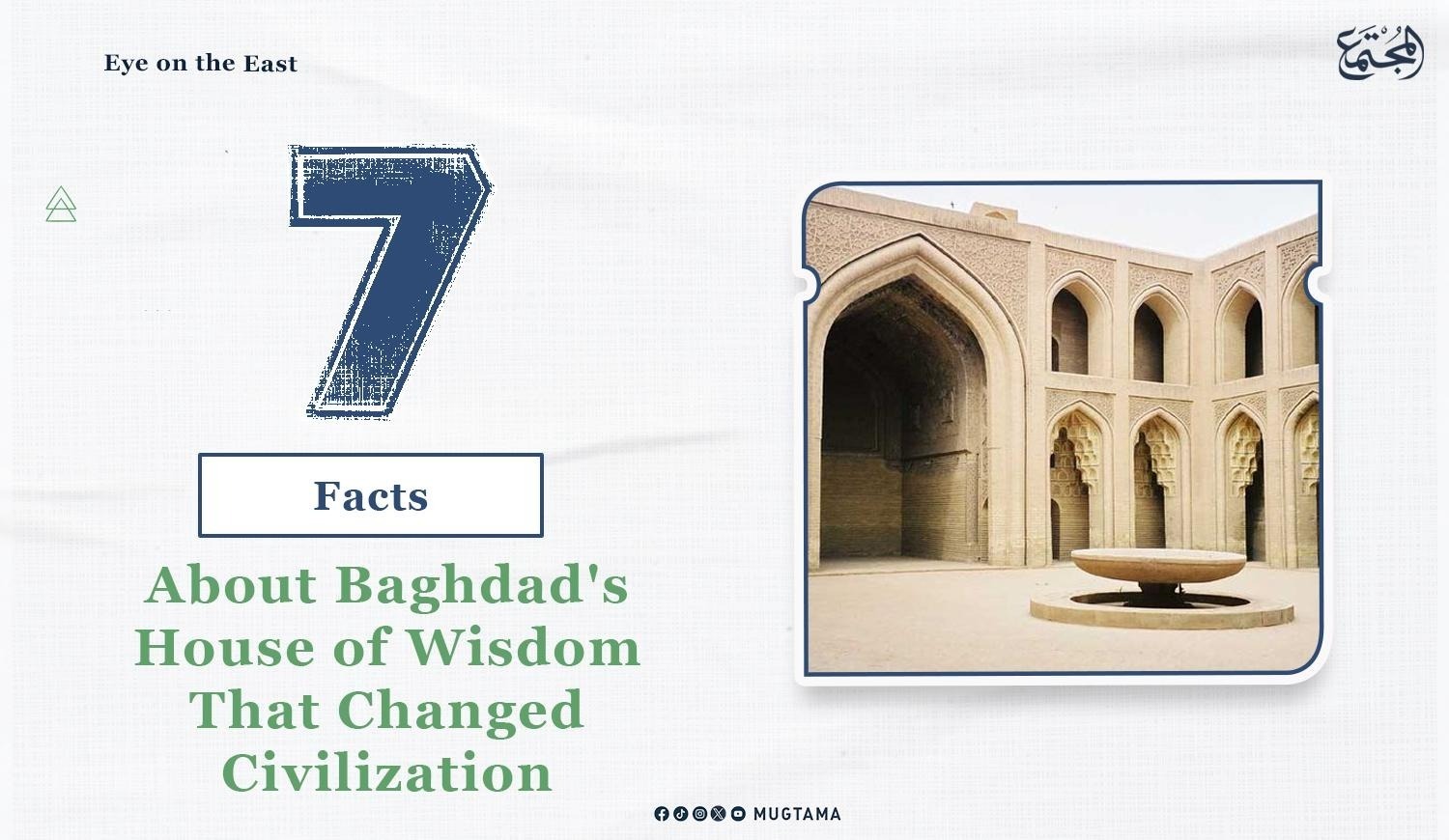
The House of Wisdom in Baghdad was not merely a library
housing thousands of books, but rather a comprehensive scientific institution
that marked a turning point in the history of knowledge during the Abbasid era.
Established in the late 2nd century AH, specifically during the reign of Caliph
Harun al-Rashid, and reaching its zenith under al-Ma'mun, it became a hub for
translating Greek, Persian, and Indian sciences, as well as a meeting point for
scholars, translators, and researchers in medicine, mathematics, astronomy, and
philosophy. This is evidenced by the works of biographers and
bibliographers—chief among them Ibn al-Nadim’s Kitab al-Fihrist—alongside
dozens of scientific manuscripts preserved from that era bearing the names of
scholars linked to this renaissance, such as al-Khwarizmi and the Banu Musa
brothers. The mission of the House of Wisdom was not limited to preserving
human heritage; it also witnessed the production of new knowledge that
contributed to the advancement of algebra, astronomy, geometry, and medicine.
These contributions were later transmitted to Europe through the Latin
translation movement, forming part of the bedrock upon which the Scientific
Renaissance was built. In this article, we review the most prominent documented
facts about the House of Wisdom and how it transformed from a scientific
institution in Baghdad into one of the most influential centers in the history
of human civilization.
Below, we review 7 documented facts about the House of Wisdom
in Baghdad, and how it contributed to shaping the features of human
civilization.
1.
Founding Date: Historical Debates on Origins and Early Patrons
The emergence and establishment of the "House of
Wisdom" (Bayt al-Hikmah) in Baghdad is considered one of the most
debated issues among classical historians and modern scholars in the history of
Islamic civilization. This debate stems primarily from the nature of early
Islamic historical references, which did not dedicate specific volumes to the
history of scholarly institutions. Instead, they mentioned the House of Wisdom
in scattered contexts within scholars' biographies, accounts of caliphs, and
records of translation movements.
Historians and researchers are divided regarding the first
founder of the House of Wisdom into three main perspectives:
First View: Establishment during the Reign of
Abu Ja'far al-Mansur (136–158 AH / 754–775 CE)
Proponents of this view maintain that the initial nucleus of
the House of Wisdom was formed alongside the construction of Baghdad (the City
of Peace). Al-Mansur designated a private repository within his palace (Qasr
al-Khuld, the Palace of Eternity) to collect books and manuscripts translated
or acquired from Persian, Greek, Syriac, and Indian sources.
- Ibn al-Nadim’s Account: Ibn al-Nadim
notes in Kitab al-Fihrist that Caliph al-Mansur was the first to take an
active interest in translating ancient sciences, bringing in physicians,
astrologers, and astronomers (such as Naubakht the Persian, Ibrahim
al-Fazari, and Jurjis ibn Bukhtishu).
- Diplomatic Acquisition: Historical
sources record that al-Mansur dispatched envoys and delegations to the
Byzantine Emperor requesting books of wisdom and science (such as Euclid’s
Elements in geometry), which he preserved in the private palace library.
Nature of the Institution at the Time: It was essentially a
"Royal Library" attached to the palace, largely restricted to the
private use of the Caliph and his inner circle of scholars and astrologers.
Second View: Establishment during the Reign of
Harun al-Rashid (170–193 AH / 786–809 CE)
A broad spectrum of historians (including Dr. Gurgis Awad and
Dr. Shawqi Dayf) maintains that Harun al-Rashid was the true founder of the
"House of Wisdom" as an institution with a distinct administrative
framework independent of the palace, and that the name itself was coined during
his reign.
- Conquest Manuscripts &
Yuhanna ibn Masawayh: Historians record
that after conquering certain Byzantine cities (such as Ankara and Dabra),
al-Rashid appointed Yuhanna ibn Masawayh to head a committee tasked with
translating, cataloging, and preserving the acquired manuscripts in a
dedicated center in Baghdad named the "House of Wisdom."
- Barmakid Patronage: Ibn Juljul notes in Tabaqat al-Atibba'
wa-al-Hukama ("Generations of Physicians and Sages") that
the Barmakid viziers during al-Rashid's era—most notably Yahya ibn Khalid
al-Barmaki—actively sponsored the translation movement, employed
translators, expanded the library's facilities, and opened them to
scholars.
- First Administrative Title: The official title "Sahib Bayt
al-Hikmah" (Director/Keeper of the House of Wisdom) appeared for
the first time in historical records dating to al-Rashid's reign, notably
referring to Aban al-Lahiqi, who was entrusted with cataloging and
preserving the manuscripts.
Third View: Establishment and Academic Zenith
during the Reign of al-Ma'mun (198–218 AH / 813–833 CE)
A third group of historians posits that what existed prior to
al-Ma'mun was merely a collection of book repositories (Bibliotheca),
and that the "House of Wisdom" in its comprehensive academic sense—as
a scientific academy, astronomical observatory, translation center, and scribal
guild—was fully realized only under Abdullah al-Ma'mun.
- Al-Qifti’s Account: In Ikhbar
al-'Ulama' bi-Akhbar al-Hukama' ("History of Sages and
Scholars"), Ibn al-Qifti details at length how al-Ma'mun transformed
the House of Wisdom into the world's premiere scientific institution. He
dispatched scientific expeditions to Constantinople—led by figures like
al-Hajjaj ibn Matar and Matar ibn Yunus—to collect foundational Greek and
Roman manuscripts.
- Patronage and Funding: Ibn Abi Usaibi'ah
notes in 'Uyun al-Anba' fi Tabaqat al-Atibba' ("Lives of the
Physicians") that al-Ma'mun appointed Hunayn ibn Ishaq as head of the
translation bureau at the House of Wisdom, rewarding him with the weight
of translated books in gold.
- Construction of Observatories: Al-Ma'mun
established an astronomical observatory attached to the House of Wisdom at
Al-Shammasiyya in Baghdad, alongside another on Mount Qasiyun in
Damascus, to calculate the Earth's circumference and observe celestial
bodies.
2.
From Library to Academy: The Organizational Structure of the House
of Wisdom
The House of Wisdom evolved from a mere palace repository for
book preservation into the first integrated scientific complex in Islamic
history. It combined translation, research, scribal copying, and knowledge
preservation within a single institution, akin to modern scientific academies.
1. Administrative Structure and Functional
Departments
Sahib Bayt
al-Hikmah (Director of the Institution): Appointed directly by Caliphate
decree to oversee the institution's affairs. Among the most prominent figures
to hold this position were Sahl ibn Harun and Hunayn ibn Ishaq.
Translation and
Transliteration Bureau: Representing the beating heart of the House of
Wisdom, its operations were organized according to target languages:
- Greek: Hunayn ibn Ishaq, Ishaq ibn Hunayn, and
Qusta ibn Luqa.
- Syriac: Yuhanna ibn Masawayh.
- Persian: The Naubakht family (Banu Naubakht).
- Indian (Sanskrit): Kankah al-Hindi.
Copying, Revision,
and Binding Department: Responsible for copying manuscripts, proofreading,
bookbinding, and manuscript conservation to ensure knowledge preservation and
dissemination.
Paper Manufacturing Workshops: Supplied the necessary paper and tools to sustain the
translation and copying movement following the widespread adoption of
papermaking technology in Baghdad.
2. Scientific Facilities
- The Astronomical
Observatory: Established by
al-Ma'mun at Al-Shammasiyya, this facility witnessed the landmark
astronomical observations of al-Khwarizmi and Sanad ibn Ali, including
revisions of Ptolemy’s Almagest and calculations of the Earth's
circumference.
- Medical and Chemical Laboratories: Utilized for testing pharmaceuticals,
compounds, and chemical substances prior to documenting them in medical
treatises.
- Debate and Lecture Halls: Hosted scholarly assemblies and debates
among academics to discuss pressing questions in medicine, philosophy, and
mathematics, as well as to review newly completed translations.
3.
Organized Translation: Knowledge Transfer Across Languages
The translation movement at the House of Wisdom was neither an
isolated individual endeavor nor a literal transposition of texts. Rather, it
was an organized scientific project relying on a rigorous methodology to
transmit knowledge from Greek, Syriac, Persian, and Sanskrit into Arabic—which
subsequently became the universal language of science in the Islamic world.
1. Source Languages and Specialized Disciplines
- Greek: Translation of seminal works in medicine,
philosophy, geometry, and astronomy, including the writings of Euclid,
Ptolemy, Galen, and Aristotle.
- Syriac: Functioned as an essential intermediary
language, facilitating the transfer of Greek texts into Arabic.
- Persian (Pahlavi): Source for works on literature, history,
statecraft, and astronomy, most notably Kalilah wa-Dimnah.
- Sanskrit: Source for major treatises in mathematics,
astronomy, and medicine, foremost among them the Zij al-Sindhind
(derived from the Brahmasphutasiddhanta).
2. Mechanisms
and Methodologies of the Translation Movement
A. Manuscript Acquisition & Scientific Expeditions:
Abbasid caliphs dispatched scientific missions to
Constantinople and other cultural hubs to acquire primary manuscripts under the
supervision of leading translators such as Hunayn ibn Ishaq and al-Hajjaj ibn
Matar.
B. Evolution of Translation Methodologies:
Translators shifted away from word-for-word translation toward
dynamic sense-for-sense translation—a methodology pioneered and perfected by
Hunayn ibn Ishaq—focusing on accurately capturing the conceptual meaning in
refined Arabic.
C. Textual Criticism and Recension:
Translators routinely engaged in collation, comparing multiple
copyists' exemplars of a single manuscript to correct scribal errors and
establish a critical base text before initiating translation.
D. Coining Scientific Terminology:
Scholars at the House of Wisdom developed standardized
terminology through transliteration (ta'rib) of specialized loanwords and
morpho-semantic derivation (ishtiqaq) from Arabic roots, laying a firm
linguistic foundation for Arabic scientific prose.
4. Financial Infrastructure: Abbasid Sponsorship of Research and
Translation
1. Sources of Financial Support
The House of Wisdom relied on diverse revenue streams that
ensured its sustainability and sustained its scientific enterprise, chief among
which were:
- The State Treasury (Bayt al-Mal):
The state allocated a dedicated portion of its public revenues to fund the
stipends of scholars and translators, procure rare manuscripts, and supply
parchment, paper, and scientific apparatus.
- Scientific Endowments (Awqaf):
Caliphs, princes, and elites established charitable endowments—involving
agricultural lands, real estate, and commercial markets—whose proceeds
were permanently earmarked for manuscript acquisition, facility
maintenance, and student stipends.
- Patronage and Private Wealth: Caliphs
and high-ranking viziers, such as al-Rashid, al-Ma'mun, and the Barmakids,
committed substantial personal funds to commission translation projects,
sponsor field research, and underwrite scientific expeditions.
2. Domains of Expenditure
- A. Translation Commissions and Bounties:
Al-Ma'mun became legendary for offering immense remuneration
to translators; historical accounts record that he rewarded select scholars
with the weight of their translated manuscripts in gold, elevating both the
prestige of translation and the societal standing of science.
- B. Scholarly Stipends:
The state provided generous monthly stipends to researchers,
astronomers, physicians, and polymaths—such as the Banu Musa brothers—allowing
them to dedicate themselves entirely to research, experimentation, and original
authorship.
- C. Funding Scientific Expeditions:
The Caliphate financed international delegations to collect
manuscripts from Byzantium and Persia. Furthermore, it underwrote major field
projects, including the geodesy expedition dispatched by al-Ma'mun to measure
the Earth's circumference.
5. Patrons and Scholars: Between Public Access and Elite Exclusivity
One of the central questions surrounding the House of Wisdom
concerns the nature of its clientele: Was it open to the general public, or was
access restricted strictly to a scholarly elite? Historical sources indicate
that it was neither a public library in the modern sense nor an entirely closed
institution. Instead, it operated under a regulated access system tailored to
its specialized research function.
1. Access to Knowledge at the House of Wisdom
- Public Libraries and
Mosques: These institutions were
open to the general public for reading, study, and religious instruction.
- The House of Wisdom: As a state-sponsored research institution,
access was primarily restricted to qualified scholars, translators, and
subject-matter specialists.
This regulated access policy was driven by three main
considerations:
1.
Protection
of Rare Manuscripts: Safeguarding valuable,
unique, and fragile primary texts.
2.
Specialized
Scientific Infrastructure: Managing advanced
facilities and delicate equipment that required technical expertise.
3.
Academic
Prerequisites: Requiring a baseline of academic
qualification to utilize its specialized collections and instruments
effectively.
2. Categories of Visitors and Staff
- A. Scholars and Translators:
Prominent figures such as Hunayn ibn Ishaq, al-Khwarizmi, the
Banu Musa brothers, al-Kindi, and Yuhanna ibn Masawayh. They spearheaded
translation initiatives, authored original scientific works, and directed
research projects.
- B. Advanced Scholars and
Students:
Granted permission to consult and copy manuscripts, attend
scholarly councils, and participate in academic debates, often receiving
institutional support.
- C. Caliphs and Senior State
Officials:
Visited to inspect ongoing scientific endeavors and consult
specialized knowledge pertinent to state administration, cartography, and
astronomy.
- D. Scribes, Bookbinders, and
Artisans:
Responsible for manuscript copying, bookbinding, document
restoration, and paper manufacturing, ensuring the preservation and physical
production of scholarly works.
6. Key Figures: Pioneers of
Mathematics, Astronomy, and Medicine
1. Pioneers of Mathematics and Algebra
Muhammad ibn Musa al-Khwarizmi:
Supervised the library repositories and the astronomical
observatory. He authored Kitab al-Jabr wa-l-Muqabala ("The
Compendious Book on Calculation by Completion and Balancing"), which
established algebra as an independent mathematical discipline. He also
popularized the Hindu positional numeral system and zero; his name became the
etymological root for the word Algorithm.
2. Pioneers of Geometry and Mechanical
Engineering
The Banu Musa
Brothers (Banu Musa ibn Shakir):
Authored Kitab al-Hiyal ("The Book of Ingenious
Devices"), detailing over one hundred mechanical contraptions. They
pioneered key principles in applied geometry, early automation, and
self-regulating machinery.
3. Pioneers of Astronomy and Cartography
Sanad ibn Ali and al-'Abbas ibn Sa'id al-Jawhari:
Directed al-Ma'mun's observatories, participating in the
historical measurement of the Earth's circumference, the compilation of
astronomical tables (Zij), and the refinement of observational
instruments.
4. Pioneers of Medicine and Pharmacology
Yuhanna ibn Masawayh:
Supervised the translation of medical treatises and educated
clinical practitioners. He made original contributions to ophthalmology and
experimental pharmacology.
Hunayn ibn Ishaq:
Head of the medical translation bureau, he rendered the works
of Galen and Hippocrates into Arabic. He authored The Ten Treatises on the
Eye, which served as a foundational ophthalmological reference for
centuries.
5. Philosophy and Cryptanalysis
Ya'qub ibn Ishaq al-Kindi:
Synthesized philosophical enquiry with exact sciences and corrected
prior translations. He is widely credited as the pioneer of frequency analysis
in cryptanalysis—laying the conceptual framework for modern cryptographic
techniques.
7. The Fall: Destruction and
Aftermath of the 1258 Sack of Baghdad
The fall of the House of Wisdom in 656 AH / 1258 CE at the
hands of the Mongols, led by Hulagu Khan, is regarded as one of the greatest
cultural catastrophes in human history. It resulted not only in the collapse of
the Abbasid Caliphate, but also brought to an end one of the world's most vital
centers of learning and scientific inquiry after nearly five centuries of
flourishing.
1. The Destruction of the House of Wisdom
Upon entering Baghdad, the Mongols laid waste to the House of
Wisdom and other major libraries. The tragedy encompassed:
- Incineration and Looting of
Manuscripts: Thousands of rare
texts and original translations compiled and authored over centuries were
permanently lost.
- Desecration of Texts in the
Tigris: Historical accounts record
that vast quantities of manuscripts were dumped into the Tigris River, to
the extent that its waters reportedly ran black with ink.
- Loss of Intellectual
Capital: Great numbers of scholars,
translators, and scribes were killed or dispersed. Those who survived fled
to Syria and Egypt, triggering a severe decline in Baghdad's academic
activity.
2. Historical Accounts and Primary Testimonies
- Ibn Kathir (Al-Bidayah
wa-l-Nihayah): Notes that the death
toll exceeded 800,000, explicitly recording that so many books were cast
into the Tigris that the river's waters turned black from the sheer volume
of ink.
- Ibn Khaldun (Al-Muqaddimah): Characterized the destruction of these
scientific works as one of the most devastating losses suffered by Islamic
civilization.
- Ibn Taghribirdi (Al-Nujum
al-Zahirah): Documented the
systematic destruction of libraries and the casting of irreplaceable
manuscripts into the Tigris.
The fall of the House of Wisdom in 656 AH was a civilizational
assassination—a tragedy that did not merely afflict Baghdad, but inflicted
severe harm upon human heritage as a whole. Nevertheless, the knowledge that
had trickled from the House of Wisdom during preceding centuries into Andalusia
and Sicily—and subsequently crossed into Europe—had already fulfilled its
seminal role. It ultimately provided the vital spark that ignited the European
Renaissance.
