









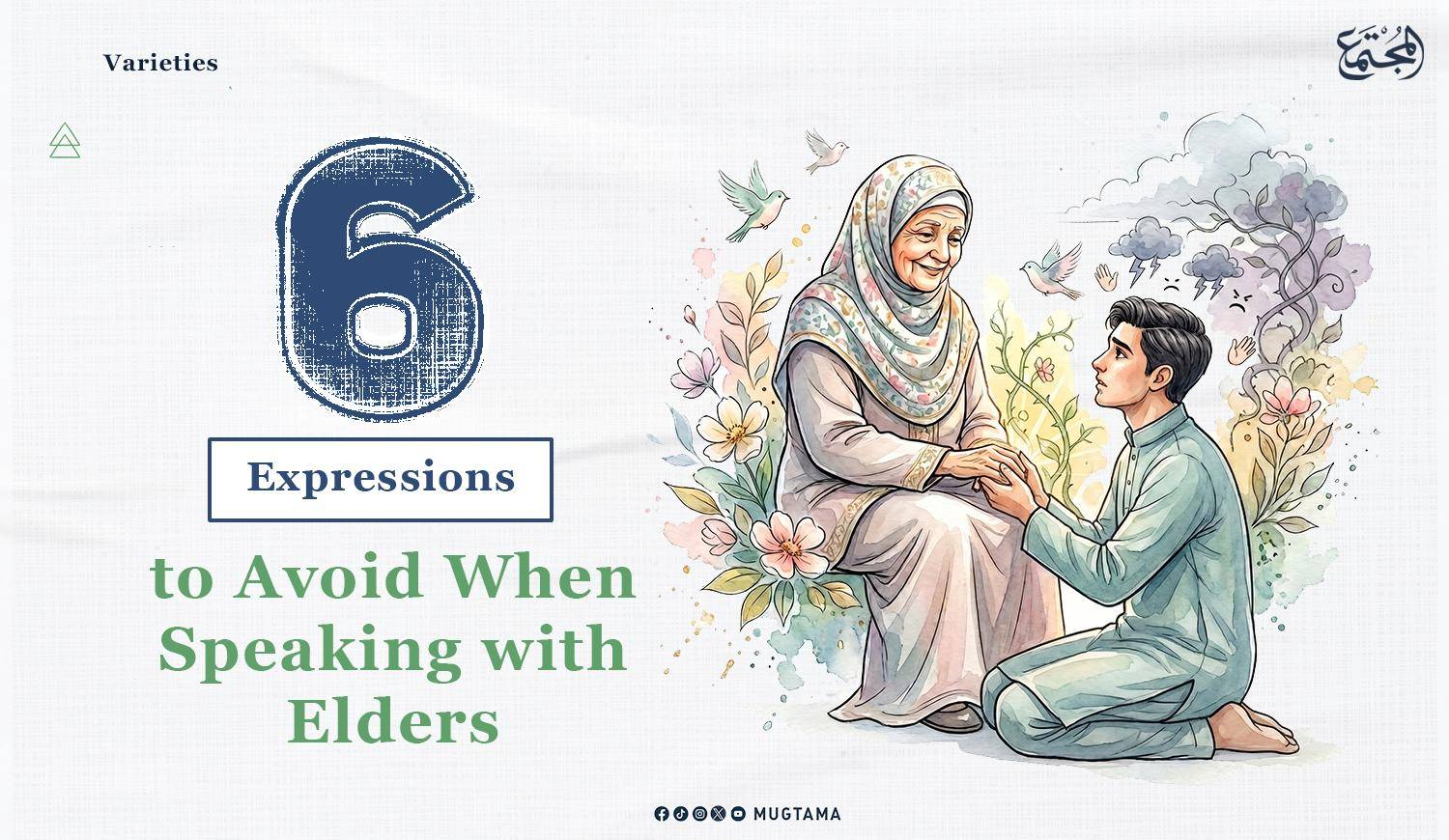
6 Expressions to Avoid When Speaking with Elders
When a person
enters old age and joins the category of the elderly, they are often
accompanied by a sense of the nearness of the end and the approach of leaving
this world. This feeling is reflected in their physical, psychological, and
mental state.
In this
context, elderly people may begin to use certain expressions that reflect the
stage of aging and their view of life and the future. The latter may no longer
be present in their minds, which negatively affects their actions and
movements. This contrasts with the prophetic approach established by the
Prophet Muhammad, peace and blessings be upon him, when he said: “If the Final
Hour comes while you have a shoot of a plant in your hands and it is possible
to plant it before the Hour comes, you should plant it.” (Ahmad)
Experts affirm
that individuals who adopt positive perceptions of aging are more capable of
recovery, healing from illnesses, and maintaining physical activity, according
to Becca Levy, a public health and psychology researcher at Yale University in
the United States.
Recent studies
warn against using negative expressions or messages charged with the idea of an
ending, or the notion that aging means decline, inactivity, and the abandonment
of work, knowledge, and future achievement.
In other words,
thinking often becomes confined to the past, while the future fades from the
minds of older adults. Others may unintentionally reinforce this by repeatedly
using negative, sympathetic, and defeatist expressions that imply the nearness
of death, such as calling someone “an old man” or “an old woman,” and therefore
assuming they should not be asked to do anything, consulted, or involved in
interactive activities.
Scientific
studies also confirm that people who view aging positively may show lower rates
of cognitive decline associated with dementia, and some cognitive abilities may
even improve.
These lines
summarize six expressions with negative connotations that may affect older
adults, and it is better not to repeat or confront them with such phrases, even
casually.
First: Avoid saying, “You are too old for this,” because it
is a negative phrase that gives a person an excuse to stop practicing an
activity or trying something new. This can make older adults prisoners of a
mindset that limits their abilities and activities, according to Time
magazine.
Second: Be careful not to adopt the phrase, “I cannot learn
at this age,” as it hinders the acquisition of new skills. Learning does not
stop at a certain age, and the boundaries of knowledge are not tied to age. The
brain is capable of forming new neural connections at all stages of life.
Third: Some older adults use the phrase, “Things will only
get worse from now on,” assuming a continuous decline in health and mobility.
This negative belief may contribute to worse health outcomes, so it is
important to avoid a pessimistic outlook on aging and to engage with life
positively.
Fourth: The imposition of an age-based rule such as “That is
not suitable for your age” creates a rigid stereotype about what a person can
or cannot do at each stage of life. This limits curiosity, experimentation, and
learning. Older adults may have passions that only need encouragement to
restore energy and vitality.
Fifth:
Another negative phrase often directed at older adults
is, “Are you still working?” This carries an implication that older people are
not capable of working, even though working in later life can give a person
great meaning and value, and allow them to contribute to society rather than be
a burden.
Sixth: The expression “an old-age lapse” is often used when
someone forgets something or makes a small mistake. However, forgetfulness can
occur at any age and may also affect young people in early adulthood, not only
the elderly.
Language is a
means of expression, but it is also a fundamental factor in shaping the human
experience of aging. Therefore, older people should be given positive
expressions that reinforce a healthy view of age, affirming that old age is not
an obstacle to life.
Read Also:
-
5 Ways to Care for Your Grandparents in Islam
-
'Elder abuse constitutes violation of right to life'
-------------------------------------------------------------