




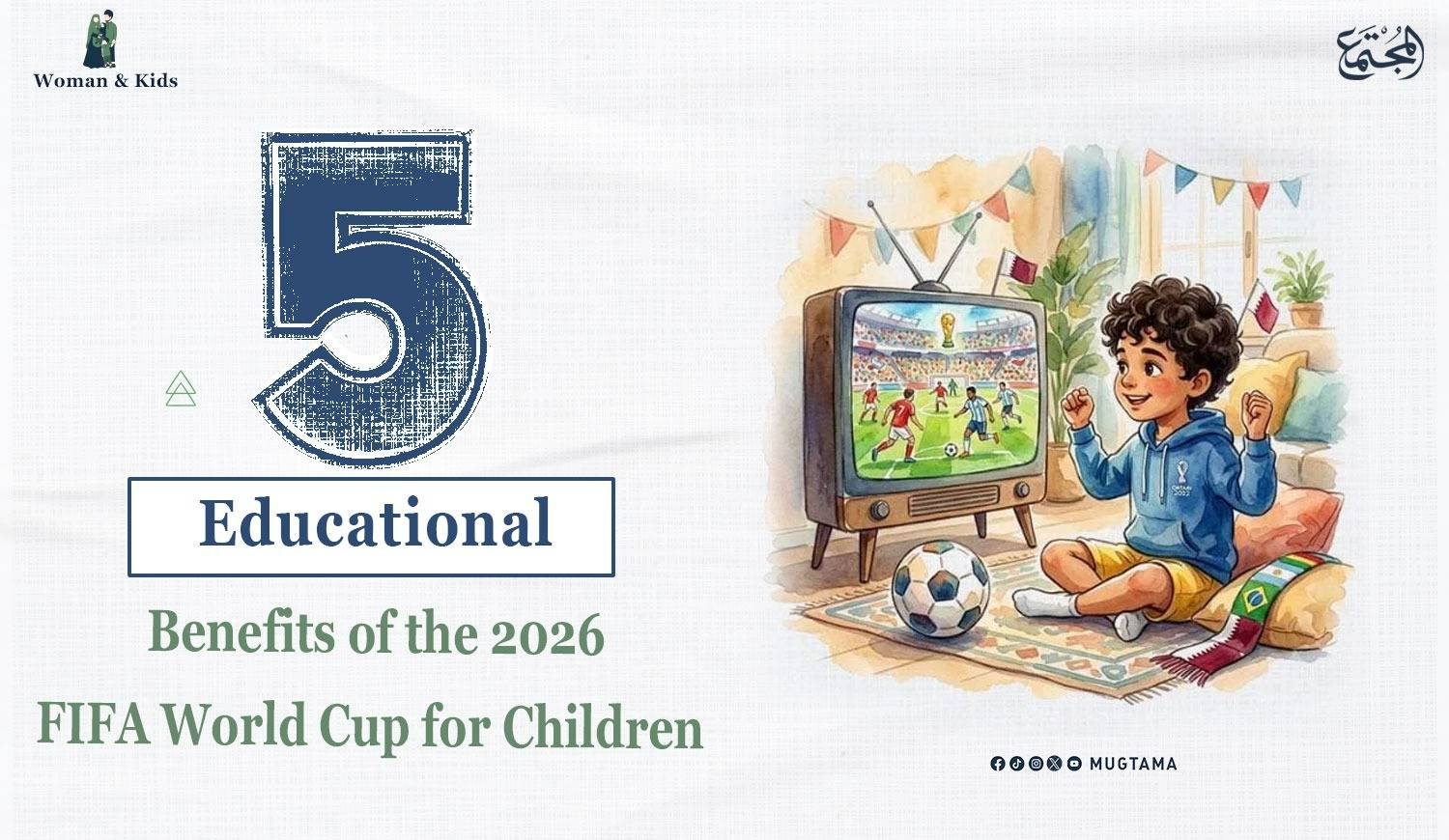
5 Educational Benefits of the 2026 FIFA World Cup for Children
The 2026 FIFA World Cup, hosted by the
United States, Canada, and Mexico, provides an ideal opportunity to benefit
from the tournament educationally, culturally, and developmentally by using it
as a valuable learning experience for children.
For the first time in World Cup
history, the tournament features 48 national teams instead of 32. The teams are
divided into 12 groups and will compete in a total of 104 matches over the
course of 39 days, making it the longest FIFA World Cup ever held.
The tournament is scheduled to
conclude on Sunday, July 19, with the final match taking place at New York New
Jersey Stadium in the United States.
The FIFA World Cup is far more than
sporting entertainment. It offers a broad window into geography, history,
participating nations, and the opportunity to become familiar with the cultures
of peoples and civilizations from around the world.
Have you ever considered
using the World Cup as a parenting and educational tool?
Here are five educational benefits
every parent can take advantage of.
1. Teaching Geography and
Expanding General Knowledge
The FIFA World Cup offers a rich
educational opportunity to introduce children to geography, the names of
countries, their flags, their locations on the map, their capitals, and their
official languages.
Parents can also share a brief
introduction to each country, including its political, economic, and military
significance, population size, the percentage of Muslims living there, and when
Islam first reached that nation.
This provides children with a broad
foundation of general knowledge while making learning enjoyable and engaging.
2. Developing Math Skills
Through Football
The World Cup can also be used to
strengthen children’s mathematical abilities.
Player numbers, match duration, added
time, goal differences, tournament standings, and other details of the game
provide practical opportunities to teach basic arithmetic skills such as
addition and subtraction in an enjoyable, real-life context.
3. Building Mental
Resilience and Teamwork
The tournament provides an excellent
opportunity to teach children valuable life skills, including mental
resilience, teamwork, and accepting defeat gracefully.
Losing is not the end. Children can
learn that mistakes provide opportunities for growth, that setbacks can be
overcome, and that hope should be maintained until the very last match.
At the same time, they witness the
importance of cooperation, teamwork, and working together with others in order
to achieve success.
4. Encouraging Language
Learning Through Sports
A tournament held only once every four
years offers a unique opportunity to develop children’s language skills.
Parents can encourage children to play
the role of sports commentators, practice pronouncing players’ names in
English, learn simple phrases related to different countries, and become
familiar with their languages.
A child may become interested in
learning Spanish because of admiration for Spain’s national team, or German
after following Germany’s team, and so on.
Thus, children become motivated to
learn a second language while continuing to master Arabic.
5. Strengthening Creativity
and Cultural Identity
The World Cup can also help develop
children’s artistic abilities. They can draw and color the flags of the
participating countries while learning the meaning and symbolism behind each
color in the nation’s history.
Children can also draw famous
landmarks representing each country—for example, the Ka`abah when learning
about Saudi Arabia—while discovering facts about the Saudi national team, the
Kingdom’s flag, and the history of the Arabian Peninsula.
Likewise, they can learn about the
landmarks, history, and football teams of Qatar, Jordan, Iraq, Egypt, Tunisia,
Algeria, and Morocco as representatives of the Arab world in the FIFA World
Cup.
Such activities help strengthen
children’s connection to their homeland, deepen their appreciation of the Arab
world, and reinforce their sense of Arab identity.
-------------------------------------------------------------