









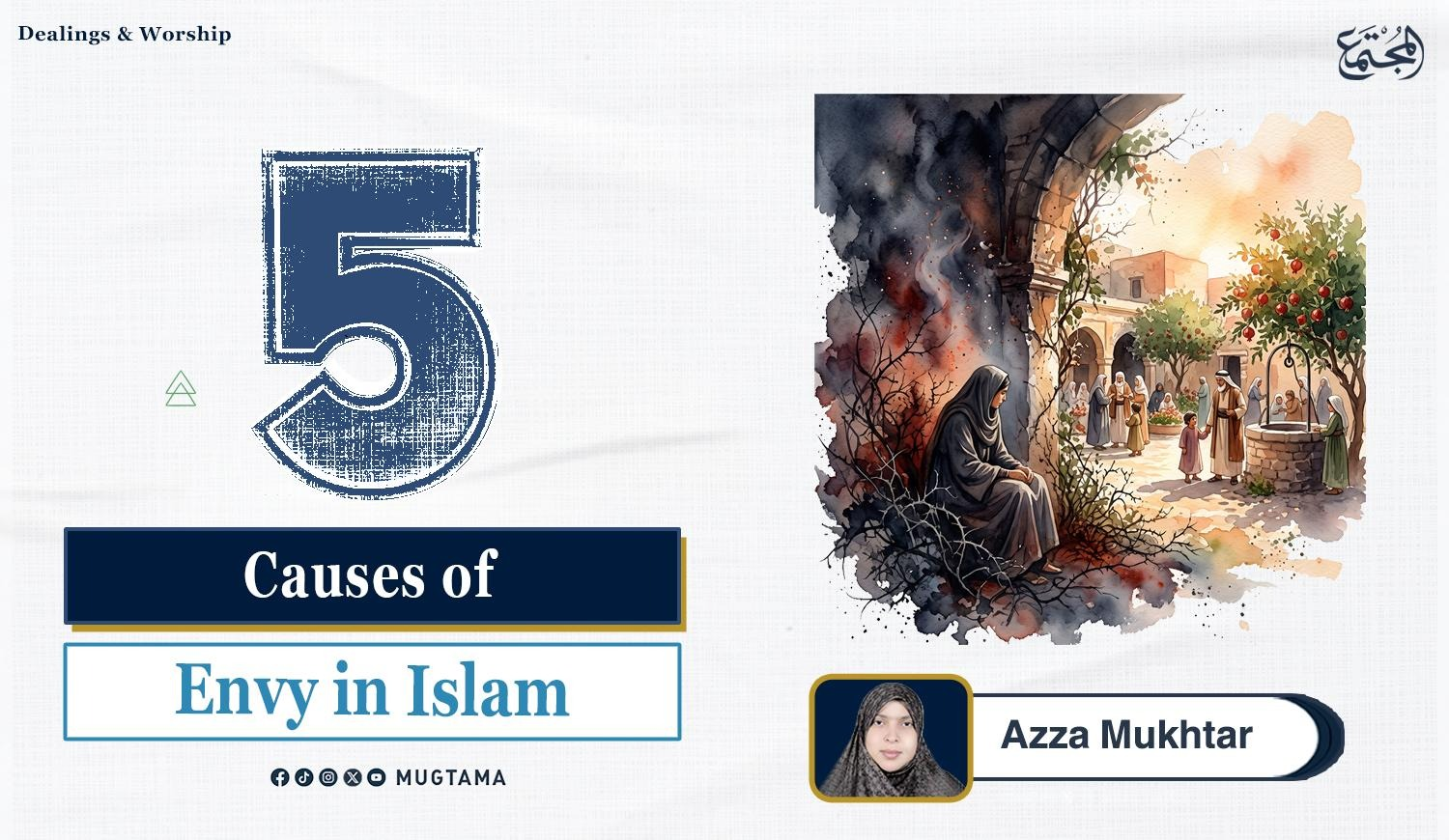
5 Causes of Envy in Islam
A person
does not necessarily have to wish for others to lose their blessings to be
envious. Someone may suddenly feel a passing sense of discomfort upon hearing
about a relative’s success, or experience a moment of unease when seeing a
friend achieve something they themselves have been unable to accomplish. A
quiet question may then arise within them: Why them and not me?
The Quran
reveals the hidden dimensions of envy in several places, linking it to
blameworthy traits such as transgression, hatred, resentment, and anger. Allah
says, {Even after the truth has become clear to
them, many of the People of the Book wish they could turn you back to disbelief
after you have believed, out of their selfish envy.} [Al-Baqarah 2:109]
The
Prophet Muhammad, peace and blessings be upon him, said: “And two will never be gathered in the heart of a salve:
Faith and envy.” (Narrated by An-Nasa’i)
So how
does this disease find its
way into a Muslim’s heart? And how does it manifest itself in harmful behavior
toward fellow Muslims?
How Envy
Takes Root in the Heart
1. When Comparing People’s
Provision Turns into Resentment
Not every
feeling of being wronged amounts to resentment. A person may genuinely suffer
injustice in the distribution of rights and become angry while defending what
is rightfully theirs. This is legitimate. The real problem arises when someone
compares their share with what others have received without any justifiable
reason.
This
pattern is clearly illustrated in the story of the brothers of Yusuf, peace be
upon him, when they said: {The
brothers said [to each other], ‘Although we are many, Joseph and his brother
are dearer to our father than we are} [Yusuf 12:8]
The
matter did not stop at accusing their father of unfairness. It escalated into
something far more dangerous: getting rid of the brother they believed had
monopolized their father’s affection. They said: {[One
of them said], ‘Kill Joseph or banish him to another land, and your father’s
attention will be free to turn to you.} [Yusuf 12:9]
This is
what comparisons can lead
to when consumed by the fire of envy: they end only when the person who
possesses the blessing is deprived of it.
2. When We See the Blessings
but Not What Lies Behind Them
Social
media has contributed to distorting our perception of reality by presenting
carefully selected, glamorous snapshots of people’s lives. One person posts
pictures of a wedding in a luxurious venue, another shows off an expensive car,
and a third boasts about a promotion and salary increase.
As
viewers scroll through these images, they may begin to feel dissatisfied with
their own lives, failing to see what lies behind the scenes. They do not see
the long nights spent studying, know about the sick child in that family, or
realize the marital conflicts that accompanied the pursuit of that promotion.
The Quran
points to the roots of this disease in Allah’s words: {Do
they envy [other] people for the bounty God has granted them?} [An-Nisa’ 4:54]
The
problem here lies in resenting the blessings Allah has bestowed upon others,
while failing to perceive the realities hidden behind their carefully
constructed appearances.
3. When Other People’s Success
Becomes a Threat to Our Status
This is a
common affliction among people working in the same field. When one person
excels and stands out, anxiety begins to spread among others who fear that
their colleague will take away their share of recognition, or attain a position
and praise from which they themselves will be excluded.
Imam
Al-Ghazali summarized this cause in Ihya’ Ulum Ad-Din (Vol. 3, p. 1688),
writing: “Fear of losing one’s objectives. This applies specifically to people
competing with one another for the same objective…”
He also
mentioned among the causes: “Love of leadership and the pursuit of status for
oneself… such as a man who wishes to have no equal in a particular field. If he
were to hear of someone equal to him, even in the farthest corner of the world,
he would be displeased and wish for that person’s death or the loss of their
blessing.”
This is
why the Prophet’s guidance was so precise when he said: “Two people only may be envied: a man to whom God has
given property, empowering him to dispose of it on what is right; and a man to
whom God has given wisdom who acts according to it and teaches it.” (Narrated by Muslim)
The
intended meaning of envy here is ghibtah: wishing to possess the same
blessing that another person has been given, without wishing for that person’s
blessing to be taken away.
4. When a New Blessing Revives
Old Hostilities
Time may
soften old disagreements, and those involved may even forget what originally
caused them. Yet when one of them receives a new blessing, buried resentment
can resurface. The envious person then begins searching for flaws and
shortcomings to diminish the other’s achievement, unable to bear seeing them
succeed.
Al-Ghazali
explains this, writing: “Hostility and hatred: this is the most powerful cause
of envy. When someone harms a person, that person’s heart comes to hate them
and becomes angry with them, and resentment takes root within them. Resentment
gives rise to the desire for gratification and revenge. If the one who hates is
unable to take revenge personally, they wish for time itself to take revenge on
the other person.”
Explaining
the relationship between resentment and envy, Allah says, {When they meet you, they say, ‘We believe,’ but when
they are alone, they bite their fingertips in rage at you. [Prophet], say, ‘Die
of rage [if you wish]!’ God knows exactly what is in everyone’s hearts. They
grieve at any good that befalls you [believers]} [Ali `Imran 3:119–120]
5. When Envy Turns into a
Desire to Gloat Over Others’ Misfortune
Envy may
remain hidden in the depths of the soul for a long time before erupting into
unjustified attacks on other people’s achievements. This may take the form of
questioning whether they deserve their success, tracking their mistakes, or
circulating distressing news about them out of sheer satisfaction at their
misfortune.
The Quran
describes this behavior, saying: {They grieve at
any good that befalls you [believers] and rejoice at your misfortunes.} [Ali
`Imran 3:120]
The
Prophet’s prohibition was unequivocal: “Do not
hate one another, nor be jealous of one another; and do not desert one another,
but O Allah’s worshipers! Be Brothers!” (Narrated by Al-Bukhari)
The fact
that the prohibition against envy is linked to the prohibition against hatred
and turning away from one another raises an important question about every
interaction and action: Am I genuinely seeking to set things right, or am I
looking for an opportunity to humiliate someone and undermine them?
The
remedy is not to close our eyes to other people’s blessings, but to reflect on
them fairly, ask Allah alone for His bounty, and focus on being grateful for
the blessings we already have, rather than exhausting our souls by constantly
watching what others possess.
-------------------------------------------------------------
