








5 Reasons for Envy Between Siblings
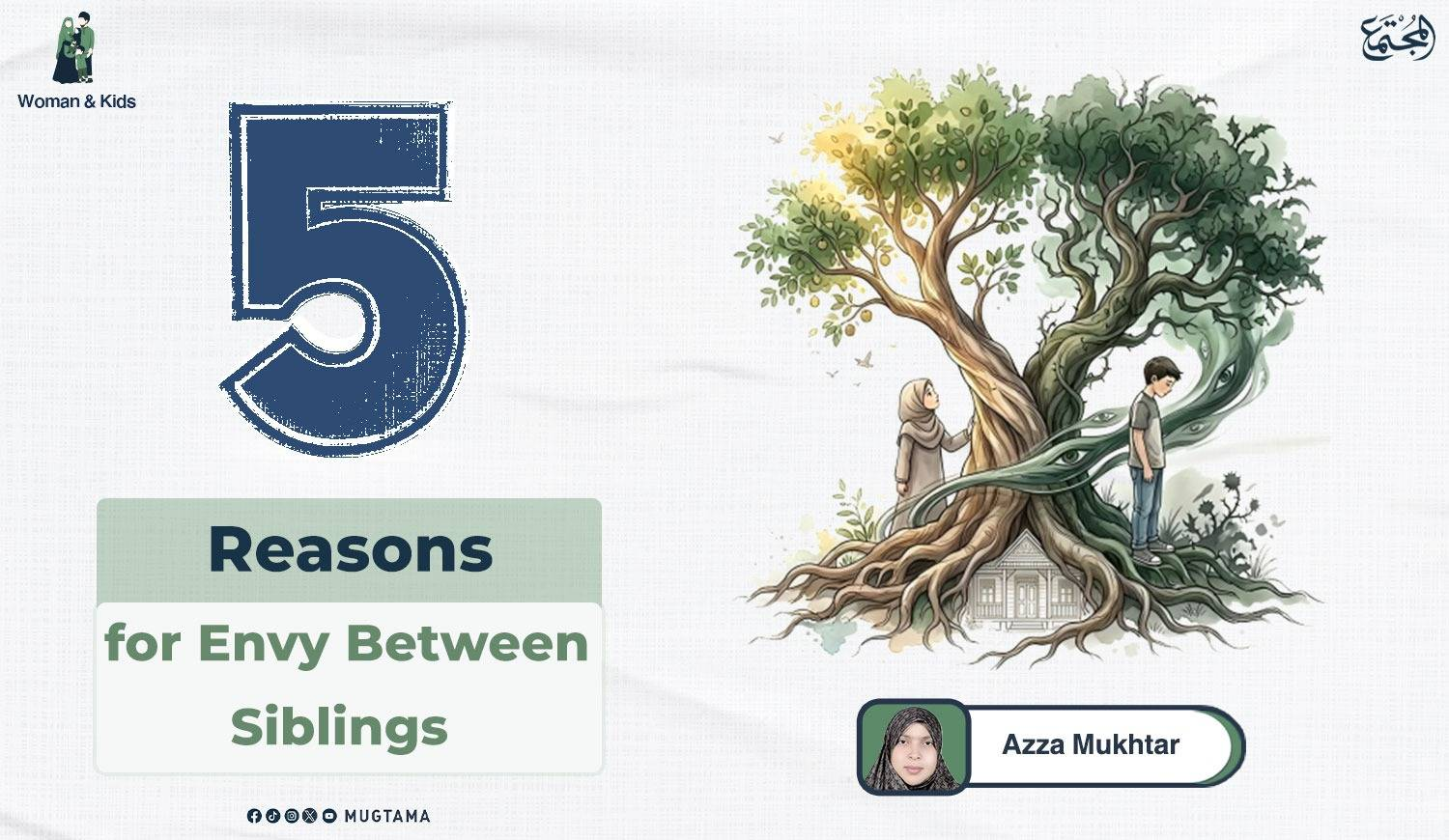
Bitter events sometimes take place
within the same family, among siblings who share the same bloodline, ate from
the same dish, and shared many human emotions, including joy, sadness, worry,
and need. They waited together for relief during the same hardship, and they
shared the sound of loud laughter when one of them experienced a moment of joy.
Then the years pass, and the disease
of conflict begins to creep in. Hearts change, comparisons and competition
emerge, and eventually hatred can develop when one finds himself envied by
those closest to him.
Human nature is such that Allah, the
Almighty, has decreed that people differ in their provisions. Some are wealthy
and others are poor; some are strong and others are weak; some are blessed with
beauty while others have less of it. Likewise, some are believers who receive
Allah’s decrees with contentment with His allocation, while others are
discontented and never satisfied.
Envy is a
disease that afflicts humanity regardless of time or social status. It may
begin with a feeling of injustice, deprivation, or distress over another
person’s blessing, or even with resentment over the way some parents treat one
child differently from another. But its end can be frightening.
What causes those closest
to a person’s heart to turn into enemies, carrying within themselves a fire
that is difficult to extinguish?
1. When a Child Feels That
a Sibling Is Favored
One of the most prominent stories that
the Quran presents on this subject appears in the surah of Yusuf. Allah, the
Most High, says, {˹Remember˺ when they said ˹to one another˺, “Surely Joseph and his brother ˹Benjamin˺ are more beloved to our father than we,
even though we are a group of so many. Indeed, our father is clearly mistaken.} [Yusuf 12:8]
It was a hidden feeling that one of
the children was being favored. The emotions developed from distress into envy,
and from envy into a desire to kill: {Kill Joseph
or cast him out to some ˹distant˺ land.}
[Yusuf 12:9]
One of the most dangerous things that
can enter a child’s heart and mind during childhood is the feeling that his or
her value in the eyes of the parents is far less than that of a sibling.
Parents may unintentionally show
favoritism toward one child over the others for reasons that the siblings do
not understand. Perhaps the child is weak, sick, more capable of expressing
affection toward the parents, an only boy among girls, or an only girl among
boys. As a result, parents may show that child some preferential treatment,
which can provoke resentment among the others.
The Quran reveals such feelings
through the experience of the sons of Jacob, peace be upon him, and how these
feelings turned them against their younger brother. Therefore, parents should
avoid anything that could fuel their children’s suspicions, even though it is
possible for a parent to feel greater affection toward one child than toward
his or her siblings. The danger begins when one child feels that his or her
value is far lower than that of the others.
2. The Harm of Constantly
Comparing Children
There is no doubt that parents love
their children to nearly equal degrees, even when one of them makes many
mistakes or puts forth little effort. A parent may reprimand such a child, but
the reprimand itself may come from love and concern for the child’s future.
Yet the fatal mistake parents can make
is constantly comparing one child with a sibling: Why can’t you excel like your
brother? Why don’t you listen to advice like your sister? Why can’t you behave
as politely as your brother?
They may go even further by rewarding
the supposedly better child in a way intended to spite the other. In this way,
resentment is planted between the siblings.
All these comparisons may be intended
to motivate a child to become better, but they can instead push the child
toward hating the sibling and harboring envy toward him or her. This is why
Islam categorically forbids envy and hatred, even when there are educational
and social factors that may contribute to them.
The Prophet, peace and blessings be
upon him, said: “Do not jealous of one another,
do not hate one another, and do not desert each other. And O, Allah’s
worshipers! Be brothers.” (Reported
by Al-Bukhari and Muslim)
3. Envy and Being
Discontent With Allah’s Decree
Not all people are the same. Even when
children are raised in the same home and receive the same degree of attention
and care, they differ in faith, understanding, comprehension, and provision.
The absence or weakness of faith may
be the fundamental cause of the disease of envy. One sibling may be blessed
with greater wealth after the children establish independent lives, another may
have a better spouse, a more spacious home, or children, while another may not
be blessed with them. One sibling may therefore feel distressed by the other’s
blessing and forget the blessings he or she already possesses.
This is the blameworthy envy that
Allah, the Almighty, has forbidden. He says, {Or do
they envy the people for Allah’s bounties?} [An-Nisa’ 4:54]
The Prophet, peace and blessings be
upon him, said: “Beware of envy because envy
consumes (destroys) the virtues just as the fire consumes the firewood.” (Reported
by Ibn Majah, with a good but unusual chain of transmission)
Therefore, the Prophet, peace and
blessings be upon him, warned against comparing one’s provisions with those of
others. He said: “Be satisfied with what Allah
has alloted for you and you shall be the richest of the people.” (Reported
by At-Tirmidhi)
There is a difference between envy and
wishing for a similar blessing without wanting it to disappear from another
person.
Ibn Mandhur says: “Admiration is when
a person sees another enjoying a good condition and wishes for himself a
similar good condition without wishing for that blessing to disappear from him.
If he asks Allah for something similar, he has followed what he was commanded
to do and what was approved for him. As for envy, it is when a person desires
to have what the envied person has and wishes for what that person possesses to
be taken away.” (Lisan Al-Arab, 7/359)
4. Competition Over Money
and Inheritance
Some people do not reveal their true
character until they are tested with money. A person may remain a loving
brother, exchanging visits with his sibling, until the effects of money begin
to surface when they disagree over an inheritance, a business they share, or a
project in which they disagree over one of its terms despite having previously
been cooperative and understanding partners.
How many homes were built on love and
warmth until a disagreement over money entered their lives and tore those
relationships apart, as though the people involved had never been brothers
before.
“You took more from our father.” “You
took the better share.”
In this way, brotherhood eventually
becomes nothing more than a brief statement whose meaning is clear: the envy
had been hidden all along, and the dispute merely brought it to the surface.
5. Accumulated Anger and
Failing to Address Problems
Small disagreements sometimes occur
between children. Later, when they grow older, those incidents may be
interpreted negatively, or they may be suppressed and brought up again in
adulthood after leaving behind layers of resentment and hidden bitterness.
With some people, these incidents pass
without leaving a lasting effect, particularly when the siblings blame one
another, or when parents intervene to reconcile them and the matter ends there.
With others, however, they leave a
profound impact. When such feelings accumulate without being addressed at the
time, and without resolving the cause of the sadness or anger, envy and hatred
can eventually grow from them.
Envy between siblings does not begin
with an obvious hatred that parents can see and address directly. Rather, it
may begin with a simple comparison in how
everyone is treated compared with their siblings, with a question asked
inwardly: Why is he not me?
Or it may begin with a feeling of
distress when a sibling succeeds or receives a blessing.
Therefore, protecting children from
envy and hatred must begin early, before the disease becomes severe and takes
hold of the heart.
It begins by ensuring fairness among
children, helping them learn from an early age to be content with what Allah has decreed for them, raising them to love good for their siblings, and
teaching them to share in one another’s joys and sorrows.
An envious person does not usually
choose a stranger to envy. More often, the object of his envy is someone
closest to him, while he wishes for that person’s blessing to disappear.
Protecting siblings from this disease
does not begin after it appears; it must begin long before it ever takes root.
-------------------------------------------------------------