








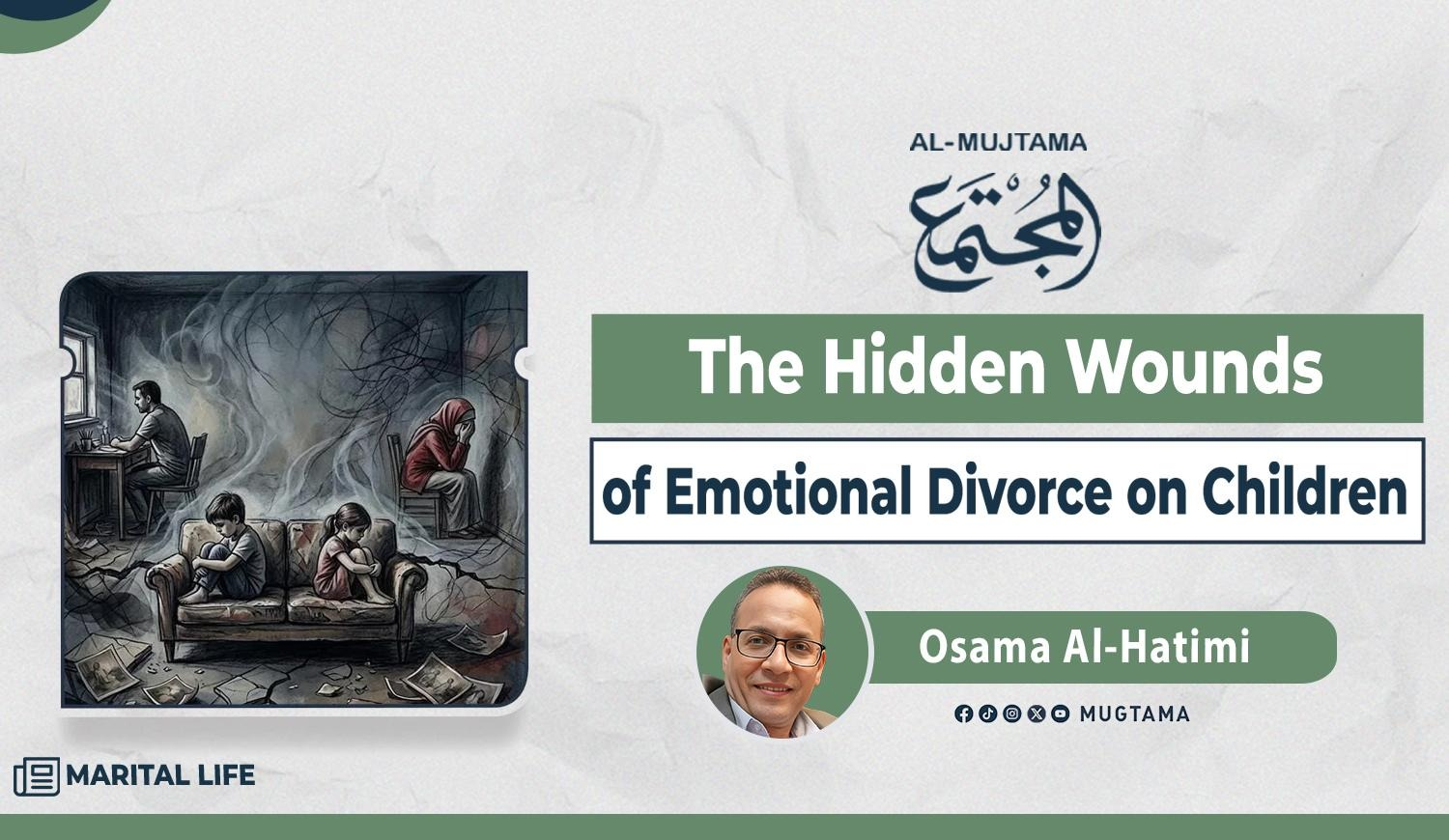
The Hidden Wounds of Emotional Divorce on Children
The psychological well-being of
children whose parents have divorced has received considerable attention,
leading to numerous studies on how to prevent or, at the very least, mitigate
the psychological impact on them. However, the psychological effects on
children whose parents have separated emotionally without obtaining a divorce
have not received the same level of attention or research.
There are, of course, objective
reasons for this, some social and others financial. Chief among them is the
difficulty of identifying cases of emotional separation, also known as
emotional divorce, and determining their prevalence. Such situations are often
kept secret to preserve the family’s social image.
Thus, beneath a roof that appears
peaceful on the surface but conceals suffering within, this silent separation
tightens its grip on the walls of the home. The marriage covenant, originally
intended to establish tranquility, affection, and mercy, is reduced to a mere
administrative document used to maintain appearances before society.
The parents’ apparent success in
deceiving those around them does not mean their children escape the price of
this pretense. This is precisely where the tragedy lies. Behind this
suffocating silence, children face psychological and behavioral dangers that
are no less severe than those associated with openly declared separation and
may even be deeper and more painful.
What Is Emotional Divorce, and How
Widespread Is It?
Although statistics issued by
ministries of justice and relevant authorities in Arab countries do not mention
the number of cases of emotional divorce, official statistics on legal divorce
reveal a troubling picture of family life.
In Kuwait, for example, reports from
the Ministry of Justice recorded more than 8,000 divorces in a single year,
representing approximately 40% of the total number of marriage contracts. In
Saudi Arabia, the General Authority for Statistics reported more than 50,000
divorces in one year, at a rate exceeding 160 cases per day. In Egypt, the
annual figure surpassed 260,000 cases, according to the Central Agency for
Public Mobilization and Statistics.
It is important to note that these
alarming figures represent only the final outcomes officially recorded in
court. The vast majority of these cases did not occur overnight. Rather, they
followed a longer and more complex period of emotional separation during which
the spouses attempted to preserve the outward appearance of a family, until
their efforts ultimately failed.
In this context, the connection
between publicly declared divorce and emotional divorce can be seen as an
indicator of an important reality: the number of people experiencing emotional
divorce is many times higher than the number of cases officially recorded. This
is where the danger lies. The home becomes a stage for muffled cries behind
closed doors, where children grow up amid a cold coexistence that has abandoned
the spirit of affection and mercy. They breathe in an oppressive silence and
suppressed tension that damage their psychological development even before an
actual divorce takes place.
Silent Wounds
The psychological harm experienced by
these children is a natural consequence of the complex reality in which they
live. In these homes, there are no divorce papers, no division of residence
between two households, and no need for children to move between their father
and mother according to familiar separation arrangements. Nevertheless, these
children may experience another form of separation. They witness a marital
relationship that has lost much of its meaning and find themselves in a family
that appears complete to outsiders but suffers from an emotional breakdown that
remains unacknowledged.
This is a painful paradox. When
children breathe air poisoned by silence and emotional coldness inside their
homes, their young minds cannot comprehend the parents’ justification for
preserving the family’s social image. Instead, they interpret this cold
atmosphere as a constant threat and develop an unjustified sense of fear.
Effects of a Cold Home on Children
Social studies and mental health
research in Arab societies have identified several psychological and behavioral
consequences of this emotionally cold environment for children. The most
prominent effects can be summarized as follows:
1. Chronic Anxiety and
Persistent Uncertainty
Studies on family mental health published
in the Arab Journal for Humanities and Social Sciences indicate that
continued cold coexistence leaves children in a state of constant anticipation
and distress because they do not understand the true nature of the relationship
between their parents. This differs from an openly declared divorce, which
gives children a clearer reality that they can gradually learn to navigate.
Emotional divorce, therefore, leaves
children suspended in an environment filled with ambiguity, generating
anticipatory anxiety and a persistent sense that their family’s security is
under threat.
2. Feelings of Guilt and Low
Self-Esteem
Specialized research suggests that
young children tend to interpret emotional distance and unspoken tension at
home as something that concerns them personally. A child may believe they are
directly responsible for their parents’ unhappiness or their oppressive
silence.
This belief can negatively affect the
child’s psychological development, fostering persistent feelings of guilt and
significantly undermining self-confidence and social adjustment.
3. A Distorted Family Model
and Insecure Attachment
A distorted understanding of family
life can contribute to the development of what is known as an insecure
attachment pattern. As adults, these children may either avoid marriage and
intimate commitment altogether or struggle to build and maintain healthy,
stable family relationships.
4. Social Withdrawal and
Behavioral Escapism
To escape the distress caused by
silence and suppressed tension at home, children often withdraw socially,
isolate themselves, or retreat excessively into screens and the virtual world.
In other cases, they may release their
pent-up emotional distress through aggressive behavior and angry outbursts
outside the home.
5. A Transactional View of
Marriage
A distorted understanding of family
life may also lead children to grow up believing that the relationship between
a man and a woman is merely a cold, utilitarian arrangement based on mutual
benefit.
This perception can hinder their
ability to build a successful marriage in the future, as noted by Dr. Mustafa
Hijazi in his study on the psychological effects of family conflicts.
6. Emotional Vulnerability,
Especially Among Adolescents
Emotional deprivation can leave children, particularly adolescents,
vulnerable and drive them to seek the warmth they lack at home through
relationships outside the family. Such relationships may prove emotionally,
psychologically, and behaviorally damaging.
7. Declining Academic
Performance
Dr. Mona Kashik, a professor in the
Department of Educational Foundations at the Faculty of Education at the
University of Damascus, notes that psychological divorce can cause children to
experience difficulty concentrating at school and a decline in academic
achievement.
How Can Parents Help Children Recover from
Emotional Divorce?
Faced with this painful psychological
reality, which children endure behind silent walls, two questions arise: How
can the psychological impact on children be reduced in the first place? And how
can emotional separation be contained before it becomes deeply rooted and more
severe?
The greater part of this
responsibility falls on the parents. Their success requires a courageous and
constructive approach that pursues two parallel objectives: immediate action to
protect their children’s mental health and a practical effort to repair the
marital relationship or bring it to an honorable resolution.
Several steps can help reduce the
psychological harm experienced by children. Parents should shield them from the
conflict and emotional distance between them and reassure them that they are
not responsible for the disagreements.
They should also ensure that children
are not placed in the role of mediator or messenger between their parents,
maintain a stable family routine, and provide an open, supportive environment
in which children can express their feelings. Specialized professional support
should also be sought when necessary.
At the level of the marital
relationship, spouses can work toward rebuilding communication and determining
the future of their relationship through honest conversations and courageous
self-examination.
This process may involve opening channels
of dialogue,
restoring trust, fostering warmth and closeness, seeking professional
counseling, and assessing whether both spouses genuinely wish to continue the
marriage. The role of institutions and the wider community should also be
strengthened to help address this issue.
-------------------------------------------------------------
