









Salat al-Hajah: 5 Reasons to Turn to Allah in Supplication
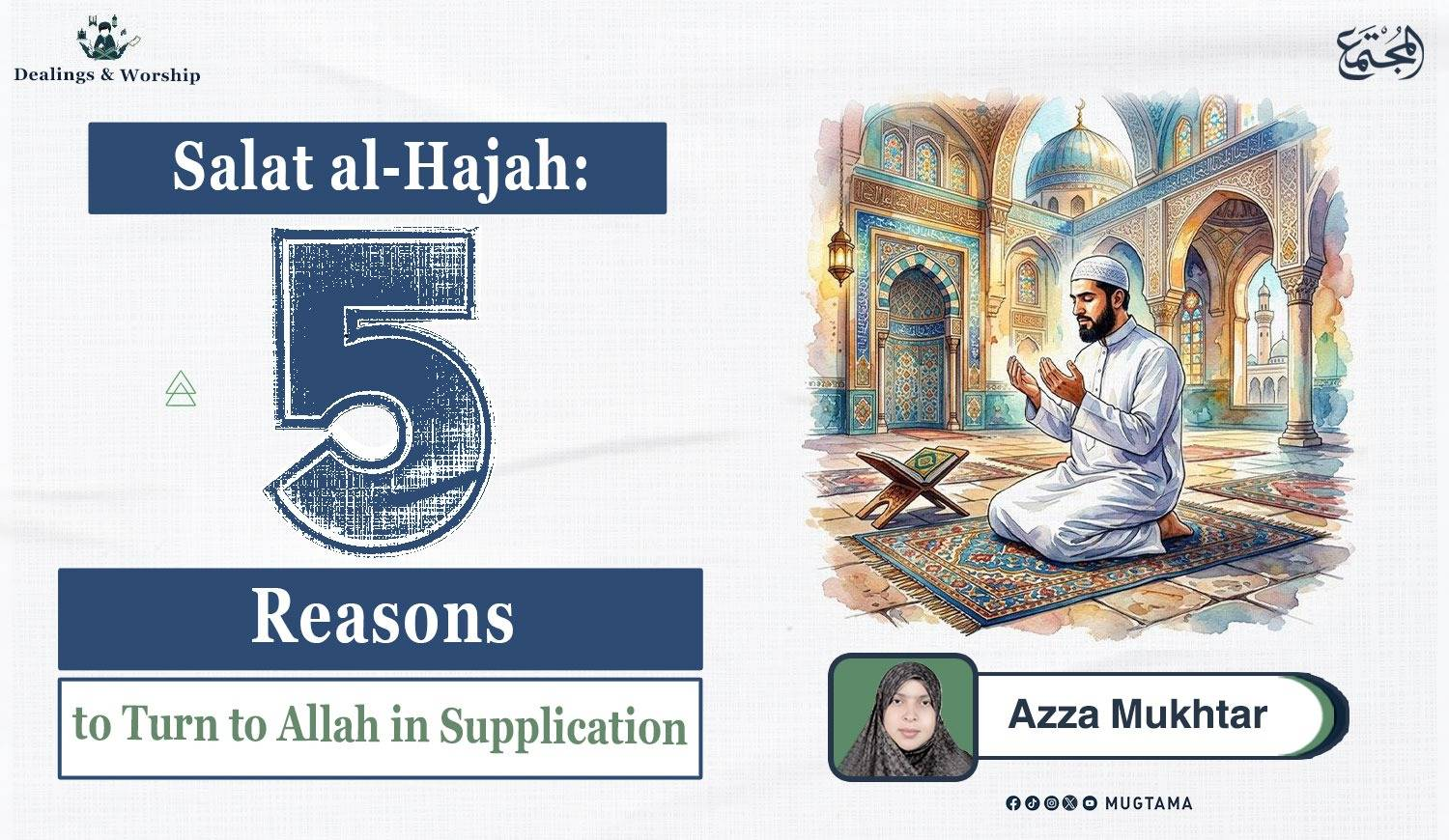
Supplication is not
merely a refuge when all options seem exhausted; it is an ongoing act of
worship and a strong bond between a servant and their Lord. Allah Almighty says, {When My servants ask you ˹O Prophet˺ about Me: I am truly near. I respond to
one’s prayer when they call upon Me.}
[Al-Baqarah 2:186]
The Prayer of Need in
Islam “Salat Al-Hajah”
The Prophet Muhammad, peace and
blessings be upon him, encouraged Muslims to increase their supplications while
prostrating in prayer. As for the narration concerning performing two rak`a of
prayer specifically to seek the fulfillment of a need, it was reported by `Abdullah
Ibn Abi Awfa, who said that the Messenger of Allah, peace and blessings be upon
him, came out to us and said: “Whoever has some
need from Allah or from any of His creation, let him perform ablution and pray
two Rak’ah, then let him say: La ilaha illallahul-Halimul- Karim. Subhan-Allahi
Rabbil-`arshil-`azim. Al-hamdu Lillahi Rabbil-`Alamin. Allahumma inni as’aluka
mujibat rahmatika, wa `aza’ima maghfiratika, wal-ghanimata min kulli birrin,
was-salamata min kulli ithmnin. As’aluka alla tada`a li dhanban illa
ghafartahu, wa la hamman illa farrajtahu, wa la hajah hiya laka ridan illa qadaitaha
li (None has the right to be worshipped but Allah, the Forbearing, the Most
Generous. Glory is to Allah, the Lord of the Mighty Throne. Praise is to Allah,
the Lord of the worlds. O Allah, I ask You for the means of Your mercy and
forgiveness, the benefit of every good deed and safety from all sins. I ask You
not to leave any sin of mine but You forgive it, or any distress but You
relieve it, or any need that is pleasing to You but You meet it). Then he
should ask Allah for whatever he wants in this world and in the Hereafter, for
it is decreed.” (Reported by Ibn Majah) (1)
There are five reasons why we should
turn to Allah Almighty in supplication when our options narrow and doors close
before us.
1. Your Need Reminds You Who
Has the Power to Fulfill It
Everyone faces hardships and needs at
some point in life. People may believe that fulfilling their needs depends on a
particular person, money they are waiting to receive, or a job that will
provide them with a good income. During every trial, their hearts may become
attached to the means while forgetting the One who creates and controls those
means.
The Quran comes to restore the proper
relationship in a Muslim’s heart, reminding them of the ultimate source of help. Allah Almighty says, {Who
responds to the distressed when they cry to Him, relieving ˹their˺ affliction...} [An-Naml 27:62]
This verse does not tell us to abandon
the means available to us. Rather, it reminds us that all matters ultimately
rest with Allah. A doctor may prescribe medicine, but healing comes from Allah.
2. You Do Not Have to Exhaust
Every Option Before Asking Allah
The Quran teaches us that a servant
should never feel embarrassed about asking their Lord for either small or great
things. Prophet Zechariah, peace be upon him, supplicated to Allah when he had
reached old age. The apparent limitations of his circumstances did not prevent
him from asking his Lord. Allah Almighty says, {My
Lord! Grant me—by your grace—righteous offspring. You are certainly the Hearer
of ˹all˺ prayers.} [Ali `Imran 3:38]
Prophet Zechariah did not say that all
the means had been exhausted and that there was no point in supplicating. A
servant should ask their Lord for every small and great matter that brings
goodness in this world and the Hereafter.
Ibn Rajab said: “Some of the Salaf
used to ask Allah for all their needs during prayer, even for the salt in their
dough and the fodder for their sheep.” (2)
3. Supplication Gives You
Strength When You Cannot Change Your Circumstances
In many difficult situations, a person
can adjust part of their plan to make up for what they have missed and correct
their course. In other situations, however, events move beyond their control.
At such times, supplication is not a sign of helplessness; rather, it is a
means of remaining steadfast.
Thus, supplication was present in the
lives of the prophets during their most difficult and distressing moments.
Prophet Yunus, peace be upon him,
turned to supplication and remembrance of Allah
while inside the belly of the whale: {There is no
god ˹worthy of worship˺ except You. Glory be to You! I have certainly done wrong.} [Al-Anbiya
21:87]
Allah answered his supplication and
rescued him from distress: {So We answered his
prayer and rescued him from anguish. And so do We save the ˹true˺ believers.} [Al-Anbiya 21:88]
These verses teach us the proper
etiquette of supplication. Prophet Yunus began by affirming the Oneness of
Allah, then declaring His perfection and transcendence, and finally acknowledging
his own shortcomings. This sequence reflects the state of heart that
accompanies supplication and helps provide the strength a person needs.
Therefore, the Prophet Muhammad, peace
and blessings be upon him, said: “The closest a
servant comes to their Lord is when they are prostrating, so increase your
supplications.” (Reported by Muslim)
4. A Delayed Answer Does Not
Mean Your Supplication Has Been Rejected
One of the most painful experiences
for a person is to supplicate for a long time for something they believe to be
good, only for it not to happen at the time they desire. Despair may then creep
into their heart, leading them to complain that their prayers have not been
answered and even to abandon supplication altogether.
The Prophet Muhammad, peace and
blessings be upon him, warned against impatience, saying: “The invocation of anyone of you is granted (by Allah) if
he does not show impatience (by saying, ‘I invoked Allah but my request has not
been granted.’)” (Narrated by
Al-Bukhari and Muslim)
A servant must not dictate to their
Lord the form an answer should take or when it should come. They do not know
whether what they are asking for is truly good for them. The servant
supplicates, while Allah responds according to His perfect prior knowledge of
what will benefit them.
5. Supplication Is an Act of
Worship Even Before the Answer Comes
The value of supplication is not
limited to obtaining what the person asks for in precisely the form they
desire. Allah Almighty says, {Your Lord has
proclaimed, “Call upon Me, I will respond to you. Surely those who are too
proud to worship Me will enter Hell, fully humbled.”} [Ghafir 40:60]
In this verse, supplication is
described as an act of worship, while turning away from it is an expression of
arrogance toward Allah.
When you raise your hands and
acknowledge your need for Allah, you are doing more than simply making a
request. You are engaging in a profound act of worship of the heart,
acknowledging your own neediness, affirming your Lord’s power, and abandoning
the illusion that you can do without Him.
------------------------------------------------------------
