







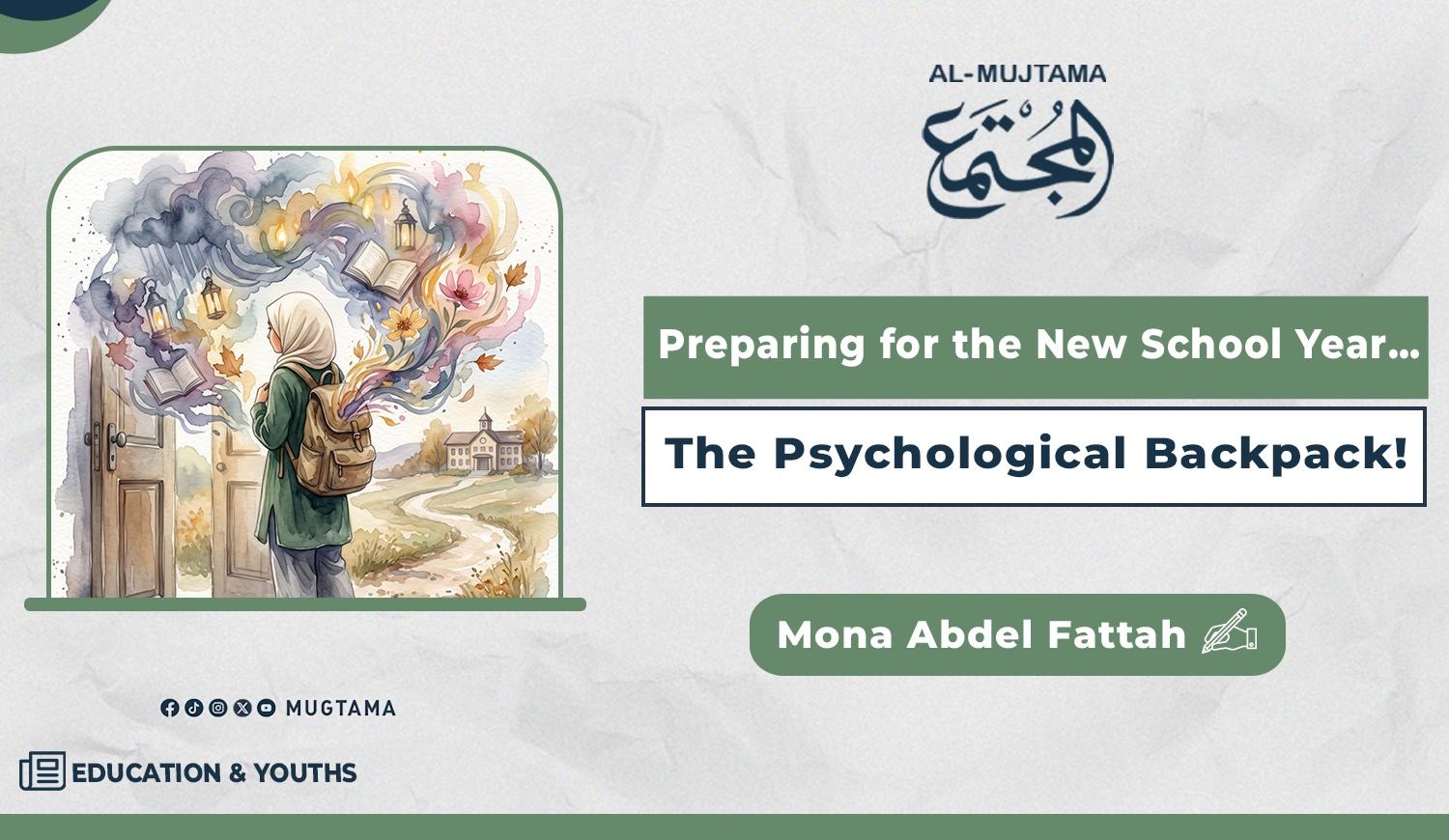
Preparing for the New School Year… The Psychological Backpack!
As the new
school year approaches, parents prepare their children for the journey ahead by
providing school bags, stationery, lunch boxes, uniforms, and all the other
material necessities and accessories they will need.
Of course, the
aim is to make the child’s return to school comfortable and enjoyable, yet this
often takes place within an increasingly materialistic and consumer-driven
culture that can overlook other, more urgent psychological and intellectual
needs. These, too, should have a place in what we might call the child’s
“psychological backpack.”
So let us ask
ourselves: Have we equipped our children with the skills they need to face the
challenges of the new school year?
What
Should the Psychological Backpack Contain?
The
psychological backpack helps protect children from the pressures and social
challenges they may encounter in the school environment. Its contents will, of
course, vary according to the child’s age and stage of development.
Studies
published by the American Psychological Association (APA) indicate that
academic performance pressures are among the leading sources of psychological
distress among students. So before you zip up your child’s school bag, make
sure you have also equipped them with the skills and abilities that will
strengthen their psychological and intellectual well-being and help them thrive
morally, educationally, and academically.
Among these
skills is preparing children to approach the academic year as a meaningful
journey, teaching them that seeking knowledge is an act of worship and a form
of striving for the sake of Allah, and that they should seek His reward through
their efforts. They should understand that increasing one’s knowledge can be
more virtuous than engaging in voluntary acts of worship, and that a single
person of deep religious knowledge can be more formidable to Satan than a
thousand devoted worshippers. In this way, children can grow into eager and
determined seekers of knowledge, carrying forward the legacy of a community
commanded to read and learn.
Abu Hurairah
and Abu Dharr reported: “A chapter of knowledge that one learns is more
beloved to us than a thousand voluntary rak`ahs, and a chapter of knowledge that one teaches,
whether acted upon or not, is more beloved to us than one hundred voluntary rak`ahs.” (Jami` Bayan Al-Ilm
wa Fadlihi by Ibn Abd Al-Barr)
The
psychological backpack should also contain resilience and the ability to
recover from setbacks. Children need to understand that grades are not the end
of the road, and that the true value of knowledge lies not merely in passing
periodic examinations, but in putting that knowledge into practice, using it to
benefit others, benefiting from it personally, and sharing it with people. The
pursuit of knowledge does not end when the school timetable ends. It is a
lifelong journey through which a person can eventually become a source of light
and knowledge for others.
Moral
Skills and Values
Within the
educational environment, children learn honesty, trustworthiness, respect for
teachers, respect for elders, appreciation of time, punctuality, communication
skills, the value of cooperation, and the importance of teamwork. They also
learn that cheating, bullying, mocking classmates, and damaging school property
are unacceptable. These are all essential lessons that should have a place in
every child’s psychological backpack.
Parents should
also teach their children how to build healthy friendships, how to choose good
friends, and how to compete with them honorably in the pursuit of knowledge.
They should encourage perseverance, striving together to do good, maintaining
regular congregational prayer, cooperating in righteousness and piety, and
working toward strong academic achievement.
Good conduct in
the school environment also means maintaining personal hygiene, appearing neat
and well-groomed, respecting the privacy and belongings of classmates, and
helping keep the classroom clean and pleasant. Children should learn the
importance of expressing gratitude and appreciation to school custodians,
greeting their teachers sincerely, understanding the value of discipline, and
respecting the rules and standards of the educational community.
Psychological
and behavioral research suggests that children who are encouraged to practice
gratitude and develop moral intelligence tend to report greater personal
happiness, gain greater social acceptance, and become less likely to engage in
aggressive behavior.
Accumulated
Knowledge and Life Experience
The
psychological backpack may ultimately be more important than the school bag
itself. Its purpose is not simply to ensure that a child returns home with
perfect grades, although that is certainly a worthy and desirable goal. The
goal of a Muslim family is for the child to return with a balanced personality,
a more mature mind, and a growing awareness of the world around them. Families
build character and develop minds, not merely bodies.
We want a child
who is intelligent, capable, well-mannered, righteous, well-liked, and
responsible. A child who may one day become a scholar, jurist, inventor,
teacher, physician, or leader in whatever field they choose. We do not want
someone who merely receives knowledge, memorizes and studies only to answer
questions in oral or written examinations. We want someone capable of becoming
an active participant who asks questions, engages in dialogue, contributes
ideas, and innovates. In doing so, the nation gains, in the future, not only a
high-achieving graduate, but also a person of noble character.
School is a
small community, but one of enormous importance and vitality in a child’s life.
The hours spent among classmates and teachers may have an impact greater than
the hours spent at home with family members. School is often the first
educational and formative environment in which a child fully engages with the
wider community. It is a genuine workshop for shaping character from an early
age, refining it, instilling discipline, developing potential, and helping
children grow.
As the sound of
the school bell draws near, announcing the beginning of another academic year,
do not concern yourself only with your shopping list, the latest pens and
notebooks, or the strongest school bag. Concern yourself instead with the
skills your child developed during the summer break. Ask yourself how you
prepared them to enter the world of learning and knowledge, and most
importantly, what have you placed inside their psychological backpack?
-------------------------------------------------------------