








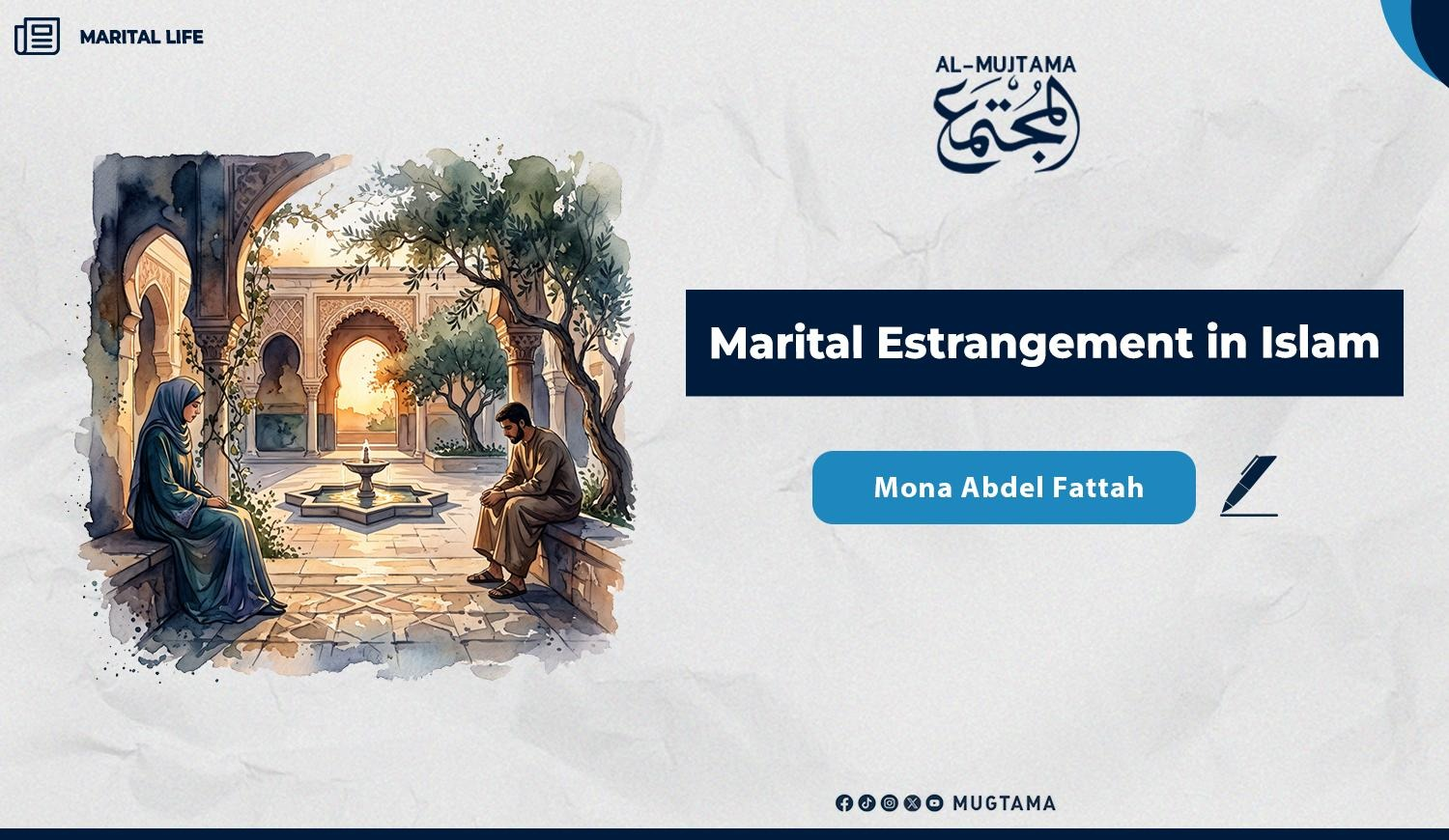
Marital Estrangement in Islam
When
Islam prescribed marital estrangement, it was as a means of disciplining and
correcting a wife and addressing her defiance toward her husband. Allah, the
Exalted, says, {Men are the caretakers of women, as
men have been provisioned by Allah over women and tasked with supporting them
financially. And righteous women are devoutly obedient and, when alone,
protective of what Allah has entrusted them with. And if you sense ill-conduct
from your women, advise them ˹first˺, ˹if they persist,˺ do not share their beds, ˹but if they still persist,˺ then discipline them ˹gently˺. But
if they change their ways, do not be unjust to them. Surely Allah is Most High,
All-Great.} [An-Nisa’ 4:34]
Marital
estrangement was also among the practices of the Prophet (peace and blessings
be upon him). When he became displeased with his wives, he withdrew from them
and stayed away for a month. The hadith reporting the Prophet’s withdrawal from
his wives is established in both Sahih Al-Bukhari and Sahih Muslim, narrated by
Ibn `Abbas. The reason for this withdrawal was his profound displeasure with
them. In one narration in Sahih Al-Bukhari, he said: “‘I will not enter upon them for a month,’ because he was so upset
with them.” In the narration of
Sahih Muslim, it reads: “And he (Allah’s
Messenger) had taken an oath that he would not visit them for a month due to
extreme annoyance with them.”
The
narrations differ regarding the reason for his displeasure. Some mention that
it was because Hafsah disclosed to `A’ishah a secret that the Prophet (peace
and blessings be upon him) had entrusted to her. Others say that he withdrew
because of his profound displeasure with them after his Lord, the Exalted,
reproached him for prohibiting something lawful for himself, as mentioned in
Surah At-Tahrim.
Others
have stated that the reason for his anger and subsequent withdrawal was that
his wives had asked him for increased financial support. This is mentioned in
Jabir’s narration in Sahih Muslim, although other reasons have also been
reported.
Al-Hafiz
Ibn Hajar, in his book Fath Al-Bari, stated: “It is possible that all
these matters together were the reason for his withdrawal from them. This is
what befits his noble character, his broad-mindedness, and his great capacity
for forgiveness. It also indicates that he did not do so until the reasons for
his displeasure had been repeated by them, may Allah be pleased with them.”
Feminism and Wives Abandoning Their Husbands
In our
modern age, amid the spread of radical feminism,
growing waves of incitement against husbands, and rising rates of domestic
violence, a new form of estrangement has emerged in some Arab and Muslim
societies, if not all of them: wives abandoning their husbands!
Muslim
women—an unfortunate phenomenon that has become one of our trials—have begun
imposing this estrangement on men for days, weeks, or even months. They
withdraw from them both physically and emotionally, and remain in conflict with
them day and night, whatever the reason may be. Yet they continue to live under
their husbands’ care, reside in their homes, and eat their food and drink. This
is a grave matter.
Some
Muslim wives use marital intimacy as a means of punishing their husbands. They
abandon the marital bed, deprive them of what Allah has made lawful, and deny
them the means of maintaining their chastity. Others refuse marital relations
for weeks or months, under one pretext or another.
Even more
alarming is that some Muslim women influenced by feminism disregard the
Prophetic warning in the hadith in which the Prophet (peace and blessings be
upon him) said: “When a man invites his wife to
his bed and she does not come, and he (the husband) spends the sight being
angry with her, the angels curse her until morning.” (Narrated by
Al-Bukhari)
In Sahih
Muslim, Abu Hurairah reported that the Prophet (peace and blessings be upon
him) said: “By Him in Whose Hand is my life,
when a man calls his wife to his bed, and she does not respond, the One Who is
in the heaven is displeased with her until he (her husband) is pleased with
her.”
The
scholars of Islamic jurisprudence explained that this ruling applies when the
wife has no legitimate excuse, such as obligatory fasting, illness, or anything
similar. If a woman has a valid religious excuse, she bears no blame.
The Culture of Marital Defiance and Its
Threat to Muslim Families
Wives
abandoning their husbands is part of organized and suspicious campaigns
operating under false human rights slogans. These campaigns seek to create a
new climate in which women are encouraged to assert dominance over men and
adopt an attitude of superiority toward them, sometimes under the pretext of
equality and at other times in the name of women’s empowerment. They also
promote the claim that a woman’s right to abandon her husband is equal to a man’s
right to do so.
Such a
wife harbors a desire to punish her husband, discipline him, and break his
spirit, using an argument, a harsh word he may have uttered, or perhaps an
alleged instance in which he treated her badly or harmed her. Thus, in the age
of feminism, it is the woman who abandons her husband!
The aim
behind these campaigns is to spread a culture of marital defiance in Muslim
societies and undermine the principle of male responsibility
and care that Islam has established to keep marital life on a balanced course.
This principle grants women their rights while preserving the husband’s
responsibilities; undermining it throws the balance off course and leaves the
marital ship vulnerable to sinking.
Among the
forms of marital defiance that have emerged in our time are:
- Disclosing marital
secrets through social media.
- Broadcasting details
of family life across digital platforms.
- Traveling for work
without the husband’s consent.
- Demanding financial
payments in exchange for allowing the husband to exercise his marital
rights.
- Using foreign laws to
strip the husband of his religiously established rights within the marital
relationship, including what is known in Western countries as the
accusation of “marital rape.”
Islam
places great importance on preventing marital defiance. It emphasizes the
prevalence of affection and mercy between spouses, good character, treating one
another with kindness, and dealing gently with one’s wife.
The
Messenger of Allah (peace and blessings be upon him) said: “The best of you is he who is best to his family, and I
am the best among you to my family.”
When he
was asked what right can any wife demand of her husband, he replied: “That you should give her food when you eat, clothe her
when you clothe yourself, not strike her on the face, and do not revile her or
separate from her except in the house.” (Narrated
by Abu Dawud)
Abandoning
one’s husband is a grave source of harm, leading to further cases of divorce,
family disintegration, and marital infidelity.
Therefore,
fear Allah, O women!
-------------------------------------------------------------
