




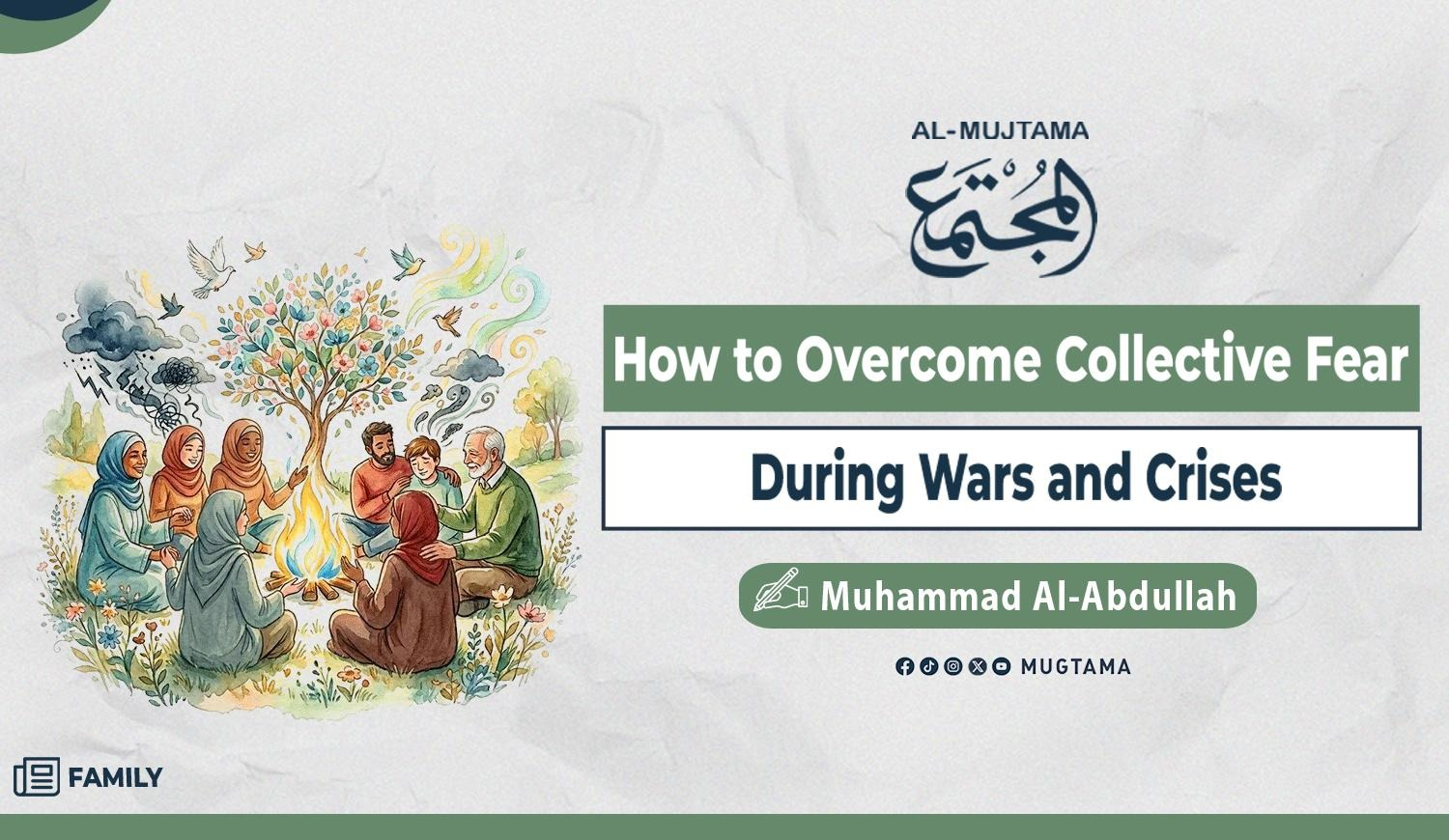
How to Overcome Collective Fear During Wars and Crises

Caring for families and ensuring their
stability, both materially and emotionally, is one of the foremost concerns of
countries and societies. Family stability is a symbol of security and a source
of resilience in the face of challenges during wars and crises.
Al-Mujtama spoke with several experts
in social affairs and human behavior in an effort to develop a practical guide
for helping society cope with collective fear during times of crisis.
Emotional Stability: A Family’s First Line
of Defense
Jordanian media professional and
social behavior researcher Abdul Quddus Al-Qudah emphasized in an interview
with Al-Mujtama that a fundamental principle for Muslims is that Allah is the
One who averts affliction. If any of us were to reflect on events in our lives,
we would recall numerous instances in which we experienced Allah’s subtle
kindness and care under different circumstances.
Al-Qudah explained that strengthening
trust in Allah and promoting this outlook are responsibilities of an aware
individual. They also distinguish those who positively influence the people
around them from those who do not.
He continued: This is the conscious
attitude that rejects crude exaggeration, rises above the circulation of
rumors, and refuses to spread unjustified panic. In psychology, such a person
is described as emotionally balanced and psychologically stable. This is what
we mean by effective courage, especially since spreading collective fear is one of the objectives of various conflicting
parties. True awareness is demonstrated by promoting a counterreaction that
frustrates these malicious efforts.
He added that negative emotions, such
as panic, are known to spread rapidly through groups like an infectious
disease, particularly during calamities such as wars. This is why the Quran
encourages us not to allow ourselves to be overwhelmed by emotions fueled by
fearmongering and exaggeration, which are often excessive. Instead, we should
take the initiative and play an active role in responding to events.
He called on individuals to become an
impenetrable barrier against the social disruption that rumors can
cause, sometimes more effectively than battles themselves. He outlined several
ways to achieve this:
1.
Have
faith in Allah and trust that He is the One who removes adversity.
2. Condemn those who publicize every
report they receive, whether reassuring or alarming. Such people end up serving the interests of rumor-mongers
by spreading their claims.
3. Refer matters to qualified experts who can draw sound conclusions and offer
well-informed judgments. In military situations, these are people with military
and political expertise.
4. Recognize that, in the circumstances
currently facing some of our countries, the volume of information circulated
and broadcast is often many times greater than the actual facts warrant.
How Calm and Confident Leadership Reassures
Society
Iraqi researcher and community
medicine specialist Omar Al-Ayoubi emphasized that fear during crises and wars
is a natural, instinctive human response. It helps people prepare to deal with
difficult situations and make quick decisions to protect themselves and others.
However, he warned that fear can become
a psychological problem when it intensifies excessively or persists for a
prolonged period. It may then lead to widespread collective panic, which can be
difficult to control and becomes an additional burden on top of the crisis or
difficult circumstances themselves.
Those responsible for crisis
management would therefore do well to adopt a set of measures to acknowledge
these emotions and channel them in a constructive direction. These measures
include the following:
1.
Credibility: A society facing a crisis first needs to know the
truth through credible media channels that have earned the audience’s trust and
possess the means to guide public understanding.
2. Composure in leadership: The more a crisis manager appears confident and balanced
in decision-making, the more this helps calm society and reduce the perceived
magnitude of dangers in people’s minds.
3. Distributing responsibilities: Crisis managers should give members of society roles
to play in responding to the crisis, even if those roles are small. Such
participation helps ease feelings of fear and channel them toward constructive
action.
4. Protecting vulnerable groups: Those responsible for managing crises must not
overlook vulnerable members of society, for whom excessive fear can have
serious psychological and health consequences. Children, for
example, should be protected from exposure to warnings, instructions, or news that
could have a deeply distressing or harmful effect on them.
Concluding his remarks to Al-Mujtama,
Al-Ayoubi stressed that managing public emotions requires an integrated
approach combining effective communication, responsible leadership, and
psychological and social support.
Mental Stability Between Awareness and Trust
in Allah
Dr. Ibrahim Abdul Mohsen Haggag,
Professor of Community Development and Environmental Studies at Al-Azhar
University, offered a set of recommendations for dealing with such circumstances.
Among the most important are the following:
First: Limit your exposure
to news. Constantly following the news
can intensify anxiety.
Second: Distinguish
between what you can control and what you cannot. Some events lie beyond your control, so entrust them
to Allah and focus on what you can do: take care of yourself, support your
family, and fulfill your daily responsibilities.
In his interview with Al-Mujtama,
Haggag explained that, amid the escalating tensions and rapidly unfolding
events in the region, many people are experiencing anxiety and apprehension.
These are understandable human feelings in times of uncertainty. However, the
real challenge lies not so much in the events themselves as in how we respond
to them psychologically and socially.
He continued: “Society is naturally
affected by the rapid flow of news. With the spread of social media, feelings
of fear are amplified by repetition and, at times, exaggeration. This is where
the need for collective awareness
becomes apparent—awareness that restores balance so that we neither exaggerate
dangers nor lose sight of reality.
“The social environment also plays an
important role in containing anxiety. Family discussions and the reassurance
friends offer one another help reduce tension. A kind word and psychological
support can make a tremendous difference during such times.”
Haggag noted that staying engaged in
daily life, work, and productive activities is an effective way to regain a
sense of control rather than surrendering to feelings of helplessness. Life
does not stop; instead, it requires us to manage it wisely, even under the most
difficult circumstances.
He concluded: “Peace of mind does not mean denying reality; it means maintaining a balanced perspective on it. We must recognize that events beyond our control should not deprive us of our inner peace. Between awareness and trust in Allah, and between taking the necessary measures and placing our confidence in Him, a person can preserve their psychological stability and continue to be a positive presence in society, no matter how severe events become.”
-------------------------------------------------------------