









How the Quran Liberates the Human Mind

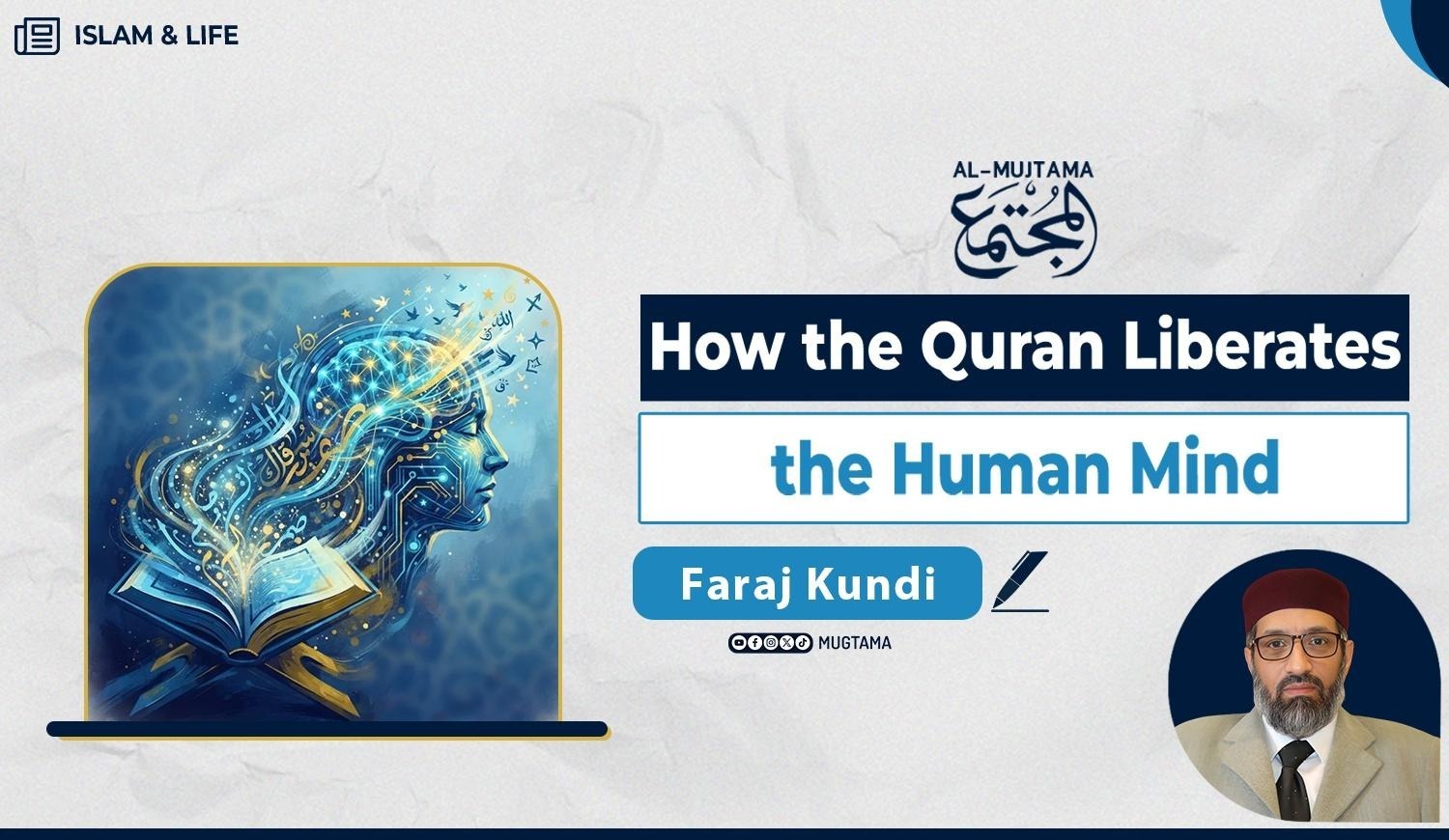
The relationship
between the Quran and reason is not a discussion of two opposing spheres, one
religious and the other human. Nor is it an attempt to reconcile a sacred text
with a mind searching for truth. Rather, it concerns a foundational
relationship in shaping the human being and the method the Quran seeks to
establish for the mind: freeing it from illusion and blind imitation, moving it
from emotional reaction to insight, and guiding it from fragmented knowledge
toward an understanding of facts, universal laws, and ultimate purposes.
The Quran
does not address human beings merely as recipients of commands, but as rational
and accountable beings, called upon to observe, think, and reflect on
revelation, the universe, the self, and history, and to make knowledge a path
toward guidance, action, and reform.
From this
perspective, the Quranic worldview does not erect a dividing wall between faith
and reason. Instead, it makes sound reflection a means of deepening and
strengthening faith. Faith does not require the suspension of reason, just as
thinking does not require detachment from divine guidance. The real issue is
freeing the mind from desires, illusions, and assumptions unsupported by
evidence, as well as from submission to social or political authorities that
deny people their right to question, criticize, and reconsider.
Reason in the Quranic Worldview:
Understanding and Responsibility
Reason
occupies a central place in shaping the human being. Through it, people
distinguish between truth and falsehood, justice and injustice, and reform and
corruption, becoming capable of moral accountability and bearing
responsibility.
However,
the Quran does not regard reason as an absolute power independent of the other
dimensions of human existence. Rather, it places it within an integrated system
in which human nature, revelation, the senses, experience, and conscience
interact.
Notably,
the Quranic expression of reason appears through verbs and acts such as
understanding, thinking, and reflecting. This emphasizes that reason is not a
passive faculty, but an active process that requires observation, connecting
premises to conclusions, moving from what is seen to what is understood, and
translating knowledge into action. Allah says, {Indeed,
in the creation of the heavens and the earth and the alternation of the day and
night there are signs for people of reason.} [Ali `Imran 3:190]
Reflecting
on the universe, therefore, is not an intellectual activity detached from
faith. It is a path toward recognizing the precision and order of creation,
contemplating its wisdom and purpose, and becoming aware of humanity’s
responsibility within existence. In this way, faith is transformed from a mere
inherited custom into a firmly rooted awareness connected to observation,
contemplation, and action.
Freeing the Mind from Blind Imitation and
Demanding Evidence
One of
the most prominent features of the Quranic method is that it does not merely
call people to think; it also confronts the obstacles that prevent them from
thinking freely. Foremost among these are blind imitation and submission to
inherited beliefs without examination. Allah says:
{When it is said to them, “Follow what Allah has revealed,” they reply,
“No! We ˹only˺ follow what we found our forefathers
practicing.”} [Al-Baqarah 2:170]
This
criticism does not mean rejecting heritage or severing ties with history.
Rather, it means refusing to turn inherited traditions into an authority that
disables reason, or to regard the age or widespread acceptance of an idea as
proof of its validity.
History
is a source of experience, but it is not infallible. Heritage is a field for
reflection and learning, not an excuse to close the door to independent
reasoning and reassessment. A sound-minded person neither rejects an inherited
idea simply because it is inherited nor accepts it for the same reason.
Instead, they measure it against the standards of truth and evidence.
Closely
connected to this is the Quran’s insistence on argument and proof. Allah says, {“Show
˹me˺ your proof if what you say is true.”}
[Al-Baqarah 2:111]
Truth is
not established merely by repeating a claim. Nor does the majority automatically
constitute evidence of what is right, and an assumption does not become
knowledge simply because it is widespread. This establishes an approach to
knowledge that resists superstition and illusion, making evidence the standard
by which ideas and positions are evaluated.
The
pursuit of evidence is also inseparable from moral responsibility. Allah says, {Do not follow what you have no ˹sure˺ knowledge of. Indeed, all will be
called to account for ˹their˺ hearing, sight, and intellect.}
[Al-Isra’ 17:36]
Human
beings are accountable for what they receive, transmit, and judge. Verifying
reports and distinguishing between fact and opinion, and between information
and rumor, therefore become part of the ethics of knowledge. This is further
emphasized in Allah’s words: {O believers, if an
evildoer brings you any news, verify ˹it˺ so you do not harm people unknowingly.}
[Al-Hujurat 49:6]
Reflection on the Quran: From Understanding
the Text to Improving Life
If reason
is the instrument of observation and inquiry, reflection is one
of its most important functions in engaging with the Quran. Recitation cannot
be separated from understanding, and understanding remains incomplete unless it
is reflected in behavior and action. Allah says, {Do
they not then reflect on the Quran? Or are there locks upon their hearts?}
[Muhammad 47:24]
Reflection
is not simply passing over words. It involves examining the meanings of verses,
the connections between their messages, and their objectives, while considering
how they guide people toward reforming themselves and society.
However,
responsible reflection does not mean freely imposing personal opinions on the
text without knowledge. It requires familiarity with the Arabic language,
context, and principles of Quranic interpretation, as well as drawing on the
work of scholars and distinguishing between definitive meanings and areas open
to independent interpretation. In this way, respect for the text and the
exercise of reason come together, avoiding both rigidity that obstructs
understanding and forced interpretations that attribute meanings to the text
that it cannot bear.
The Quran
also directs the mind to examine the universe, the human self, and history. It
does not confine knowledge to abstract contemplation or separate faith from
discovering the laws governing existence and understanding real-world events.
Observation
and experimentation remain important tools for understanding the world, but
they cannot, on their own, exhaust questions of purpose, value, and
responsibility. This highlights the need to combine rigorous scientific inquiry
with Quranic guidance, which directs knowledge toward justice and reform,
without allowing scriptural references to replace the study of facts and the
analysis of their causes.
Reason and Personal Desires: The Ethics and
Limits of Thinking
Possessing
the tools of thought is not enough to guarantee sound judgment. People may use
reason itself to justify their desires and interests, select evidence that
supports their positions, and interpret events in ways that serve their biases.
This is why the Quran warns against following personal desires. Allah says, {Do not follow ˹your˺ desires or they will lead you astray
from Allah’s Way.} [Sad 38:26]
Personal
desires do not always disable reason by preventing people from thinking. They
may instead turn it into a tool for justifying what a person has already decided
they want. Therefore, freeing the mind requires more than simply providing
information. It also requires purifying the self, examining one’s motives,
acknowledging mistakes, and treating those who disagree with fairness.
Thus, the
Quran connects piety with justice and forbids allowing disputes to drive people
into injustice. Allah says, {Be just! That is
closer to righteousness.} [Al-Ma’idah 5:8]
Justice is not
merely a social value; it is one of the conditions for sound perception and
judgment. Fanaticism, self-interest, and hostility can prevent people from
seeing the truth. This reveals the close relationship between reason and
ethics: honest knowledge requires truthfulness, fair-minded thinking requires
freedom from prejudice, and sound judgment requires a commitment to justice
rather than submission to personal desires.
The Integration of Revelation and Reason in
Islam
The
Islamic worldview is based on the integration of revelation and reason, not on
the cancellation of one in favor of the other. Reason is capable of
observation, deduction, and discovery, but it remains limited by human nature,
the tools available to people, and the nature of the subjects they investigate.
There are
truths that human beings can understand through observation and experience,
while there are matters of the unseen whose details reason cannot independently
establish. Revelation therefore comes as guidance, clarifying what reason
cannot fully grasp on its own and directing people toward ultimate purposes and
values that empirical knowledge alone cannot determine.
Conversely,
reason plays an essential role in understanding revelation, distinguishing its
meanings, examining its contexts, reconciling its evidence, and applying its
rulings to real-life situations.
This is
why two extremes must be avoided: disabling reason in the name of submission,
and treating it as an absolute authority detached from revelation. It is also
important to distinguish between the divine text and human understanding of it,
and between established truths and human theories that remain open to revision.
Many intellectual problems arise from confusing these different levels.
Respecting
revelation does not mean closing the door to inquiry, just as respecting reason
does not mean making it the ultimate judge of every truth without considering
the nature and limits of different sources of knowledge. A balanced approach
emerges when reason operates within its proper sphere, draws guidance from
revelation, and remains open to research, learning, and reassessment.
Reason, Consultation, and Building
Civilization
The
impact of reason is not limited to shaping individuals; it extends to building
societies and making decisions. Shared life requires exchanging opinions,
bringing together different areas of expertise, and assessing interests and
potential consequences. This is why the Quran establishes the principle of
consultation. Allah says, {And those who respond to
their Lord, establish prayer, and conduct their affairs by mutual
consultation.} [Ash-Shura 42:38]
And He
said to His Prophet, peace and blessings be upon him: {And
consult them in matters of importance.} [Ali `Imran 3:159]
Consultation
acknowledges the limitations of individual judgment and recognizes that sound
decisions benefit from different perspectives and the expertise of specialists.
However, its purpose is not fulfilled merely by bringing different people
together. It also requires accurate information, responsible freedom to express
opinions, justice, integrity, and institutions that protect rights and prevent
the imposition of a single person’s views.
This is
where the question of reason connects with the broader project of building
civilization and achieving progress. The Quranic mind does not remain confined
to theoretical contemplation. Instead, it connects knowledge with action, faith
with reform, and reflection with cultivating the earth.
Civilization
is not simply an accumulation of buildings, wealth, and technology. It is the
comprehensive development of individuals, institutions, and relationships,
built on justice, integrity, and the protection of rights. It puts knowledge to
beneficial use and prevents power from becoming an instrument of corruption.
A nation
cannot restore the role of reason merely by repeating calls for critical
thinking. It must build an environment that respects knowledge, honors
researchers, allows questions, resists superstition, connects education to
society’s needs, and frees knowledge from propagandistic exploitation.
Knowledge
that does not translate into action and reform has a limited impact. Likewise,
discourse that is not grounded in an understanding of reality may fail to
diagnose and address problems.
The Quran and Reason: Building a Mind Guided
by Truth and Justice
The
relationship between the Quran and reason is one of development, guidance, and
integration. The Quran awakens the mind, frees it from the constraints of blind
imitation and personal desires, and calls it to pursue evidence, verify
information, reflect deeply, and examine the universe, the self, and history.
It then connects knowledge with moral responsibility and righteous action.
Reason,
in turn, understands divine discourse, contemplates its meanings, examines
reality, and draws on science and experience to address life’s challenges.
The
fundamental question lies in the kind of mind we seek to cultivate. Is it a
mind content with repeating what is familiar, or one that is free from illusion
and guided by evidence? Is it a mind that justifies prejudice and
self-interest, or one that weighs matters with justice? Is it a mind
preoccupied with abstract debate, or one that moves from knowledge to reform
and the building of civilization?
Our
contemporary need is for a believing mind that is not afraid to ask questions,
knowledge that does not dispense with ethics, and an engagement with the Quran
that goes beyond recitation to reflection, and beyond reflection to shaping
individuals and reforming society.
When the
mind is freed from personal desires, illuminated by revelation, and open to the
laws governing the universe and history, it becomes better equipped to fulfill
its mission of cultivating the earth. At that point, the Quran becomes a method
that guides awareness, establishes sound standards of judgment, directs human
will, and contributes to building individuals and societies founded on truth,
justice, and mercy.
-------------------------------------------------------------
