




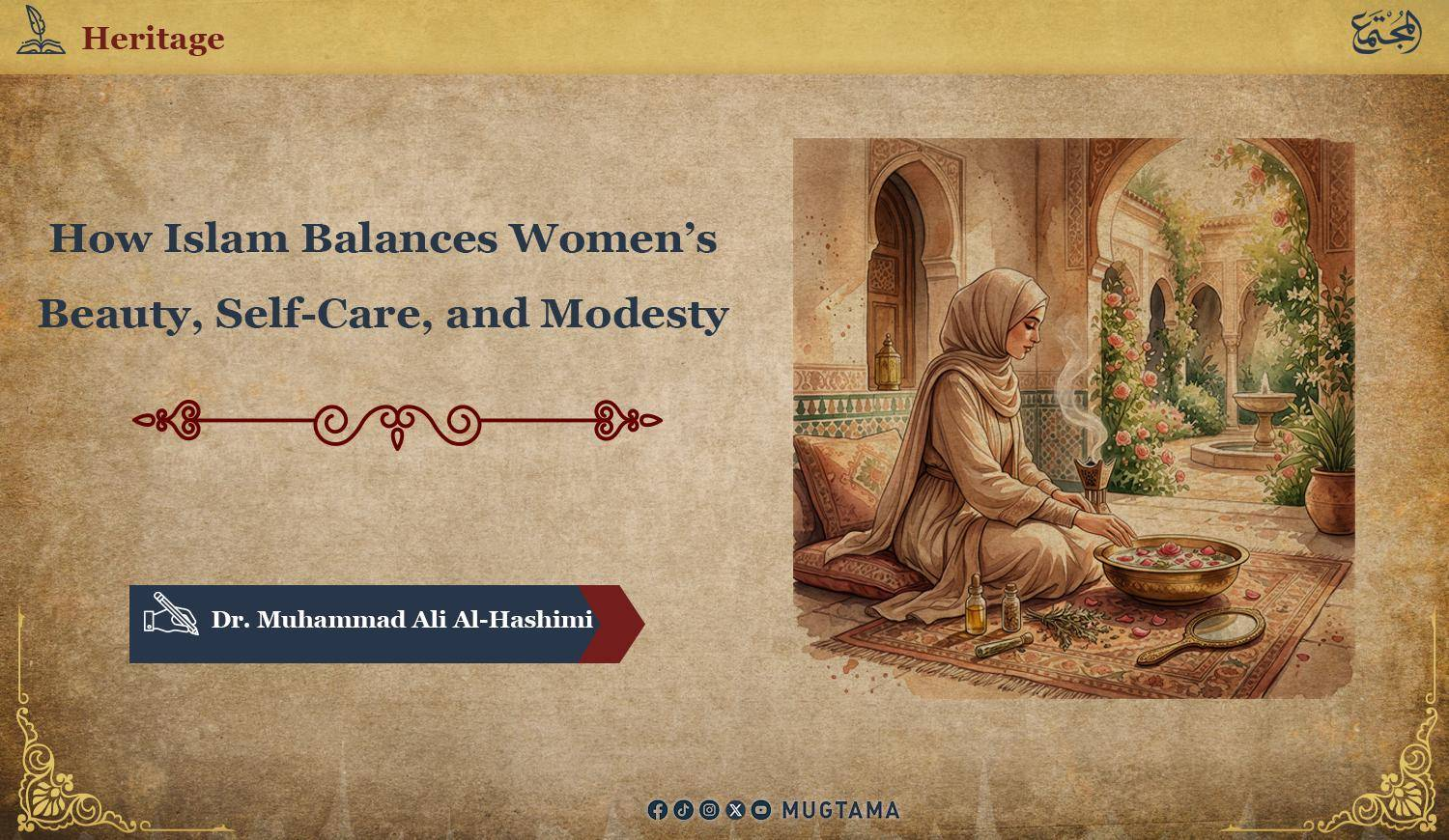
How Islam Balances Women’s Beauty, Self-Care, and Modesty
It is no
surprise that the Muslim woman is concerned with her clothes and appearance,
without going to extremes or making a wanton display of herself. She presents a
pleasing appearance to her husband, children, mahram relatives and other Muslim
women, and people feel comfortable with her. She does not put them off with an
ugly or untidy appearance and she always checks herself and takes care of
herself, in accordance with the teachings of Islam, which asks its followers to
look good in ways that are permitted.
In his
commentary on the ayah: {Say: Who has
forbidden the beautiful [gifts] of Allah, which He has produced for His
servants, and the things, clean and pure, [which He has provided] for
sustenance?} [Al-A`raf 7:32]
Al-Qurtubi
said: “Makhul reported from `A’ishah (May Allah
be pleased with her): ‘A group of the Companions of the Prophet (PBUH) were
waiting at the door for him, so he prepared to go out to meet them. There was a
vessel of water in the house, and he peered into it, smoothing his beard and
his hair.’ (`A’ishah said) I asked him, ‘O Messenger of Allah, even you do
this?' He said, ‘Yes, when a man goes out to meet his brothers, let him prepare
himself properly, for Allah (SWT) is beautiful and loves beauty.’”
Islamic Teachings on Beauty,
Cleanliness, and Appearance
The
Muslim does all of this in accordance with the Islamic ideal of moderation,
avoiding the extremes of either exaggeration or negligence: {Those who, when they spend, are not extravagant and not
niggardly, but hold a just balance between those [extremes].} [Al-Furqan 25:67]
Islam
wants its followers, and especially its advocates (da`is), to stand out
in gatherings in an attractive fashion, not to appear unsightly or unbearable.
Neglecting one’s appearance to the extent of being offensive to one’s
companions in the name of asceticism and humility is not part of Islam. The
Prophet (PBUH), who was the epitome of asceticism and humility, used to dress
in decent clothes and present a pleasant appearance to his family and
companions. He regarded dressing well and looking good to be a demonstration of
the Blessings of Allah (SWT): “Allah (SWT) loves
to see the signs His gifts on His servant.”
Ibn Sa`d
reports in At-Tabaqat (4/346) that Jundub Ibn Makith (RAA) said: “Whenever a delegation came to meet the Messenger of
Allah (PBUH), he would wear his best clothes and order his leading Companions
to do likewise. I saw the Prophet (PBUH) on the day that the delegation of
Kindah came to meet him; he was wearing a Yemeni garment, and Abu Bakr and
'Umar were dressed similarly.”
Ibn Al-Mubarak,
Tabarani, Al-Hakim, Al-Bayhaqi and others report that `Umar (RAA) said: “I saw the Messenger of Allah (PBUH) ask for a new
garment. He put it on, and when it reached his knees he said, ‘Praise be to
Allah (SWT), Who has given me clothes with which to cover myself and make
myself look beautiful in this life.’”
So long
as this taking care of one’s outward appearance does not go to extremes, then
it is part of the beauty that Allah (SWT) has allowed for His servants and
encouraged them to adopt: {O children of Adam! Wear
your beautiful apparel at every time and place of prayer: eat and drink: but
waste not by excess, for Allah loves not the wasters.} [Al-A`raf 7:31]
{Say, Who has forbidden the beautiful [gifts] of Allah, which He has
produced for His servants, and the things, clean and pure, [which He has
provided] for sustenance? Say: They are, in the life of this world, for those
who believe, [and] purely for them on the Day of Judgement. Thus do We explain
the Signs in detail for those who understand.} [Al-A`raf 7:32]
Muslim
reports from Ibn Mas`ud (RAA) that the Prophet (PBUH) said: “No-one who has even an atom’s-weight of pride in his
heart will enter Paradise.” A man asked him, “What if a man likes his clothes
and shoes to look good?” (Meaning, is this counted as pride?) The Prophet
(PBUH) said: “Allah (SWT) is beautiful and loves beauty. Pride means denying
the truth and looking down on other people.”
This is
the understanding adopted by the Sahabah and those who followed them
sincerely. Therefore Imam Abu Hanifah (RAA) always took care to dress well and
to ensure that he smelled clean and fresh, and urged others to do likewise. One
day he met a man who used to attend his circle, who was dressed in scruffy
clothes. He took him to one side and offered him a thousand dirhams with
which to smarten himself up. The man told him, “I have money; I do not need
this.” Abu Hanifah admonished him: “Have you not heard the hadith, ‘Allah (SWT) loves to see the signs of His gifts on His
servant’? So you have to change yourself, and not appear offensive
to your friend.”
Naturally,
those who call people to Allah (SWT) should be better and smarter in appearance
than others, so that they will be better able to attract people and make their
message reach their hearts.
Indeed
they, unlike others, are required to be like this even if they do not go out
and meet people, because those who proclaim the word of Allah (SWT) should take
care of their appearance and pay attention to the cleanliness of their bodies,
clothes, nails and hair. They should do this even if they are in a state of
isolation or retreat, in response to the call of the natural inclination of man
(fitrah) which the Prophet (PBUH) told us about and outlined its
requirements: “Five things are part of the
fitrah: circumcision, removing the pubic hair, plucking hair from the armpits,
cutting the nails, and trimming the moustache.”
Taking
care of oneself in accordance with this fitrah is something encouraged
by Islam and supported by every person of common sense and good taste.
Modesty in Islam: Avoiding Excessive
Beautification and Showing Off
Paying
attention to one’s appearance should not make a Muslim woman fall into the trap
of wanton display (tabarruj) and showing her beauty to anyone other than
her husband and mahram relatives. She should not upset the balance which
is the basis of all Islamic teaching, for the Muslim woman always aims at
moderation in all things, and is on the alert to prevent any one aspect of her
life from taking over at the expense of another.
She never
forgets that Islam, which encourages her to look attractive within the
permitted limits, is also the religion that warns her against going to such
extremes that she becomes a slave to her appearance, as the hadith says: “Wretched is the slave of the dinar, dirham and fancy
clothes of velvet and silk! If he is given, he is pleased, and if he is not
given, he is displeased.”
Our women
today, many of whom have been influenced by the international fashion houses to such
an extent that a rich women will not wear an outfit more than once, have fallen
into that slavery of which the Prophet (PBUH) warned and, as a result, they are
trapped in the misery of that senseless enslavement to excessively luxurious
clothing and accessories. Such women have deviated from the purpose for which
humanity was created in this world.
Extravagance in Fashion and the
Importance of Moderation
One of
the worst excesses that many modern Muslim women have fallen into is the habit
of showing off expensive outfits at wedding parties, which have become fashion
shows where competition is rife and is taken to extremes far beyond the realms
of common sense and moderation. This phenomenon becomes clearer when the bride
herself wears all her outfits, which may number as many as ten, one after the
other each time she changes, she comes out and shows it off to the other women
present, exactly like the fashion models in the West.
It does
not even occur to the women among whom this habit is common, that there may be
women present who are financially unable to buy such outfits, and who may be
feeling depressed and jealous, or even hostile towards the bride and her
family, and other rich people. Nothing of this sort would happen if brides were
more moderate, and just wore one or two outfits at their wedding parties. This
is better than that extravagant showing-off which is contradictory to the
balanced, moderate spirit of Islam.
No doubt the Muslim woman who has surrounded herself with the teachings of this great religion is spared and protected from such foolish errors, because she has adopted its principles of moderation.
-------------------------------------------------------------
Taken from: “The Ideal Muslimah” By Dr. Muhammad Ali Al-Hashimi
