







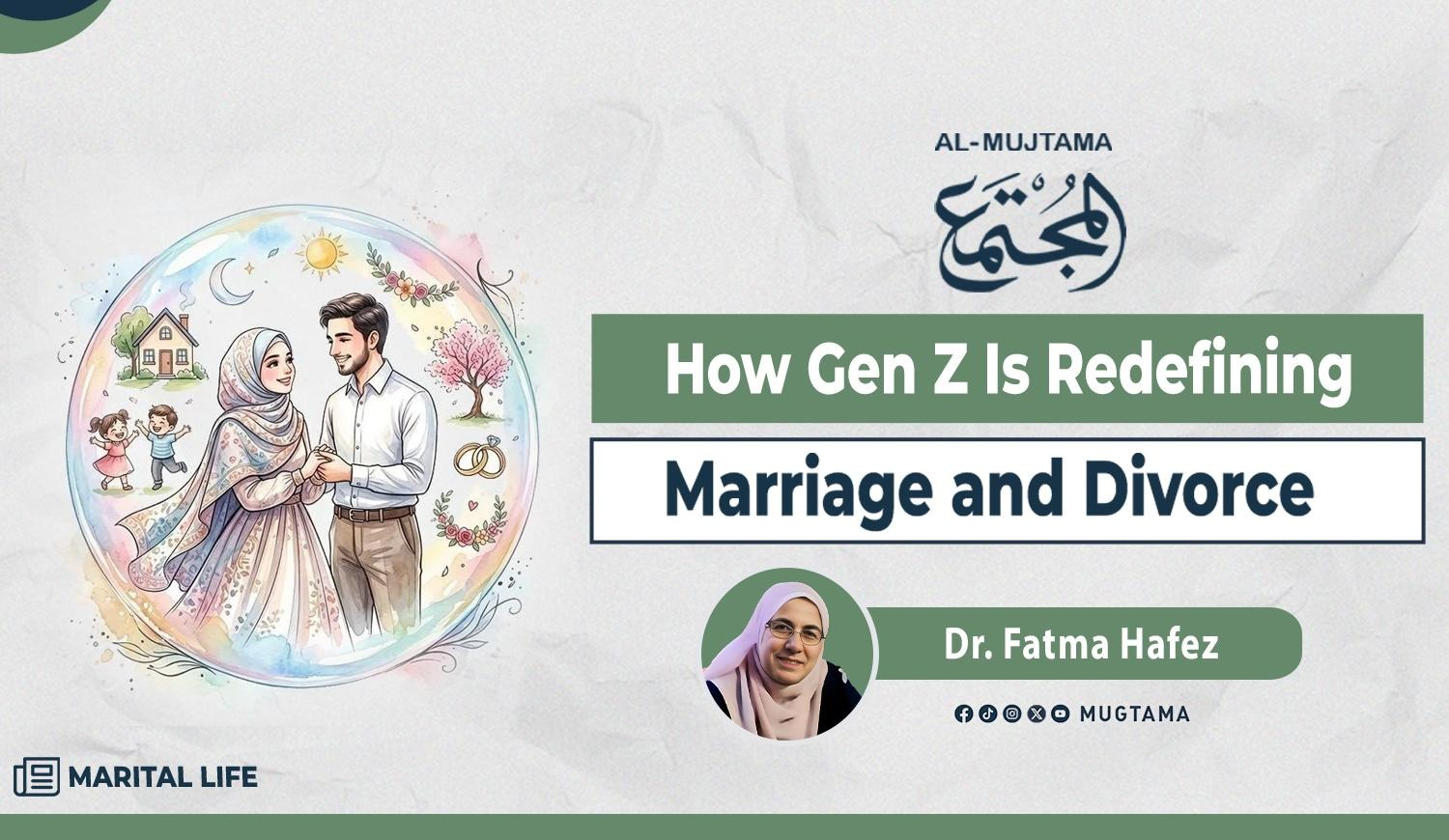
How Gen Z Is Redefining Marriage and Divorce

Arab societies are remarkably young.
Statistics consistently show that nearly one-third of the Arab world’s
population consists of young people between the ages of 15 and 29.¹ This means
that roughly one-third of the Arab demographic belongs to what is known as Gen Z—the
generation that grew up alongside the rise of the digital age. Technology has
become inseparable from their lives and a defining feature of their identity,
earning them the label of “digital natives.”
Gen Z derives much of its worldview
from digital platforms, which have become the primary source shaping
perceptions of the self, relationships, and society. In the following
discussion, we explore how this generation views marriage and family, and how digital
technology has reshaped those perceptions.
Marriage: From a Social Institution to a
Personal Choice
In traditional societies, marriage
stood at the top of a young person’s priorities. It often came before education
or employment. Many young people married at an early age while living within the extended family, which
typically supported the newly married couple financially until they became
independent.
Over time, however, this priority has
declined significantly. Since the rise of modernity, education, career
advancement, and migration have increasingly replaced marriage as the primary
aspirations of young people. Statistics clearly reflect this transformation.
For example, the 2024 Arab Youth
Survey found that marriage ranked as a priority for no more than 35% of young
people in the Gulf states. Meanwhile, official statistics from Algeria revealed
that 50% of Algerian youth are choosing not to marry, with 43% of those
preferring migration over marriage.²
Another profound transformation has
occurred in how young people perceive marriage itself.
In previous generations, marriage was
fundamentally a social institution in which families played the central role.
Parents and extended relatives often selected the prospective spouse, while
individuals themselves exercised limited influence over the decision. Families
also bore much of the financial responsibility for newlyweds and played a major
role in resolving marital disputes.
Today, that narrative has largely
disappeared. Members of Gen Z rarely allow their families to perform these
traditional roles. Instead, they choose their own spouses, and in many cases,
the search begins on social media platforms or specialized online matchmaking
websites.
Some studies suggest that these modern
methods offer several advantages unavailable through traditional matchmaking.
They provide broader opportunities for men and women to find compatible
partners, allow individuals to identify people with similar interests through
their online profiles, overcome geographical barriers, facilitate communication
across distances, and reduce the social awkwardness often associated with
family-mediated introductions.³
Gen Z and the Redefinition of Family
Roles
Arab families have traditionally been
described as patriarchal, with fathers generally responsible for making
decisions while mothers carried out the daily responsibilities of family life.
The families established by Gen Z,
however, no longer fit neatly into this traditional model.
Many young men no longer accept the conventional assumption that earning the family’s income automatically grants
exclusive authority over decision-making.
Likewise, many young women, empowered
by higher education and greater participation in the workforce, no longer view
themselves primarily as homemakers. Instead, they increasingly see themselves
as equal partners in
managing the household and participating in family decisions.
A growing number of young men are
seeking not simply a wife to fulfill traditional maternal roles, but a genuine
life partner and companion.
Within this context, Gen Z is
redefining fundamental concepts that have long shaped family life, including
guardianship, partnership, and equality.
These questions have become central to
contemporary discussions across societies.
Some observers assume that these
changing attitudes result primarily from the influence of Western feminism. Recent
statistics, however, paint a more nuanced picture.
Reports published by the Arab
Barometer indicate that more than 70% of young people in both the Maghreb and
the Gulf support a married woman’s right to work and maintain financial
independence. They overwhelmingly reject the older model that viewed women as
economically dependent upon men.
The same reports also indicate that
young men from Gen Z increasingly accept sharing household responsibilities and
childcare, alongside women’s financial contribution to family life.
The Growing Social Acceptance of Divorce
Gen Z has also undergone a profound
shift in its perception of divorce. In previous generations, divorce was
generally viewed as a social failure and carried considerable stigma.
For many members of Gen Z, however, divorce is no
longer considered either a personal failure or a source of social shame. Instead,
it is increasingly viewed as a rational personal choice when a relationship no
longer fulfills an individual’s expectations or aspirations.
This shift reflects a broader
transition away from ideals of patience, sacrifice, and preserving the family
unit for the sake of children.
In their place, greater emphasis is
placed on personal fulfillment, individual satisfaction, and emotional
well-being.
Within this framework, divorce is
often perceived as a healthy course correction rather than a permanent stigma.
How Digital Technology Influences
Marital Stability
Digital technology
has also become one of the factors contributing to marital incompatibility and,
in some cases, divorce.
According to the 2024 Doha
International Family Institute report, Assessing Marital Relationships
During the First Five Years of Marriage in the Arab World, infidelity
remains the leading cause of divorce among newly established families.
The report found that 7.7% of divorce
cases resulted from discovering infidelity through social media platforms.
By comparison, feminist ideas and
Western cultural influences accounted for only 1% of reported causes of
divorce.⁴
A New Generation, A New Philosophy of
Marriage
Taken together, these developments
suggest that Gen Z holds a fundamentally different understanding of both
marriage and divorce than previous generations.
Marriage is increasingly viewed as an
individual project centered on personal fulfillment rather than primarily a
social institution sustained by family involvement. Likewise, divorce has
gradually lost much of the social stigma it once carried.
-------------------------------------------------------------
Footnotes
- 1 See, for example: ESCWA Report (2025), Demographic and Social Trends in Arab Societies.
- 2 Zahia Dabbab, Changes in Marriage Values Among Algerian Youth, Journal of Social Change, Issue 2, Biskra, 2017, p. 100.
- 3 Asmaa Mohamed Nabil Ihsan, Gen Z’s Attitudes Toward Online Marriage Platforms: An Applied Study of University Students, Reading and Knowledge Journal, Ain Shams University, Issue 267, 2024, pp. 40–41.
- 4 Doha International Family Institute, Assessing Marital Relationships During the First Five Years of Marriage in the Arab World, 2024, p. 57.