





A Turning Point in Syria’s Path
Has Syria Succeeded in Confronting Fragmentation Projects After “SDF”?

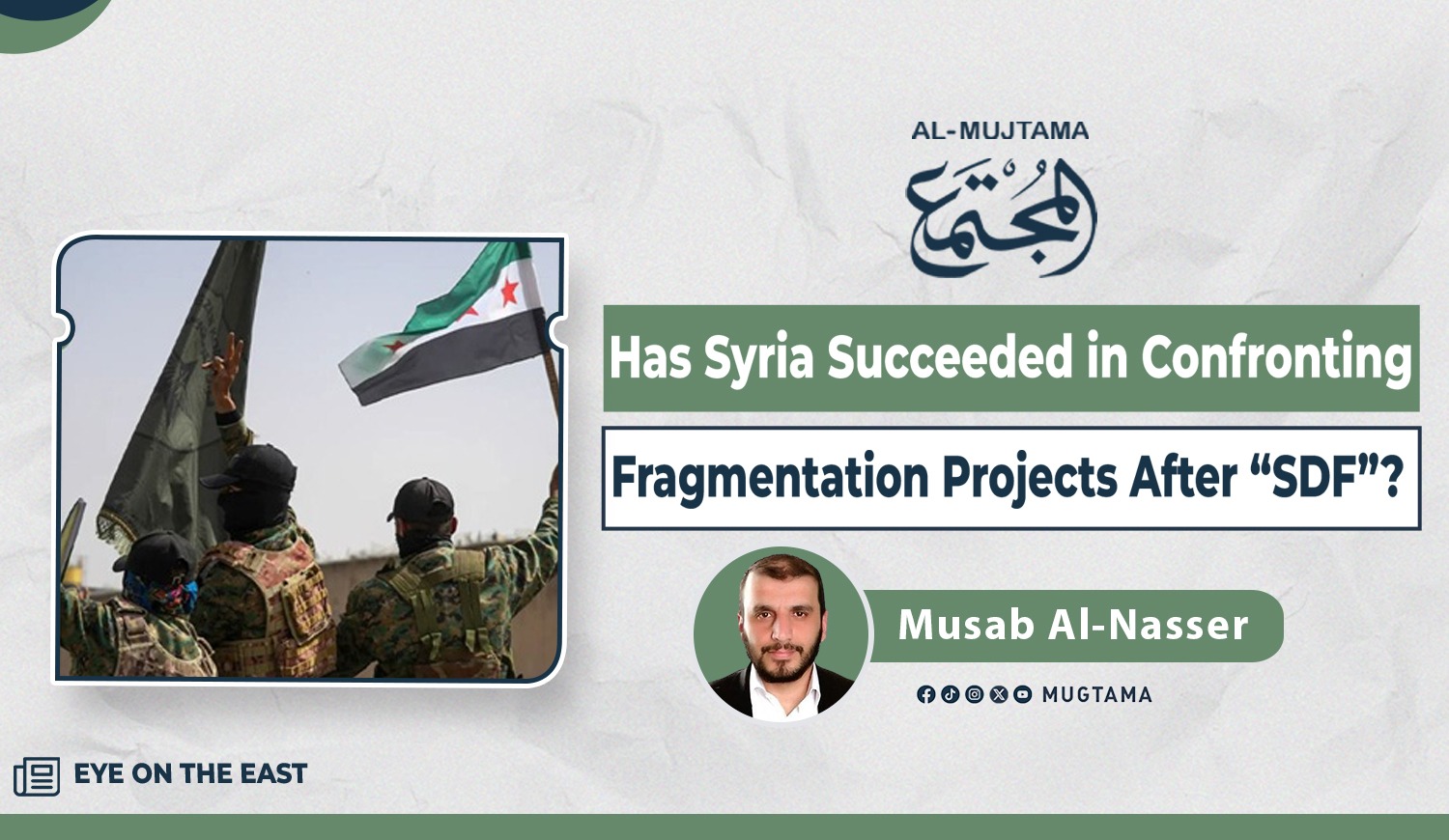
In a pivotal development, considered the most significant in the trajectory of the nascent Syrian state since the fall of Assad’s regime, and a radical shift in the balance of power in the country, the Syrian Arab Army, supported by local tribal forces, succeeded in driving out the separatist forces represented by the so-called “Syrian Democratic Forces” (SDF) from their wide areas of control in northeastern Syria. This strengthened the state’s efforts to undermine the self-rule project the separatists sought to entrench, and reinforced Syria’s drive to unify its territory under a single central authority.
This major development marked a vital achievement for the
emerging state, nearing the end of a project that had long been a chronic
headache, even a poisoned dagger in the body of the war-torn country, under
banners that marketed illusions abroad and falsely claimed to fight “terrorism”
while practicing terrorism itself.
Remarkable Progress: Causes and Roots
The Syrian army launched a military operation, regaining vast
areas in the east and northeast of the country, following repeated violations
by the SDF of agreements signed with the government since March 10. The most
important clauses stipulated the integration of civil and military institutions
in northeastern Syria into state administration, affirming territorial unity,
and the withdrawal of SDF forces from Aleppo to east of the Euphrates.
SDF’s control shrank significantly, as Syrian army and tribal
forces quickly seized Arab-majority areas previously under SDF control. By
January 19, 2026, these forces encircled the last cities still held by
separatists in northeastern Syria.
The most striking feature of the operation was the rapid
advance of the army and tribal forces, contrasted with the swift withdrawal of
separatists—an indicator of several key points.
This quick collapse revealed the external nature of the
separatist militia, disconnected from the land and people, whether through the
foreign affiliations of its leaders or its reliance on external protection and
support, primarily from the United States and some allies.
The militia also relied on coercion and incentives—forced
conscription and financial inducements—to recruit locals. This shows the
organization was largely built on opportunistic or coerced loyalties, which
quickly dissolve and may even turn against it at the first real test.
Challenges: Between Integration and Resolution
Syrian government positions, along with those of international
actors, emphasize the need to implement the agreement to integrate SDF and its
territories into Syrian state institutions. Some approaches suggest
Washington and European states like France push for an administrative-security
solution that reduces clashes while keeping the ISIS and prison files under
control.
Yet despite the importance of this achievement, and although
the Syrian state has dealt a near-fatal blow to the separatist project embodied
by SDF, it is far too early to say Syria is fully safe from fragmentation and
secession projects—at least in the short term. Challenges remain embedded in
the details of the scene.
Military and Political Dimensions
On the ground, the rapid advance of government forces was a
necessary achievement to assert control and defeat the enemy with minimal cost.
But it also suggests the separatists’ strategy was to withdraw quickly with
limited losses, meaning they retain a considerable portion of their military
and human capacity, awaiting new circumstances to possibly reignite conflict.
Politically, some external powers that previously supported
SDF extensively, but have now withdrawn their cover for various reasons, remain
unreliable. As long as interests govern international relations, and those
interests intersected with Syria’s and its allies for now, such convergence may
not last.
Meanwhile, Syria faces two other sensitive internal
challenges in the south and west, both sharing with SDF the principle of
external sponsorship by international and regional powers.
The Shadow of the Old Regime
Remnants of the former regime in the coastal region and
elsewhere remain dormant, launching occasional attacks, backed by powers that
considered Assad’s fall and the people’s revolution a major loss. They now seek
to salvage what they can—or sabotage what they cannot.
Thus, Syria’s real challenges are not purely internal but tied
to international and regional actors, cloaked in different fronts, who view the
nascent Syrian state as an enemy to be weakened or eliminated, exploiting
internal vulnerabilities to advance their agendas.
Security Guarantees
Security measures, backed by political and legal steps, are
essential to structurally and fairly separate separatist organizations from any
coerced social bases.
Part of the solution also lies in Syria’s ability to present
itself domestically and internationally as a reliable, humane authority capable
of managing crises created or exploited by separatist groups—groups that
portrayed themselves as proxies for solving local and regional problems, such
as “extremist organizations.”
Internal Solutions as the Ultimate Guarantee
Above all, internal solutions remain the strongest shield
against crises caused by separatist groups. Kurdish citizens, more than others,
have paid the price, becoming hostages of factions that hijacked their decision
and manipulated their fate.
These solutions rest on strengthening social immunity against
future disruption, by reinforcing coexistence with other national partners
through:
1. Recognizing
the Kurdish component as an authentic national part of Syria, with
positive contributions and active participation in its history and
civilization.
2. Clearly
separating the Kurdish community from the organizations that hijacked
its decision by force, and bridging the social divide they created.
3. Working
to rebuild afflicted areas, allocating resources for comprehensive, sustainable
development.
4. Promoting
political and social elites from these regions who adopt a unifying national
discourse, reject secession outright, and affirm the Kurds’ right—like all
Syrians—to share in decision-making, authority, and national wealth.
Undoubtedly, these approaches to the SDF file apply equally to
other challenges. At their core lies justice in all its material and
moral dimensions, from which stem principles that strengthen coexistence:
respect for human rights, recognition of diversity, belief in equality, and
rejection of violence.
These principles are the essence of good governance, without
which Syria cannot achieve strength, progress, or resilience.