




Book Review: “Child Education in Islam” by Abdullah Nasih `Ulwan
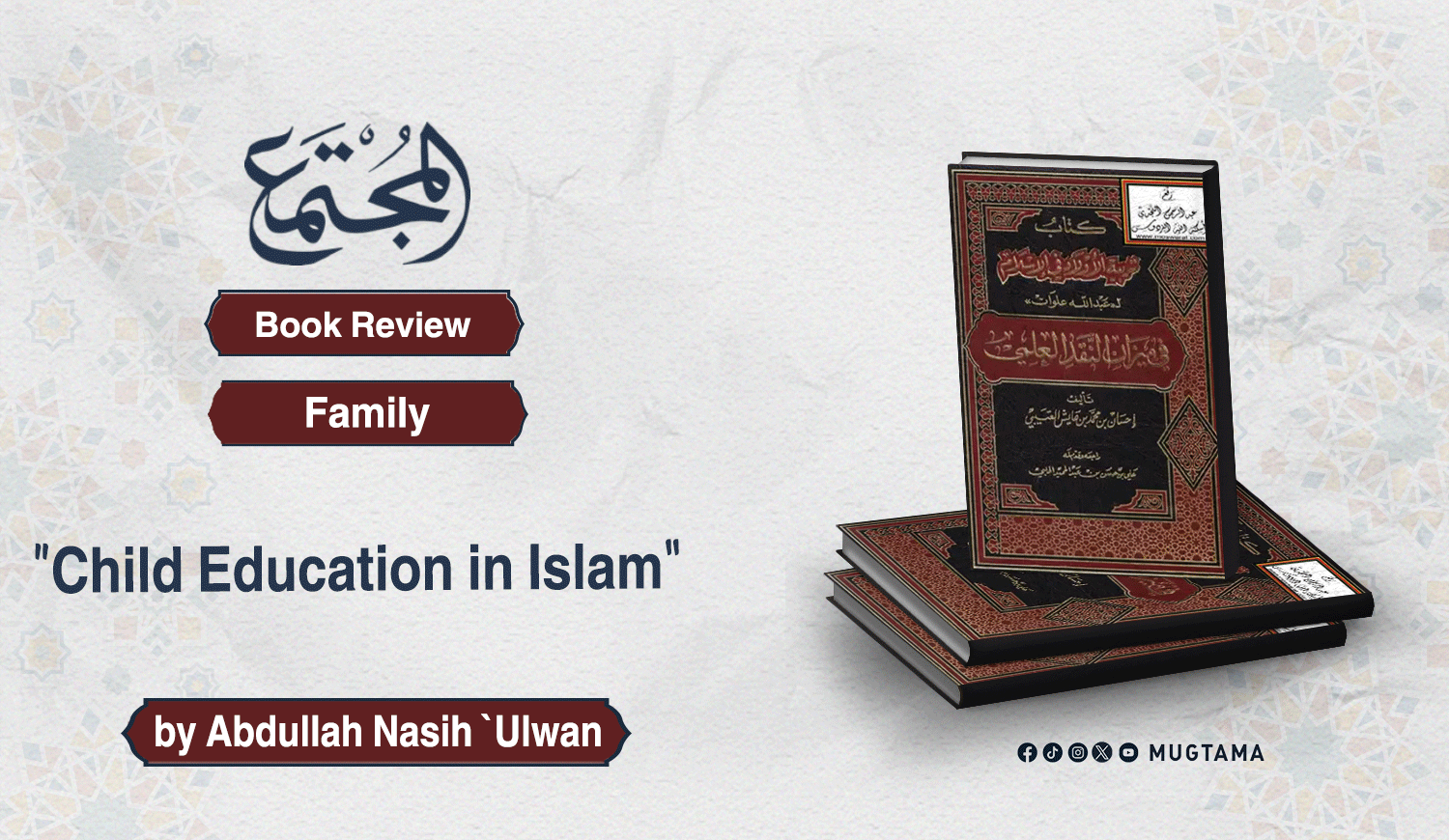
In Child Education in Islam,
Abdullah Nasih `Ulwan presents education as a responsibility that begins long
before a child enters a classroom and extends far beyond academic achievement.
For raising a child means shaping faith, character, intellect, physical
well-being, emotional balance, and social conduct. The book therefore
approaches childhood education
as a comprehensive process through which parents and educators prepare the next
generation to live with purpose, responsibility, and moral awareness.
Education Begins Before Childhood
One of the book’s distinctive features
is that it does not begin its discussion with the child. `Ulwan first examines marriage
and the selection of a spouse, arguing that the foundations of education are
laid within the family itself.
Choosing a spouse on the basis of
religion, character, and suitability is presented as the first step toward
raising a sound generation. Marriage is understood not only as companionship,
but as a social institution through which children are born, nurtured, and
prepared for life.
From there, the author follows the
child from birth, discussing matters such as welcoming the newborn, naming the
child, `aqiqah, and
other practices intended to establish a child’s identity and connection to
faith from the earliest stage.
The underlying principle is that
education is not a task that begins when formal schooling starts. It is a continuous responsibility beginning within
the home.
Faith and Character Before Achievement
The book places faith education at the
center of this process. Parents and educators are encouraged to introduce
children to belief in Allah, the pillars of Islam, worship, the Quran, and love
for the Prophet (peace be upon him) from their earliest years. The author
emphasizes that these foundations should become familiar to the child
gradually, through teaching, practice, and example.
Yet religious education is not
separated from character. Ethical education occupies a major part of the book,
with honesty, trustworthiness, generosity, respect, mercy, modesty, and good
manners treated as qualities that must be deliberately cultivated. `Ulwan stresses
that children learn not only from instructions but from what they observe in
the adults around them. Parents and educators therefore become part of the
curriculum themselves.
This makes the book’s concept of
education fundamentally formative: the goal is not simply to make children
knowledgeable, but to shape the kind of people they become.
The Whole Child: Body, Mind, and
Emotions
`Ulwan’s approach also extends beyond
spiritual and moral development. Physical education includes proper nutrition,
healthy habits, sleep, hygiene, protection from illness, and physical activity.
The book even connects children’s physical development with swimming, archery, horsemanship, and an active
lifestyle.
Intellectual education is given
similar importance. The author presents seeking knowledge as a responsibility
and calls on parents and educators to cultivate children’s curiosity,
awareness, and understanding. He also stresses the importance of exposing young
people to beneficial books, history, knowledgeable teachers, and a wider
intellectual environment.
Psychological education addresses another dimension frequently neglected in
discussions of parenting. Shyness, fear, feelings of inferiority, envy, and
anger are treated as conditions that require understanding rather than simple
punishment. The author argues that excessive indulgence, humiliation, unequal
treatment, and neglect can contribute to psychological difficulties, while
confidence, patience, affection, and balanced discipline help children develop
emotional stability.
Education Through Example, Habits, and
Wise Discipline
Perhaps the book’s most practical
contribution is its discussion of how children should be educated. `Ulwan
identifies several effective methods, including setting a good example,
establishing beneficial habits, offering wise admonition, observing the child
closely, and using appropriate punishment when necessary.
Discipline, in this framework, is not
meant to be arbitrary severity. The author repeatedly warns against
humiliation, excessive indulgence, and inconsistent treatment. When children
make mistakes, correction should be measured and educational, with the aim of
reform rather than simply inflicting pain.
This emphasis on example is
particularly significant. A child cannot be expected to develop honesty while
surrounded by adults who lie, or self-control while witnessing uncontrolled
anger. Education begins with the behavior children repeatedly encounter.
Social Responsibility and the World
Around the Child
The book also recognizes that children
are shaped by environments beyond their parents. Friends, neighborhoods,
schools, media, and broader social conditions can either reinforce or undermine
what is taught at home. `Ulwan therefore calls on parents and educators to
monitor children’s surroundings and to protect them from influences that may
contribute to moral or psychological harm.
At the same time, social education
teaches children that they have obligations toward others. Respect for parents,
relatives, neighbors, teachers, companions, and the elderly forms part of the
moral training described in the book. The author presents qualities such as
brotherhood, mercy, selflessness, forgiveness, and courage as essential
elements in developing a socially responsible Muslim.
The result is a vision of education in
which the child is prepared not merely to succeed individually, but to become a
constructive member of society.
A Comprehensive Philosophy of Raising
Children
Child Education in Islam ultimately argues that successful upbringing cannot
be reduced to schooling, discipline, or religious instruction alone. It
requires an integrated approach in which faith informs character, character
influences behavior, intellectual growth accompanies spiritual development, and
psychological and physical well-being are treated as genuine educational
responsibilities.
The book’s central message is that
children do not simply need information; they need formation. Their habits,
relationships, emotional responses, worldview, and sense of responsibility are
all being shaped from an early age. Parents and educators therefore carry a
responsibility that extends across virtually every dimension of childhood.
-------------------------------------------------------