








Violence as a World Problem
Bondi Beach Incident: An Echo of Global Tragedies

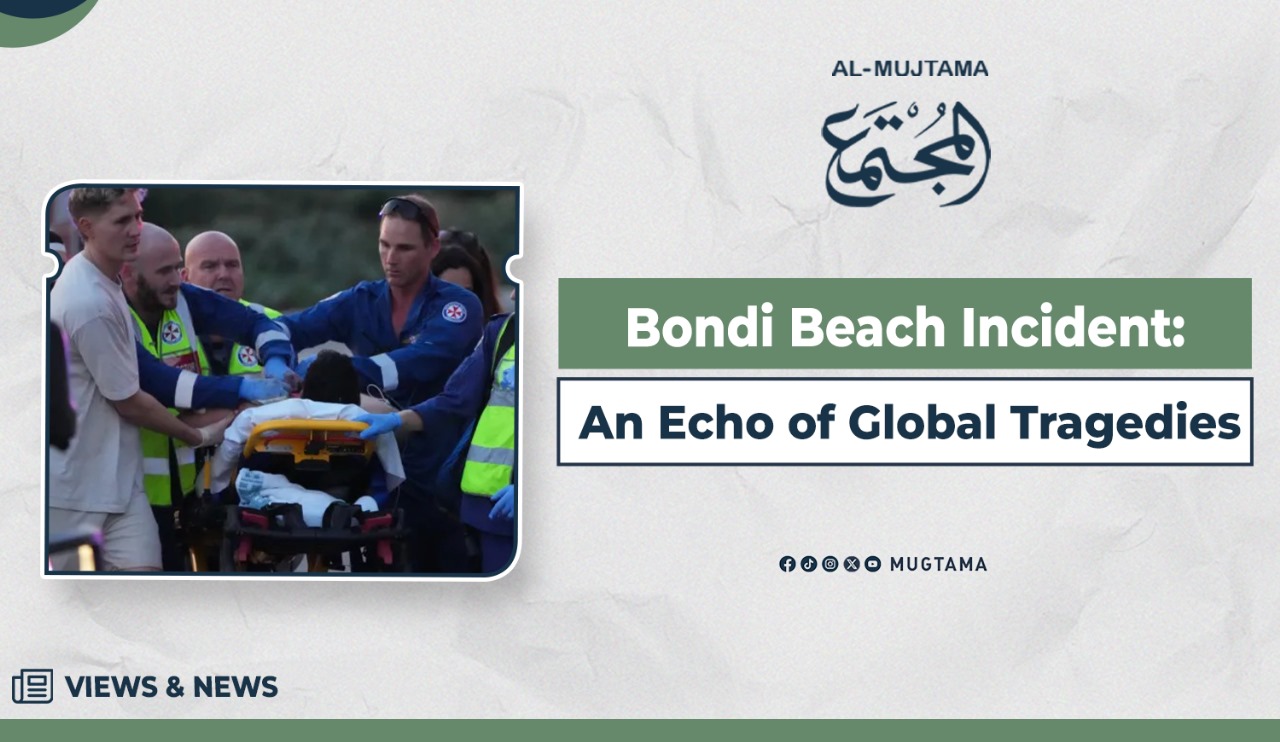
Last Saturday evening, the Australian city of Sydney witnessed a bloody shooting during Jewish Hanukkah celebrations in the Bondi Beach area, leaving 12 people dead and dozens more seriously injured. Australian police announced the arrest of one attacker and the killing of another, while investigations continue to uncover the background and motives of the assault. This incident, which shocked Australian society—long known for its strict gun laws since the Port Arthur massacre in 1996—places the country before a new test in protecting religious minorities.
Local Shock, Global Context
Although mass shootings are rare in Australia,
this massacre comes at a time when hate speech against religious minorities in
the West—whether Muslims or Jews—is on the rise. It is not an isolated event
but part of a troubling global pattern marked by growing sectarian violence,
where places of worship and religious gatherings have increasingly become
targets of hate crimes.
Islamophobia and Attacks on Mosques
The Bondi Beach attack recalls a series of assaults on mosques in the
West, most notably the Christchurch
Mosque massacre in New Zealand in 2019, when more than 50 worshippers
were killed by a far‑right extremist. Europe and the United States have also
witnessed repeated attacks on Islamic places of worship amid rising
Islamophobia and hate rhetoric. These assaults demonstrate that sectarian
violence does not target one group alone, but threatens all religious
minorities and undermines the values of coexistence.
Genocide in Gaza
At the same time, the world is witnessing the
tragedy of Gaza, where Palestinian civilians are subjected to an
Israeli military campaign described by human rights organizations as genocide.
The targeting of hospitals, schools, and essential infrastructure reflects a
systematic policy aimed at breaking the will of the Palestinian people. These
crimes are tied to a global discourse that demonizes Muslims and justifies
their targeting under the guise of “security” or the “war on terror,” making
Gaza’s tragedy part of the broader picture of violence against Muslims.
Attacks in India, Burma, and East Turkestan
Beyond the Arab world, Muslims face similar challenges. In India, Muslims
endure discriminatory policies and mob violence. Burma has witnessed the
Rohingya catastrophe, which the United Nations described as “crimes against
humanity.” In East Turkestan (Xinjiang), Uyghur Muslims face severe repression,
including mass detention and attempts to erase their religious and cultural
identity. These examples reveal that violence against Muslims is not confined
to one region but is a phenomenon spanning continents.
The Position of Muslims in Australia
In this context, the Australian National Imams Council (ANIC) issued a
strong statement condemning the attack and describing it as “horrific,”
affirming that “our hearts, thoughts, and prayers are with the victims and
their families.” The council stressed that Muslims in Australia stand against
violence in all its forms and reject the targeting of any religious group,
whether Jewish, Muslim, or otherwise. This stance reflects a deep awareness
that confronting hatred is a collective responsibility, and that solidarity
among victims of sectarian violence is the only way to safeguard religious
pluralism.
An Echo of Global Tragedies
The Bondi Beach incident is not merely a local tragedy but part of a
global scene marked by escalating violence against religious minorities. From
Gaza, where civilians are killed under bombardment, to India, Burma, and East
Turkestan, where repression is directly enforced, and across Europe, where
Islamic communities are targeted by Islamophobic rhetoric, one picture emerges:
a worldwide crisis in respecting Muslims as part of human diversity. The
condemnation by Muslims of the attack in Australia underscores that confronting
hatred cannot be selective but must encompass all religions and minorities, and
that coexistence remains the only answer to the bullets of hate.