









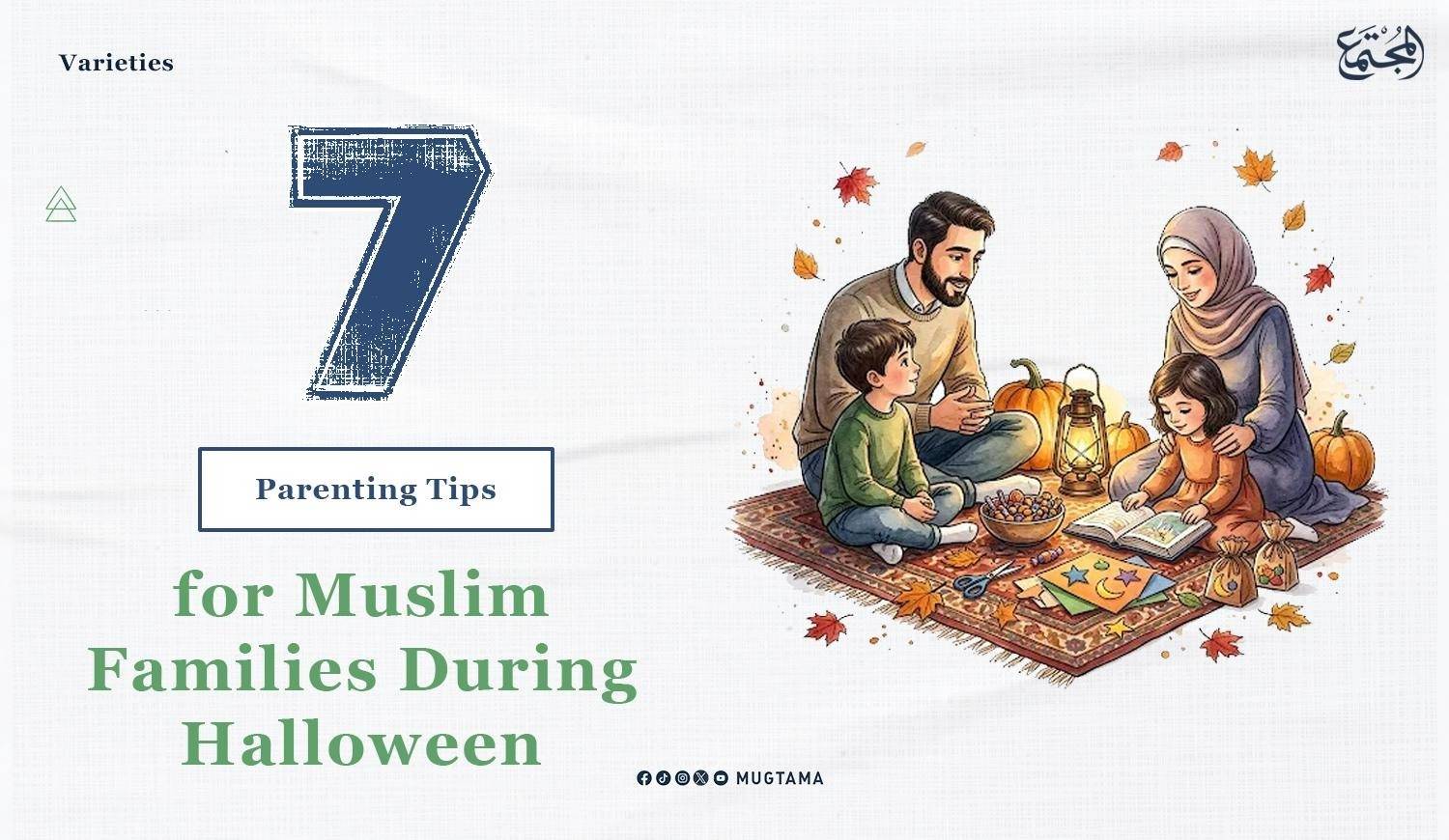
7 Parenting Tips for Muslim Families During Halloween
As Halloween approaches at the end of October each year, some
Muslim parents find themselves facing questions from their children about
costumes and festive activities their classmates take part in. Children may
even insist on joining in out of curiosity or a desire to fit in with their
peers.
The issue goes beyond whether to allow or prohibit a
celebration. It touches on a deeper parenting challenge: How can children grow
up proud of their faith, confident in their identity, and capable of making
their own decisions without feeling isolated or inferior because they are
different from others?
Building a strong Islamic identity does not require constant
confrontation with everything around a child, nor can it be achieved through
commands and prohibitions alone. Rather, it calls for thoughtful parenting that
combines firm principles with kindness and understanding. Here are seven tips
to help parents navigate this occasion.
1. Strengthen Your Child’s Identity
and Make Islamic Holidays a Source of Joy and Belonging
Protecting a child’s identity begins long before occasions
that conflict with family values arise. Children who grow up understanding
their faith, loving its practices, and experiencing the joy of Islamic holidays
are better equipped to appreciate their distinct identity without feeling
deprived of what others enjoy.
Rather than limiting conversations about Islamic holidays to
religious rulings, introduce your child to the meaning of Eid al-Fitr and Eid
al-Adha. Involve them in preparing for these occasions and create family
memories that bring together worship, family ties, and joyful celebrations.
Allah says in the Quran: {Say, ˹O Prophet,˺ “In Allah’s grace and mercy let them rejoice. That is far better than
whatever ˹wealth˺ they amass.”} [Yunus
10:58]
The goal is not to raise children who reject everything
different from their own culture, but to nurture such a strong sense of
belonging that they do not feel compelled to imitate others simply to gain
acceptance.
2. Explain Islam’s Position to Your
Child with Wisdom
When children ask why they cannot participate in Halloween, a
brief answer such as “It is haram” or “We do not do that” may not be enough.
They need an explanation suited to their age that addresses their questions
without unnecessary complexity or fear.
Listen to them first. Then explain that Muslims base their
choices on their faith, and that enjoying something or seeing it widely
accepted among friends does not necessarily make it consistent with their
values. If a religious ruling needs to be explained, ensure that the
explanation is accurate and grounded in reliable Islamic scholarship, without
exaggeration or unsupported generalizations.
Allah says: {Invite ˹all˺ to the Way of your Lord with wisdom
and kind advice, and only debate with them in the best manner.} [An-Nahl 16:125]
Wisdom in parenting does not mean compromising religious
principles. It means communicating them in a way that helps children understand
them, embrace them, and put them into practice.
3. Teach Your Child to Respect
Others Without Adopting Every Custom
Children need to understand that remaining committed to Islam
does not mean mistreating people of other faiths or cultural backgrounds.
Likewise, respecting others does not require participating in every celebration
they observe.
Teach your child to treat classmates kindly, cooperate with
them, and avoid mocking them, while remaining committed to what your family
considers consistent with Islamic teachings. Explain that people may differ in
their beliefs and customs, but such differences never justify injustice or
disrespect.
Allah says: {Speak kindly to
people.} [Al-Baqarah 2:83]
This helps children understand that they do not need to put
others down to take pride in their own identity. Good character remains
essential in every situation, regardless of differences.
4. Pay Attention to What Your Child
Encounters at School and Online
Children may first encounter Halloween through a school
activity, a commercial advertisement, or a social media video. They may see it
as an exciting experience without understanding its background or the messages
associated with it.
Ask about the activities organized at school, monitor the
content your child watches, and discuss what they see and hear. If a school
activity conflicts with your family’s convictions, contact the school in
advance and request an appropriate alternative that protects your child’s
dignity without putting them in an uncomfortable position in front of their
classmates.
Do not let parental supervision become nothing more than
prohibition and restriction. Instead, use it as an opportunity to develop your
child’s critical thinking, helping them learn to evaluate what they encounter
rather than simply waiting for their parents to decide for them.
5. Discuss Peer Pressure Without
Dismissing Your Child’s Feelings
A child may be less interested in Halloween itself than in
avoiding feeling different from their friends. They may fear missing out on the
fun or being ridiculed if they choose not to participate. Ignoring these
feelings or dismissing them as weakness will not solve the problem. It may
instead encourage children to hide their struggles from their parents.
Give your child room to express their feelings. Ask what
appeals to them about the occasion, then help them distinguish between genuine
personal interests and the desire to please others. Reassure them that their
worth does not depend on their peers’ approval and that genuine friendship does
not require abandoning their principles.
Children need to feel understood before they can be guided.
They also need to know that making different choices does not mean losing their
parents’ love or their place among their peers.
6. Teach Your Child to Say No with
Confidence and Courtesy
It is not enough for children to know what they should do.
They also need to learn how to respond when others pressure them. Teach them
simple phrases such as, “Thanks, but I do not take part in this celebration,”
or “Maybe we can do something else together.”
You can role-play possible situations with your child, such as
a friend offering them a costume or inviting them to an activity that conflicts
with your family’s convictions. Let them practice choosing an appropriate
response. This helps them learn to stand firm without becoming confrontational
and to express their position without feeling guilty.
Do not expect children to handle every form of pressure
perfectly from the outset. Confidence develops through practice and
encouragement, reinforced by parents who model consistency and respectful
behavior.
7. Do Not Mock Children Who
Participate in Halloween
Disagreeing with Halloween does not justify ridiculing
children who take part, calling them offensive names, or teaching your own
children to look down on their classmates. Children are not necessarily
responsible for their families’ decisions, and disagreement over a celebration
should never become an excuse for bullying.
Explain to your child that they can decline to participate
without insulting others, and that disapproving of an action does not justify
demeaning the person who performs it.
Allah says: {O believers! Do
not let some ˹men˺ ridicule others, they may be better than them, nor let ˹some˺ women ridicule other women, they
may be better than them.} [Al-Hujurat
49:11]
Islamic parenting is not simply about raising children who
reject certain practices. It is about raising individuals who understand what
they believe, treat those who disagree with them well, and guard their words
and conduct in every circumstance.
Parenting Through Awareness, Not
Fear
Halloween season offers parents an opportunity to reflect on
how they nurture their children’s Islamic identity and teach them to make
decisions based on understanding and conviction. Genuine protection does not
rest on prohibition alone, just as permissiveness does not necessarily produce
a more open-minded child. A balanced character develops through clear
principles, honest conversations, good role models, and an understanding of
children’s feelings.
When children know that their homes offer understanding, love,
and trust, they become better equipped to face outside pressures without
abandoning their convictions.
That is the ultimate goal: to raise Muslim children who take
pride in their faith, treat others with kindness, and remain steadfast in their
values without feeling compelled to imitate others or allowing their
differences to lead to isolation or disrespect.
