









7 Lessons from the Golden Age of Islam
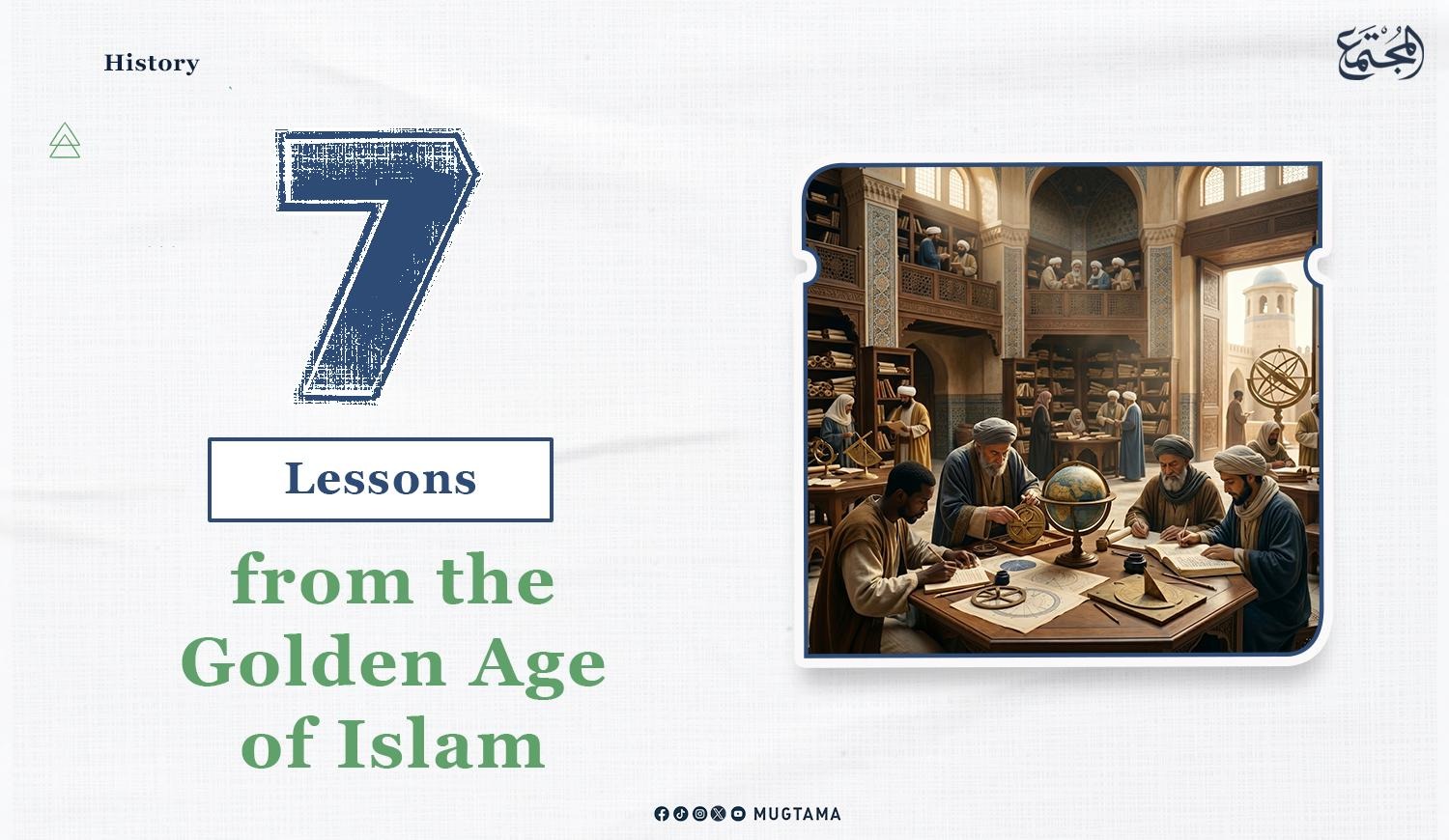
The Golden Age of Islam (roughly 8th to 14th
century) was not merely a period of religious expansion, but a sophisticated
era of intellectual synthesis. Centered
in hubs like Baghdad, Cordoba, and Cairo, this period laid the groundwork for
the modern scientific method, global trade, and humanistic philosophy.
Here are seven enduring lessons from this
era, supported by both Western and Arabic historical perspectives.
1. The Power of Radical Intellectual Openness
The Abbasid Caliphs, particularly Al-Ma'mun,
initiated the Translation Movement. They
didn't see foreign knowledge (Greek, Persian, or Indian) as a threat, but as a
treasure. The Bayt al-Hikma (House of Wisdom) in Baghdad became a hub where
scholars of diverse faiths translated the works of Aristotle and Euclid into
Arabic.
• Lesson:
Innovation thrives when we embrace diverse perspectives rather than fearing
them.
2. Science and Faith as Complementary Forces
During this era, seeking knowledge was viewed
as a religious mandate. Scholars like Al-Biruni used advanced trigonometry to
determine the direction of Mecca, while Ibn al-Haytham (Alhazen) pioneered
optics to understand God’s creation. They didn't see a conflict between the
laboratory and the mosque.
• Lesson:
Rigorous inquiry and personal values can coexist to drive progress.
3. The Institutionalization of Healthcare
The Golden Age saw the birth of the modern
hospital (Bimaristan). Unlike early European models, which were often just
hospices for the dying, Islamic hospitals were centers of healing and teaching,
offering free care, separate wards for different ailments, and even music
therapy for mental health.
• Lesson:
Access to healthcare is a fundamental pillar of a stable and flourishing
society.
4. Meritocracy Over Identity
The administration of the Caliphates often
prioritized talent over ethnicity or religion. Christian and Jewish scholars,
such as Hunayn ibn Ishaq and Maimonides, held high positions as court
physicians and translators.
• Lesson:
A society reaches its peak when it utilizes the best minds available,
regardless of their background.
5. Systematic Doubt and the Scientific Method
Ibn al-Haytham is often cited as the first
true scientist.8 He rejected the Greek tradition of "armchair
philosophy" in favor of experimental evidence.9 He famously stated that a
seeker of truth must "render himself an enemy of all he reads" and
attack it from every side.
• Lesson:
Do not accept "common knowledge" without verification and testing.
6. The Economic Value of Connectivity
The Golden Age saw the "Islamic Green
Revolution." By sharing
agricultural techniques and crops (like citrus, rice, and cotton) across the
Silk Road, the empire created a unified "Global Market." They
developed sophisticated banking systems, including the use of Sakk (the origin
of the modern word "check").
• Lesson:
Economic prosperity is linked to the free flow of goods, ideas, and people.
7. History as a Tool for Prediction
Ibn Khaldun, in his Muqaddimah, founded the
sciences of sociology and historiography. He taught that civilizations follow
predictable cycles of rise and fall based on "Asabiyyah" (social
cohesion).12 He warned that when luxury leads to the decay of social bonds,
collapse is inevitable.
• Lesson:
We must study the patterns of the past to navigate the crises of the future.
The Golden Age of Islam serves as a reminder
that when a civilization prioritizes literacy, curiosity, and inclusion, it can
transform the world for centuries to come.
You may also like:
4 Islamic Empires That Led the World
Islamic History and Smear Campaigns
7Foundations for Building the Islamic Mind
Sources:
The House of Wisdom by Jim Al-Khalili (Western) and Al-Fihrist
by Ibn al-Nadim (Arabic).
Science and Islam: A History by Ehsan Masood.
The Canon of Medicine by Ibn Sina (Avicenna).
Under Crescent and Cross by Mark R. Cohen.
The First True Scientist by Bradley Steffens.
The Venture of Islam by Marshall Hodgson.
The
Muqaddimah by Ibn Khaldun.
