







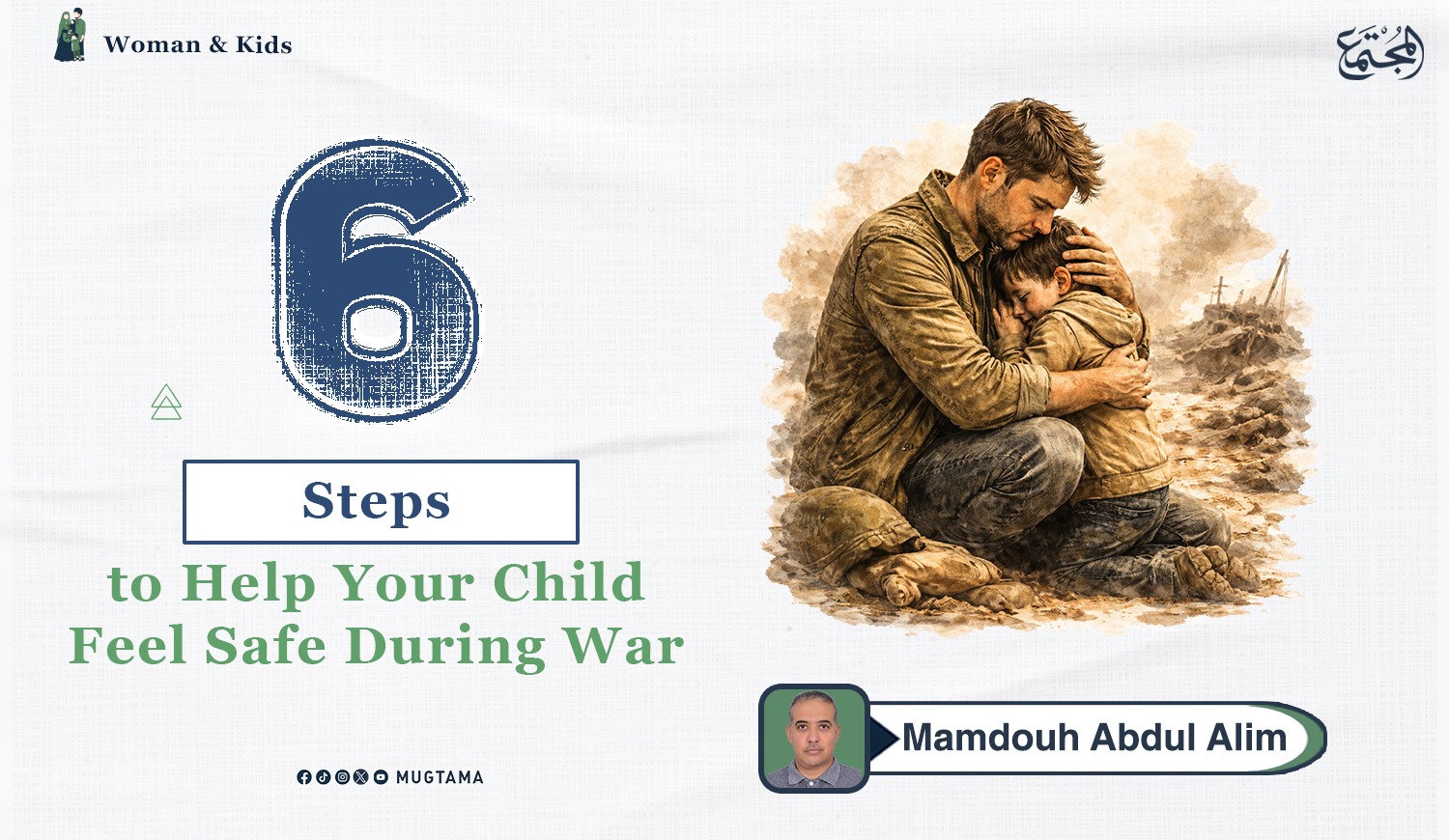
6 Steps to Help Your Child Feel Safe During War

In a
quiet and reassuring home, at the end of a normal school day, an eight-year-old
child sat, eager to enter his small world—games filling the space, laughter
echoing between the walls. Then he would leave his home for the mosque at
prayer time, and go to the club where he practiced his favorite sport freely.
Safety
surrounded him from every side. He never thought about it even once—simply
because he had never known anything else. The roads were familiar, the faces
were known, and life was secure. He had never imagined living otherwise.
But on an
ordinary evening, he sat beside his father who was watching the news, and
suddenly he saw a different reality—intense events, blood, torn bodies,
explosions, planes… and more.
The child
returned to his play, but his laughter was incomplete. His focus became
scattered, and his gaze drifted far away—eyes filled with anxiety and fear,
carrying within them questions he could not answer, nor even form into words.
At the
end of his day, he went to sleep—but his thoughts wandered into what he had
seen, what might happen, and the images that still lingered before his innocent
eyes.
From that
moment, anxiety began to seep into his depths, taking hold of him. Fear became
his constant companion, living beside his thoughts and mind. And just like
that—without warning—life began to change around the child, and so did what was
inside him. He began to lose his sense of safety.
When Children’s Inner Security Shakes
One of
the most dangerous things a human being—especially a child—faces during war is
the loss of safety. It plants seeds of anxiety, fear, and inner discomfort.
Confidence is shaken before understanding is even complete.
A child
who loses their sense of safety lives in internal turmoil that seeps into every
detail of life. Play shifts
from joy and harmony into an escape from inner emotions. Laughter turns into
hidden fear that cannot be expressed.
The loss
of inner security shakes one of the deepest psychological foundations in
children. When this feeling is lost, the body begins to express what the tongue
cannot. Symptoms may appear such as stomach pain, repeated vomiting,
nail-biting, panic attacks, fear, and anger.
In psychology, this is
known as a psychosomatic disorder, where the loss of inner safety transforms
into silent anxiety.
Silent Anxiety and the Child’s Search
for Meaning
Silent
anxiety is that feeling which quietly slips behind a child’s smile, growing in
silence without being noticed by those around them. It is not fear of something
specific, but rather a hidden tension in the heart and confusion in
understanding the surrounding world and the outcomes of ongoing events.
This
begins with distorted imagination in children due to the horrors they witness.
Even the simplest news or images become sources of threat.
In this
deadly silence, the real shaking of inner security takes hold, and anxiety
grows without words. The sense of reassurance then transforms into a persistent
and troubling question: Is the world truly safe and stable as we were told?
How to Help Children Feel Safe During
War
1. The Family as the First
Line of Emotional Protection
In times
of war, the true and highest role of the family emerges. The family is not
merely a financial provider, but the true vessel that carries and protects
children psychologically and physically through crises.
It is the
refuge—after Allah—to which the child turns in a changing and unstable world.
The family must reinforce feelings of safety and connection, reduce tension and
anxiety, and repeatedly affirm: “You are safe… we are with you.”
2. Presenting a Balanced
View of the World
We must
present the world to children as it truly is—not idealized, and not overly dark
or hopeless. Balance is essential.
It is a
world that contains good and evil, rich and poor, oppressor and oppressed, good
and bad, angels and devils.
Providing
this balanced image helps children understand reality during times of war
without exaggeration or denial. It allows them to realize that fear and anxiety
are part of life—but not the end of it—and teaches them how to coexist with
both fear and safety.
3. Filtering What Children
See on Screens
One of
the family’s responsibilities during war is to limit children’s exposure to
graphic content. Children process events differently than adults.
Continuous
exposure to scenes of violence, explosions, and blood can transform normal
anxiety into chronic fear and psychological distress, hindering healthy
emotional development.
4. Communicating
Reassurance Through Actions and Emotions
Children
do not only need reassuring words—they
need to feel reassurance.
A calm
tone of voice, a warm smile, and repeated hugs all build a deep sense of
comfort and safety within them, reducing anxiety and fear.
5. Answering Their Deep and
Existential Questions
During
times of war, children begin to ask deep questions that require both logical
and faith-based answers, such as: Why did Allah create evil? Why does the oppressor sometimes prevail?
These
questions need thoughtful responses that stabilize their emotional and
spiritual understanding, helping build a sound moral and faith-based
foundation.
6. Reducing Pressure on
Children
A child
during war is already experiencing internal pressure. Therefore, external
pressures must be reduced—such as excessive schoolwork and overloaded
schedules.
Expectations
should be moderated, allowing the child space to cope. This helps protect their
daily life from additional psychological strain.
For Further Reading:
- Bodily Privacy: Children’s Right to Safety and Dignity
- 8 Major Dangers of Internal Conflict
- Disorientation! Between the missing of a father and the illusion of love
-------------------------------------------------------------