







Kuwait Approves New Secondary Education Pathways System to Begin in 2026/2027
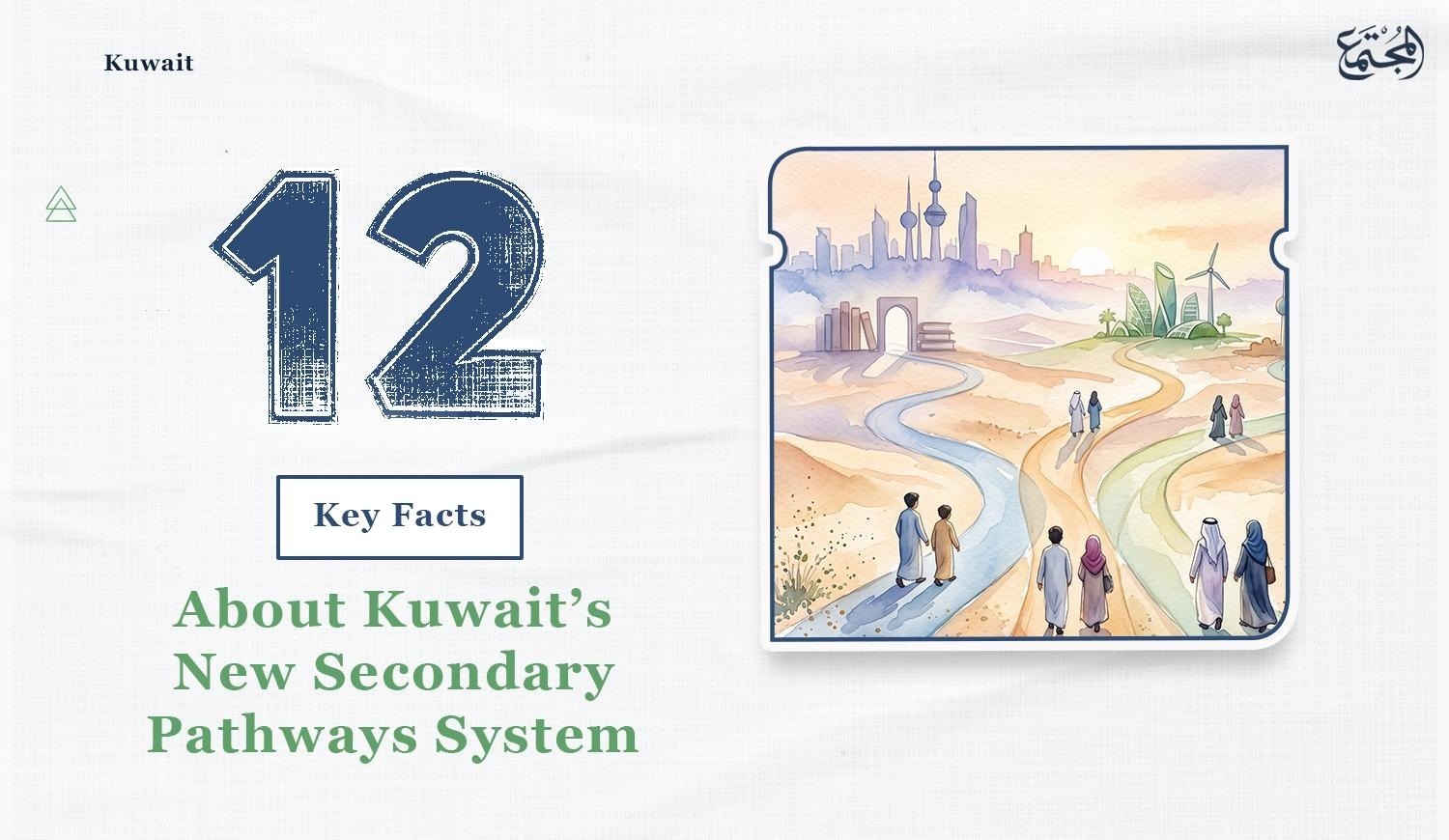
12 Key Facts About Kuwait’s New Secondary Pathways System

Minister of Education Eng. Sayed Jalal
Al‑Tabtabaei has approved the official framework for the new Secondary Pathways System, set to be implemented starting in the 2026/2027 academic year. The
reform aims to modernize secondary education and help students build academic
trajectories aligned with their abilities, interests, and future career needs.
According to the Ministry of Education, the new system introduces a structured model that begins with a
foundation and exploration phase, then transitions into specialized
pathways. The framework regulates admission, registration, coursework, assessment,
and graduation requirements.
1. Duration and Structure of Study
The pathways system spans three
academic years—from Grade 10 to Grade 12—divided into six semesters. Student progression depends on the number of completed units. If a student struggles in
a specific course, remediation is applied to that course only, without
affecting previously completed units.
Each student receives an academic
record detailing grades, GPA, and remaining requirements, enabling families and
schools to monitor progress and intervene early when needed.
2. Foundation and Exploration Phase
Students begin with a foundation year
that includes:
- Islamic Studies
- Arabic Language
- English Language
- Mathematics
- Integrated Sciences
- Social Studies
- Computing
- Exploration
- Physical Education
- Free Choice
Students take one exploration course
in the first semester and the second in the next. These courses provide hands‑on
exposure to different fields and help determine the student’s future pathway.
3. When Do Students Choose Their Pathway?
Students select their pathway after
completing 18 units and meeting all foundation requirements, including aptitude
assessments, interest surveys, and counseling sessions.
Educational counselors review results
with students and parents before documenting the final decision. The system
offers eight pathways:
1. Mathematics
2. Sciences
3. Languages
4. Business
5. Industrial
6. Technology & Artificial
Intelligence
7. Law
8. Social Sciences
4. Criteria for Pathway Placement
Student preference is the primary
factor, provided capacity and requirements are met. If prioritization is
needed, the following weights apply:
- 35% cumulative GPA
- 25% average scores in pathway‑related courses
- 15% aptitude
- 10% interests
- 10% exploration performance
- 5% counseling report
Students must earn at least 2 GPA
points in prerequisite courses for their chosen pathway. Placement
decisions are shared with students, who may appeal through approved procedures.
5. Coursework After Choosing a Pathway
Across the remaining four semesters,
students study:
- 4 general core courses
- 4 pathway‑specific courses
- Physical Education
- Free Choice
Pathway courses include mandatory and
elective components. Students may switch pathways under specific conditions,
with clear documentation of equivalent courses and graduation impact.
6. Units and Weekly Load
Each semester includes nine units
and a weekly load of 35 periods. Physical Education and Free Choice each
carry half a unit, with PE taught once weekly and Free Choice twice
weekly.
Both are graded on a pass/fail basis
and count toward graduation but not GPA.
7. The Flexible Period
A mandatory weekly flexible period is
dedicated to:
- Counseling
- Academic support
- Skill development
- Approved activities
Attendance is recorded, but the period
carries no grade or academic penalty. It cannot be used to teach or compensate
academic courses.
8. Student Assessment
Assessment combines coursework and
final evaluation:
Theoretical Courses:
- 40 marks coursework
- 60 marks final exam
Laboratory/Practical Courses:
- 50 marks coursework
- 50 marks final exam
Exploration Course:
- 60 marks coursework
- 40 marks final task & portfolio
Final exams follow centralized
standards. Grades are converted to a four‑point GPA scale.
9. Handling Absence or Academic Difficulty
Learning difficulties and academic
struggles are addressed through support plans and remediation. Students may
retake courses or improve GPA under regulated conditions. If a student misses a
final exam due to a documented medical excuse, coursework is preserved and the
student is not considered failing.
10. Attendance and Graduation Requirements
Attendance is tracked per period, with
progressive warnings before any deprivation decision. Graduation requires:
- Completion of 54 units
- Fulfillment of pathway courses
- Completion of all graduation requirements
- A cumulative GPA of at least 1.0
Only 48 units count toward GPA;
PE and Free Choice remain outside GPA calculation.
11. Graduation Project and Community Service
The graduation project is mandatory,
carries zero units, and is graded pass/fail. Students must also complete 60
documented field hours—15 hours per semester from the third to the sixth
semester—covering community service or field training.
12. Summer Study and Early Graduation
An optional summer semester allows
students to complete up to 9 units for remediation or acceleration.
Eligible students may graduate at the end of the fifth semester if all
requirements are met.
The system is currently implemented in
12 schools—one for boys and one for girls in each educational
district—and is undergoing continuous evaluation before nationwide expansion.