






When the Flames Spread
Why Saudi Arabia Must Not Stand Alone
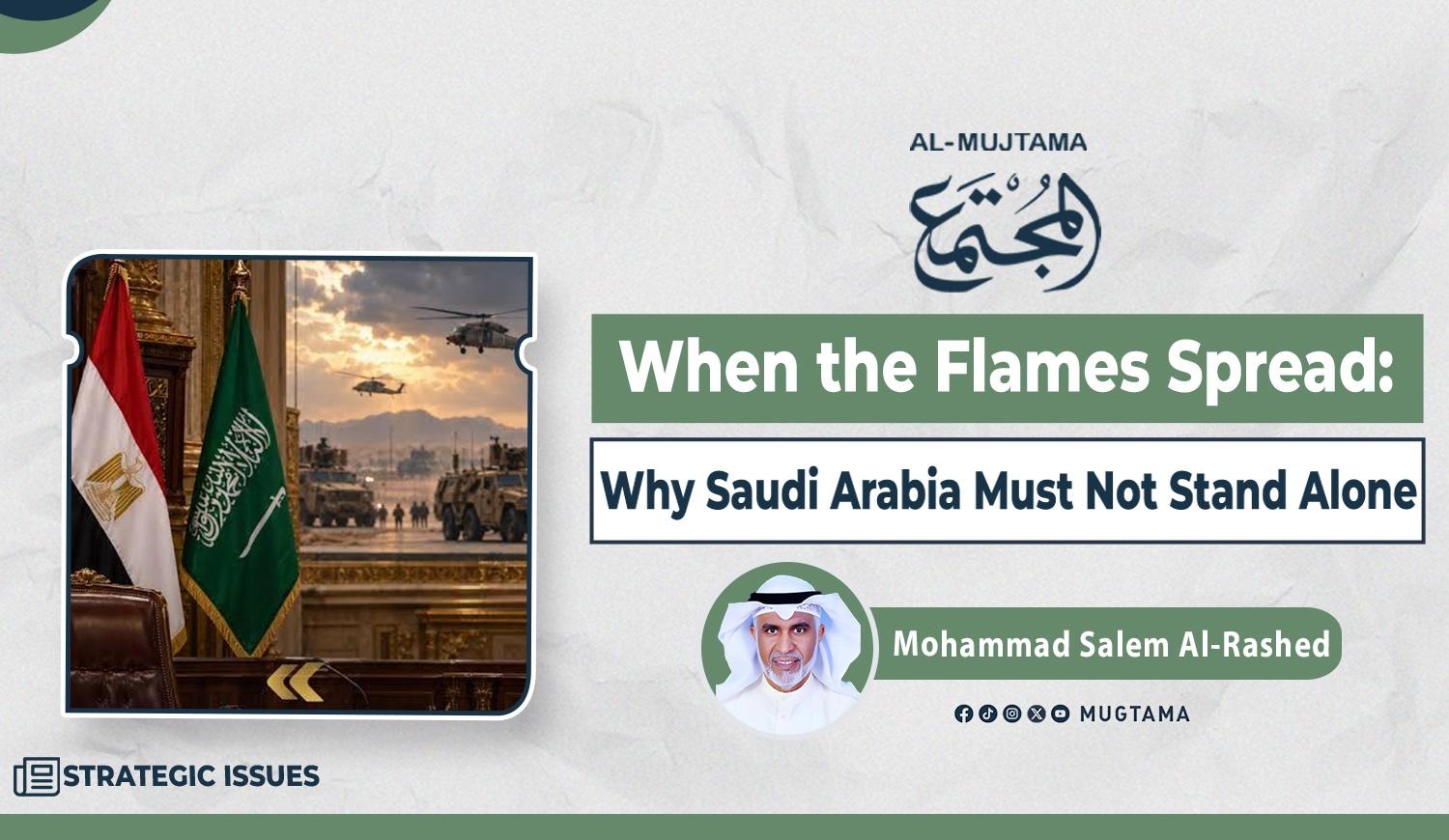
The question facing the Gulf states is no longer whether a new war will break out in the region, but rather: Have we prepared ourselves for a war that may expand before we can contain it? In just a few weeks, military, economic, and security threats have accelerated, and the fronts of the Gulf, Yemen, the Red Sea, and the Horn of Africa have intertwined, leaving the region facing a strategic test that no single country can confront alone.
At the heart of this storm stands the Kingdom of Saudi Arabia.
It serves as the greatest geographical, economic, and political weight within
the Cooperation Council, and its stability is the cornerstone of Gulf
stability. Therefore, targeting its oil facilities, airports, cities, and holy
sites represents a threat not only to Saudi Arabia, but to the security of the
entire Gulf.
The Security Umbrella
The war of February 28, 2026, and its aftermath exposed the
limitations of the American and Western security umbrella. In an investigation
published by Reuters on October 15, the agency documented at least 135
missile and drone attacks on 84 vital sites across the Gulf, including energy
facilities, ports, airports, and pipelines. These facts do not imply the end of
the Western security partnership, but they necessitate a review of its adequacy
in confronting a multi-front war.
Hence, the importance of the Saudi move toward building a
broader deterrence framework becomes evident. Saudi Arabia, Turkey, and
Pakistan announced—in an official statement issued following the Riyadh meeting
on October 5, 2026—the transition to the practical implementation of collective
defense commitments within the "Mecca Defence Alliance," along with
taking necessary measures to provide, rapidly deploy, and position agreed-upon
forces and capabilities.
As for Egypt, it declared its solidarity with the Kingdom
within the four-nation statement on October 11, and subsequently discussed
providing military support, though constitutional procedures required for
deploying its forces remained incomplete as of October 19.
Multiple Fronts and Chokepoints
On the southern front, attacks by the Houthi movement
backed by Iran represent a continuous threat to civilian infrastructure, energy
supplies, and navigation in the Red Sea. In their joint statement on October
11, Saudi Arabia, Turkey, Pakistan, and Egypt condemned Houthi attacks on King
Khalid International Airport in Riyadh, which resulted in casualties, injuries,
and civilian damage—a formal testimony to the escalation of threats to vital
facilities directly impacting population and economy.
Meanwhile, the Strait of Hormuz has transformed into a
dangerous geopolitical and economic leverage tool. The U.S. Energy Information
Administration highlights that approximately 20.9 million barrels of oil and
petroleum liquids per day transited through the strait during the first half of
2026, compared to 4.2 million barrels per day through Bab al-Mandab. This
indicates that disrupting both chokepoints simultaneously threatens global
energy flows, maritime trade, and marine insurance, while raising the cost of
war for both Gulf nations and the wider world.
On the opposite shore of the Red Sea, tensions are mounting
between Ethiopia and Eritrea, while the war in Sudan depletes state
institutions and their ability to contribute to Red Sea security. Israeli
confrontations in Palestine, Lebanon, and Syria add further possibilities for
conflict expansion, while the U.S.–Iranian confrontation remains a direct
source for potential spillover of strikes into Gulf territory. Furthermore,
European-Russian tension adds further complexity to the international
environment upon which the region relies for arms, energy, and trade.
The losses are no longer hypothetical. In an analysis
published by Reuters on October 15, based on International Monetary Fund
projections, the Saudi economy is estimated to contract by approximately 3.3%
during 2026, the UAE economy by 3.9%, and the Qatari economy by 15.6% amid the
repercussions of war and energy and trade disruptions. While these forecasts
are not final outcomes, they expose the sheer magnitude of economic risks.
The most dangerous aspect of these threats is not merely their
multiplicity, but the potential for their simultaneity: maritime passages
become disrupted, energy facilities suffer damage, air defenses are depleted,
and investment confidence erodes, all while major global powers remain
preoccupied with their own domestic and regional crises.
What Is to Be Done?
Gulf states require a collective strategic decision that
transforms the Gulf Cooperation Council from a coordination framework into an
actual system of joint security. This must be achieved through integrated
defensive operations leadership, a unified early warning network, a shared
stockpile of interceptor munitions, collective cyber defense, and contingency
plans to maintain water, electricity, food, and medical supplies.
They also need coordinated protection for maritime passages,
the development of alternative energy export routes, the establishment of a
Gulf emergency economic fund, and unified diplomatic stances to prevent the
expansion of war—alongside supporting sustainable settlements for the crises in
Yemen, Sudan, and the Horn of Africa.
Most importantly, differences in assessment among Gulf
capitals must not become vulnerabilities exploited by external interests.
Saudi Arabia should not be left to confront these threats
alone; its security is integral to Gulf security, and its strength is
part of the strength of all its neighboring states. What is required is not a
rash rush into war, but rather a joint readiness that prevents it, a deterrence
system that raises its cost, and diplomacy that addresses its root causes.
The era of assuming that the fire will remain beyond borders
has ended. When the region catches fire, the flames will not distinguish
between the borders of small or large states: either the Gulf protects its
security as a single strategic block, or each nation will face the region's
dangers alone.(1)
