






Raising Balanced Muslim Children
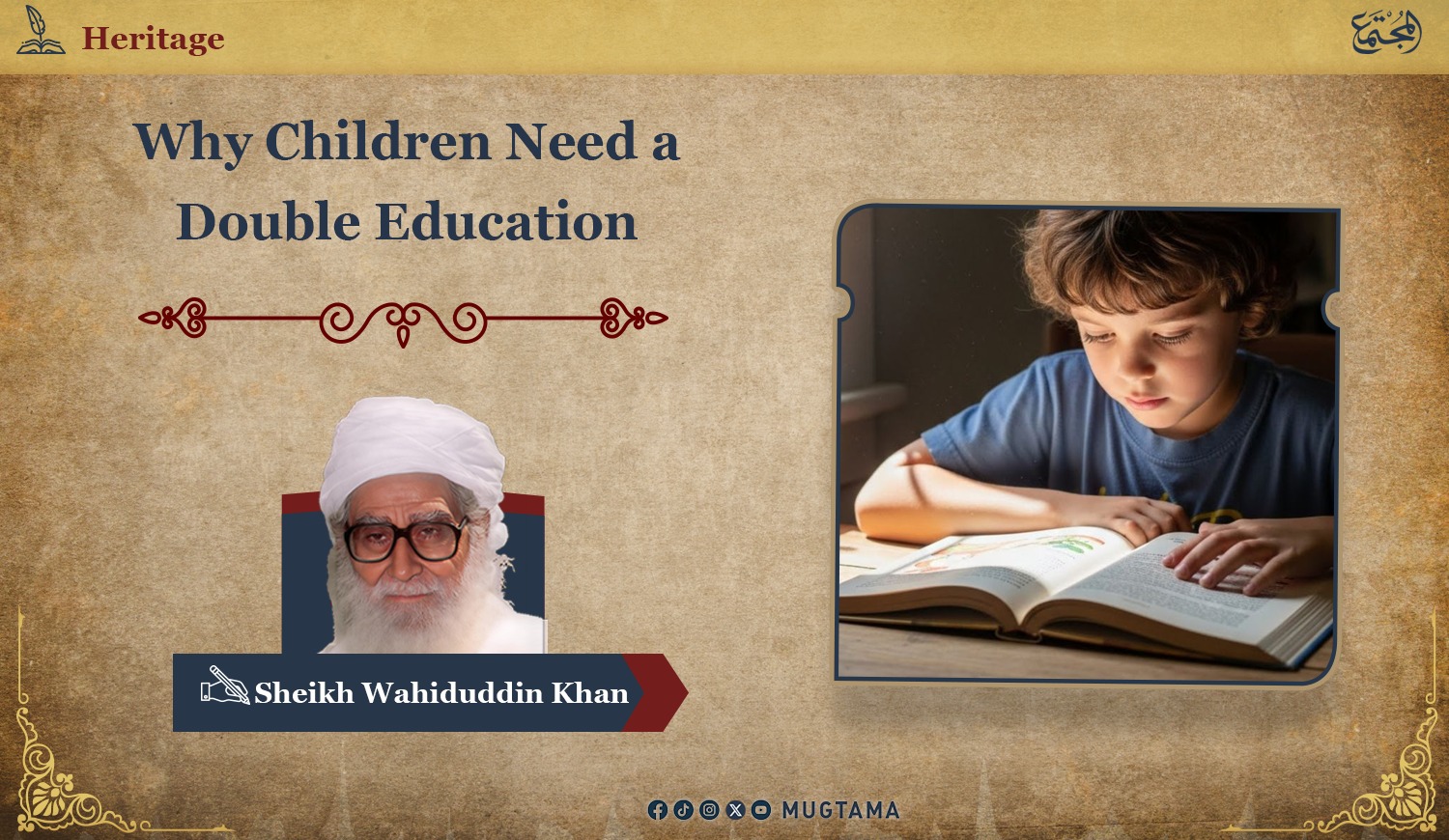
Why Children Need a Double Education

A Crisis of Education in the Modern Age
Once when I was in California, in
the USA, I happened to meet a senior Indian immigrant with whom I had a
conversation about education. I remarked that it was the age of education and
that the greatest need of our generation was to be educated up to the highest
standard. But my interlocutor said that his experience in this field had been
very disappointing. He had wanted to introduce young people to higher learning, but the result had dashed his hopes. He opined that what was
needed now was a re-conditioning of minds rather than learning.
Parents and the Failure to Understand Young Minds
I said that the fault lay with
the parents. For the parents, there were only two options: either accept
whatever was going to become of their children or try to understand them and
address their minds in such a way that what they required of them was made
clear to them. This phenomenon can be seen in every country. Parents, having
failed to understand their children’s minds, go on complaining about them. It
is, of course possible to change your children’s way of thinking, but you must first be endowed with the
intellectual ability to properly address the minds of your educated children.
The Gap Between Traditional Parents and Modern Education
The fact is that in our present
society the majority of parents are traditionally minded, but they want to
educate their offspring in modern educational institutions.
This requires an approach which
can take in a blend of the traditional and the modern. And then parents, rather
than give up on their traditional thinking, should re-define it in order to
make it understandable to the new generation. It is this failure that has
created the problem of children’s resistance to the right type of education and
the problem of how to overcome this resistance. So any shortcoming in the
sphere of education is the parents’ fault. It is not so much a question of re-conditioning
of the mind as a question of self-training. If parents want to bring about a
change of attitude towards learning in their children, they must prepare
themselves to be good counsellors. It is weak counselling on the part of
parents that has created this problem.
The Hidden Harm of Over-Pampering Children
Another problem is pampering. Parents
have great affection for their children and this often leads to their pampering
them. While affection is good, pampering is bad. Pampering fosters an
easy-going nature in children and that is the worst kind of nature for any
person to have in this world of harsh realities. Pampered children do not heed
advice. They know nothing but their own desires. Harsh realities have no place
in their dictionary. It is for this reason that pampered children cannot meet
the challenges they have to face in the external world.
Once I met two Indian boys, both
graduates, who said that they found themselves in difficult circumstances. When
they were at home, they were living under the protection of their parents, who
were always ready to provide anything they wanted. But now that they had left
their homes and wanted to find a place in the external world, they felt unloved
and unwanted. Their homes had been ready to give them everything free of cost,
but now they found that the external world was quite different. Here everything
had its price in terms of hard work, adjustment, acceptance of reality, proving
their ability and making compromises. They found that at home they had not been
trained to meet such challenges.
This is what is negative about
pampering. Parents’ pampering is like making a product that is not wanted in
the market.
The Home as the Center of Spiritual Education
Parents must come to understand
that their children need a double education – a professional education as well
as spiritual training. The former kind of education can be had in educational
institutions but the center for the latter kind is the home. And parents are
the teachers in this home institution. But parents must realize that the
language of dos and don’ts will not serve the purpose. They must prepare
themselves for a more sensitive and complex approach. Indeed, they must ground
themselves in what may be called rational spirituality.
Also Read:
- Teaching at Ibn Khaldun
- Islamic Education Curricula: Reality and Aspirations
- Book Review: "Psychological Fragility" by Dr. Ismail Arfa
-------------------------------------------------------------
Taken from: “Leading a Spiritual Life” book by Sheikh Wahiduddin Khan
