







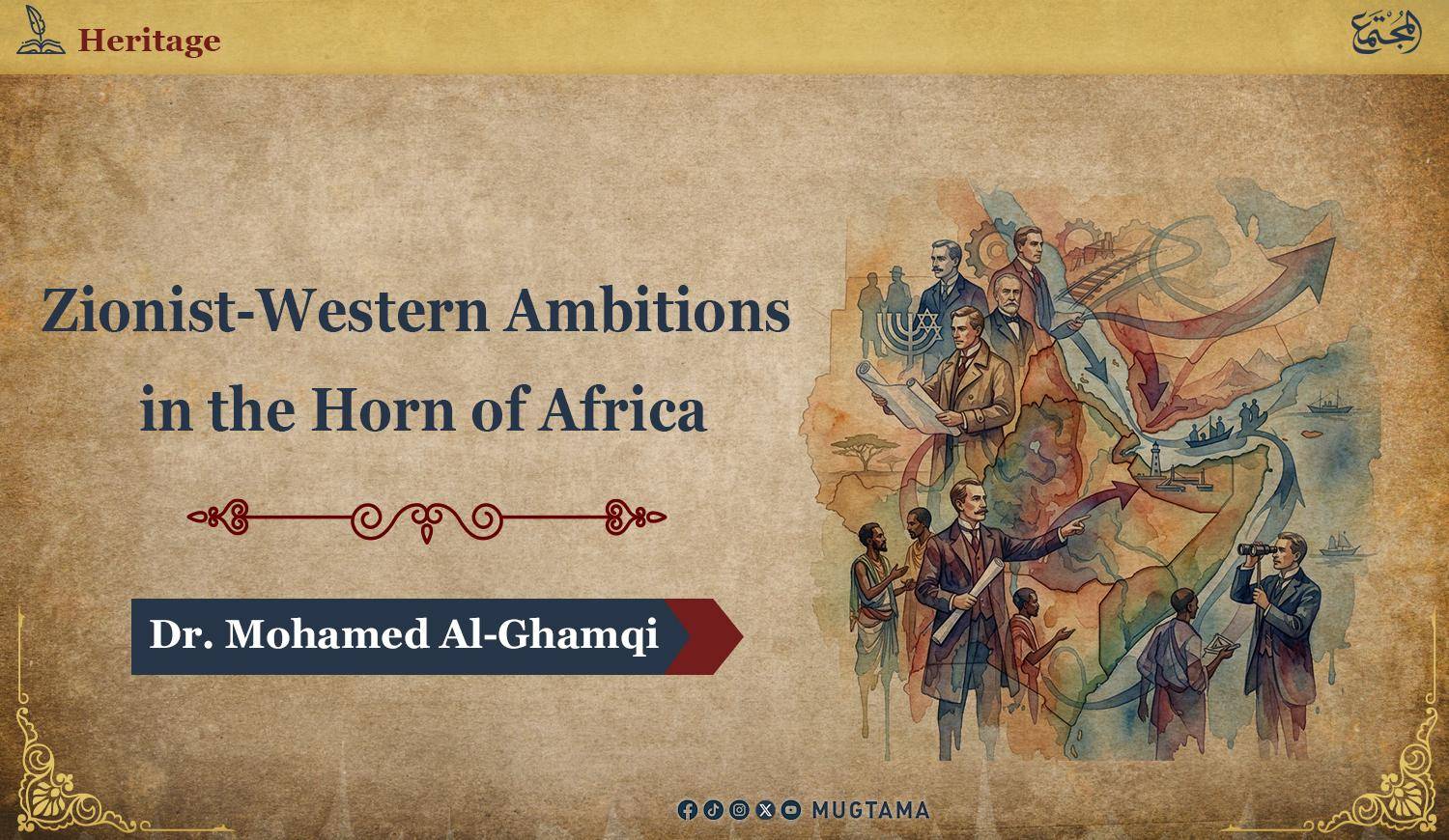
Western-Zionist Ambitions in the Horn of Africa
Following
the collapse of the Eastern Bloc and the emergence of a new American-led
international order, Western-Zionist interest in the Horn of Africa has
resurfaced. This renewed focus is driven by the region's strategic location,
the aspirations of its peoples to break free from the nightmare of foreign
hegemony, and the emergence of signs of awareness regarding the importance of
this African gateway for spreading the Islamic call throughout the Black
Continent.
The Importance of the Region in Strategic Planning
The
significance of this region has increased following major transformations
within its principal countries (Somalia, Djibouti, Ethiopia, Eritrea) or those
neighboring and surrounding it (Sudan, Yemen, Kenya), in addition to the
evolution of relations among all these parties, which are linked in turn to
international balances and circumstances. The main milestones of this
transformation process include Eritrea's independence from Ethiopia (formerly
Abyssinia) after 30 years of struggle, foreign intervention under the auspices
of the United Nations in Somalia, the establishment of a new political system
in Sudan with a clear Islamic project, entry into a democratic experience via
parliamentary elections in Yemen following the unification of its northern and
southern parts, and the fall of the Ethiopian communist dictatorial regime led
by Mengistu Haile Mariam.
Major Transformations
However,
these transformations, their regional repercussions, and the interaction of
international powers with them cannot be understood without a historical
reading of the most important phases the region has traversed. These can be
summarized into four major phases: Arab-African coexistence, colonial conquest,
the American-Soviet conflict over spheres of influence in the Horn of Africa
and Africa in general, and the current phase under the new international order.
Arab-African Coexistence
The East
African coasts witnessed the succession of numerous civilizations, and Arabs in
turn realized the importance of these regions, undertaking successive
migrations driven primarily by commercial objectives during the eras of Omanis,
Yemenites, and Hadhramis, and later for religious reasons since the emergence
of Islam in the land of the Hijaz. The first Islamic migration, led by Jaafar
bin Abi Talib—the cousin of the Messenger of Allah (pbuh)—headed to Abyssinia,
the center of gravity of Christianity in Africa during the reign of the Negus.
This religious tolerance had a profound impact on civilizational coexistence
among various cultural and religious entities spread across the East African
coasts. Several historians speak of the consolidation of the ancient
relationship between the western coast and the African coast after the
emergence of Islam. Ibrahim Tarkhan states in his book «Islam and Islamic Kingdoms in Abyssinia» that the emergence of Islam helped inject new blood
into the veins of these relationships, which witnessed remarkable prosperity in
early Islam to the extent that Islamic kingdoms were subsequently formed in
Abyssinia and the African coast, neighboring Christian rule and coexisting with
it.
This
coexistence was the prominent fundamental feature during this historical phase
extending until the beginning of the 16th century AD, the date of the
Portuguese conquest of the East African coasts. In his evaluation of the
results of this prosperous historical period, Salahuddin Hafez reviewed in his
book «The Superpower Conflict over the Horn of Africa» the
manifestations of the Arab-Islamic civilizational resurgence and «the
successful, permanent, and continuous intermarriage between Arabs and Africans
in Somalia, Eritrea, Abyssinia, Zanzibar, and even Mozambique to the south.»
Successive waves of Arab migration and their continuous intermarriage with
native Africans left far-reaching impacts in strengthening Arab-African
relations over the years, encompassing economic, political, religious, social,
and cultural dimensions. Along with the Arabic language and Islam, other
manifestations of Arab civilization—such as the architecture of house building,
cities, and trade centers, up to the dissemination of centers of culture and
science—were transferred to the African coast. These are, of course, the most powerful
and enduring impacts of the intermarriage between Arabs and Africans of all
time.
Foreign Conquest
With the
Portuguese conquest, a new phase began that paved the way for foreign
colonialism and upended the balance of power in the region. Among the most
dangerous consequences of this phase was the deprivation of the East African
coasts at the level of the Horn of Africa and the Red Sea of the important
commercial benefits that had primarily accrued to Arab trade centers. This
occurred after the historical route of Eastern trade via the Arab homeland
toward Europe was diverted to a new route passing via the Cape of Good Hope,
discovered by the Portuguese. The new beneficiary of this transformation was
the rising European powers, which subsequently became colonial empires that
came to Africa to inherit the Ottoman legacy in the north of the continent and
on its eastern coasts.
This phase
was characterized by intense colonial rivalry among Britain, France, and Italy
to expand in Africa and control strategic control areas, passages, and water
straits holding sway over international trade routes. It is well known that the
geographical and political strategic factor played a fundamental role in
shaping internal events and transformations in the Horn of Africa region and
the positions of international powers toward them in the direction of
entrenching foreign ambitions in the region. Geographically, the Horn of Africa
occupies an important strategic location by overlooking one of the main
international maritime passages, namely the Red Sea with its southern entrance
(Bab el-Mandeb) and northern entrance (the Suez Canal, inaugurated by France in
November 1869).
The Berlin
Conference of 1884–1885 is considered the decisive turning point in formalizing
the European colonial race by setting boundaries for new colonies and imposing
a political reality that established varying and different internal power
balances in favor of the Ethiopian Empire and at the expense of the Somali
party, leaving serious negative effects to this day. Somalia was divided into
four parts subject to the spheres of influence of the three colonial powers and
the Ethiopian Empire. France occupied northern Somalia, specifically the Afar
and Issa region (modern-day Djibouti). After Britain seized Aden in 1839, its
armies occupied the Somali coast facing its base in Aden and controlling the
southern entrances of the Red Sea. The Italians managed to occupy the coasts of
southern Somalia, the entire «Benadir» coast in 1889 from an area located south
of the Gulf of Aden down to the city of Kismayo, in addition to occupying
Eritrea in 1890. Italy exploited the British-French rivalry and the Egyptian-British
preoccupation with the Mahdist Revolution in Sudan to impose its control over
the region.
The Colonial-Ethiopian Alliance
What draws
attention, however, is the strategic alliance between the European colonial
countries and Ethiopia since the era of Menelik II (1889–1913) and subsequently
Emperor Haile Selassie. During Menelik's era, Ethiopia's borders expanded to
become an empire, incorporating numerous parts of Somali lands, especially
Ogaden and Haud. Wishing to gain international recognition for his expansionist
ambitions, Menelik sent a famous letter to the kings of Europe informing them
of the new borders of Abyssinia, dated April 10, 1891, in which he stated: «If
we trace the borders existing today of my empire, I will try, if Allah grants
me age and strength, to return this empire to its old borders extending to the
Sudanese city of Khartoum and Lake Nyanza.» He added: «Abyssinia has remained a
Christian island for 14 centuries amidst an ocean of infidel atheists. If
foreign countries located far away—meaning the European colonial countries—have
come to partition African lands among themselves, I will not stand by as a
spectator.»
Based on
these facts, it becomes clear that the backgrounds of this Western-Ethiopian
alliance were primarily religious, cultural, and civilizational, and
secondarily political. The religious rapprochement between Ethiopia during the
imperial era prior to the 1974 coup and the Christian Western powers pushed
both parties to ally against the Islamic presence in the region through the
partition of the Somali entity and the annexation of what remained of the
Islamic kingdoms surrounding it—the Christian Abyssinian plateau that coexisted
with its system prior to foreign intervention—including the last Arab-Islamic
emirate in the Horn of Africa, the Emirate of «Gomma», which Haile Selassie
annexed to his empire in the 1930s.
This
alliance was embodied in treaties and agreements between the two parties, such
as the 1897 treaty by which Britain handed over the Somali Ogaden after handing
over Harar, where the Egyptians had been present. In 1955, Britain handed over
the Somali «Haud» region to Abyssinia. In May 1908, Italy and Abyssinia signed
a treaty demarcating the borders of the Somali lands occupied by each party. In
1906, an agreement was reached between the European countries and Ethiopia
explicitly stipulating support and backing for the Ethiopian Empire and the
preservation of its entity and borders, where the signatory European countries
affirmed in the fourth paragraph of the agreement their full commitment to
preserving the unity of the Ethiopian Empire if it were exposed to any threat.
Thus,
Ethiopia entered as a full and direct partner in the European partition of
Africa, and Menelik the Ethiopian, creator of the modern empire, donned the
same colonial attire as the kings of Europe. His successor, Emperor Haile
Selassie, followed the same path and method, placing himself in the position of
European leaders, allied with them in both war and peace alike. Just as Menelik
had sent his army between 1900 and 1904 to assist his colonial ally Britain in
crushing the Mahdist Revolution in Sudan and the Somali revolution led by
Mohammed Abdullah Hassan—who began his revolution in 1897—Haile Selassie
volunteered to send some of his soldiers as well to assist America in the
Korean War as an expression of solidarity in times good and bad. This colonial
phase ended by entrenching the division of the region into warring ethnicities
and nationalities between Somalia and Ethiopia, and imposing Ethiopian hegemony
over a wide sector of Somali lands, with the Ogaden region alone estimated at
one-third of today's Ethiopia's area.
International Polarization
True to
form, the Western colonial powers were keen to ensure their interests in the
region before the departure of their soldiers and the independence of the
countries of the Horn of Africa. Thus, the third phase was characterized by the
intertwining of the superpower conflict during the past three decades with
internal political transformations and the struggle for power among factions
with different ethnic affiliations, alongside the conflict between rising
national and Islamic regimes and forces.
Amidst the
weakness of the European colonial empires following two fierce wars, America
emerged, successfully supervising East-West communication lines and control
points in the arteries of international trade by establishing military bases
and communication bases in Ethiopia and occupied Eritrean lands in exchange for
protecting the Ethiopian emperor's regime and granting it all prerogatives to
expand in the region. It suffices to note that Ethiopia is among the first
African countries to reclaim sovereignty over its lands a decade ahead of the
wave of independence in Africa and Asia, facilitated by Western support.
Following
Italy's waiver of its rights over its old colonies in light of the Paris Peace
Treaties of 1947, Ethiopia reoccupied Ogaden in 1948 following Britain's
withdrawal from this Somali region. On December 2, 1950, United Nations
Resolution 1090 was issued, stipulating the establishment of an
Ethiopian-Eritrean federation, which stated: «Now the General Assembly, in view
of the report of the United Nations Commission for Eritrea and the report of
the Interim Committee, takes into account:
a. The maintenance of peace and security in East Africa.
a. The maintenance of peace and security in East Africa.
b. The
rights and claims of Ethiopia based on geographical, historical, racial, and
economic grounds, including in particular Ethiopia's legitimate need for
adequate access to the sea; and recognizing that the disposal of Eritrea must
be based on its close political and economic association with Ethiopia,
recommends that Eritrea shall constitute an autonomous unit federated with
Ethiopia.»
Through
this resolution, it becomes clear that one of the main reasons for annexing
Eritrea to Christian Ethiopia was to secure the latter's access to the Red Sea
so that it would have influence and an eye to monitor the Gulf of Aden and Bab
el-Mandeb, noting that it also controls the sources of the Blue Nile, Sobat,
and Atbarah, which provide 80 percent of the waters of this river.
With the
beginning of the 1960s, political developments took place in the region,
represented by the independence of Somalia on July 1, 1960, through the merger
of two old colonies: British Somaliland and Italian Somaliland, and the
establishment of a republic whose first constitution stipulated working to
restore its sovereignty and unity by annexing the remaining five regions,
namely French Somaliland, the Afars and Issas, the Western Somali Coast, Ogaden
from Ethiopia, and the North-Eastern Province of Kenya. One year later, the
armed struggle of the Eritrean people was launched following the formation of
the Eritrean Liberation Front, demanding the right to self-determination and
independence from Ethiopia, which hurried on November 14, 1962, to end the
federation and completely merge Eritrea into the empire without the
international community moving to protest Ethiopian practices.
Alliances and Counter-Alliances
Faced with
Western-American hegemony over major regions in the Horn of Africa, the Soviet
Union, in light of the Cold War, sought to gain a foothold in these strategic
regions in order to approach energy sources, monitor the movement of global
trade, and play the role of a partner in the Arab-Zionist conflict. In a first
step, it managed to penetrate the American sphere of influence by signing the
first military agreement with the modern Somali Republic in 1961, supplying it
with weapons overtly since 1963 at a time when British-Somali relations became
tense due to Somalia's insistence on annexing the northeastern region of Kenya,
which was still under the occupation of the British Crown.
The
Americans realized the danger of the Soviet Union breaking out of its isolation
within the Eastern Bloc, and Somalia was a prospective new Vietnam whose front
the Soviets attempted to open to exhaust the American effort in the Horn of Africa.
American
fears were reflected in Ethiopian positions as Ethiopia exploited its hosting
of the Organization of African Unity to influence its decisions and
recommendations. African presidents at the first conference of the organization
in Addis Ababa in May 1963 rejected the Somali request to recognize the right
to self-determination of the Somali regions under Ethiopian and Kenyan control
under the banner of «inviolability of existing borders between African states,»
as stipulated by the organization's charter. On this basis, the organization
intervened to halt the armed confrontation between Somalia and Ethiopia in the
Ogaden region in 1964, and both the Soviet Union and America called for
resolving the conflict peacefully.
New Balances
However,
with the end of the 1960s and the beginning of the 1970s, important
transformations occurred in the political map of the Horn of Africa. Faced with
the weakness of the Somali civilian government, its reduction of demands for a
greater Somalia, and its concession before French colonialism regarding
Djibouti, a political crisis occurred in Mogadishu resulting in the
assassination of President Sharmarke on October 15, 1969. A military coup took
place on the 21st of the same month, through which Siad Barre assumed power and
announced the establishment of a republic adopting scientific socialism as a
foundational basis in its policy. The new regime threw itself into the arms of
the Soviet Union, which provided massive military and economic aid, though the
Somali regime also established relations with other parties such as China,
Cuba, and Saudi Arabia, especially after becoming a member of the Arab League.
In
contrast, Barre's regime entered into a confrontation with the nascent Islamic
movement, the most significant milestones of which were the execution of ten
scholars in 1975 and the trial of 25 others before the State Security Court on
charges of distributing pamphlets and inciting opposition to the new family law
that places Islamic Sharia on trial. The Islamic movement stood against the
secular communist orientation of the regime and paid a heavy price.
As for the
Ethiopian side, the late 1960s and early 1970s witnessed weakness and
deterioration in the conditions of the empire, culminating in the 1974 coup,
Mengistu Mariam's assumption of power, and the establishment of a radical
communist regime in which the Soviet Union found a strategic ally. Mengistu
exploited his strong position to launch a counter-offensive on the Ogaden
region and, thanks to Soviet-Cuban assistance, managed to defeat the offensive.
Mengistu also attacked the Eritrean revolutionary movements starting in July
1978 and occupied the major part of Eritrea. On November 20, 1978, a friendship
and cooperation treaty was signed between Moscow and Addis Ababa.
The
Ethiopian revolutionary regime stood out by adopting a one-person party system
and pursuing a tyrannical policy dubbed the Red Terror, whose victims reached
about 25,000 people, a large percentage of whom were Muslims who demanded their
religious and civil rights.
The Soviet
Union found in this new ally major compensation for the setbacks it suffered in
Egypt, Sudan, and then Somalia, following the expulsion of its military experts
from Egypt, Moscow being accused of standing behind the coup plotters in
Khartoum in 1971, and the shift in Barre's regime toward the West in the wake
of the deterioration of Somalia's relations with Moscow during the Ogaden War
in 1977 and 1978 and the expulsion of Soviet experts from Mogadishu.
Zionist Infiltration
Since that
date, the Horn of Africa region entered into new balances and alliances, and
Western-American hegemony returned to the eastern coasts at a time when an
important factor emerged, represented by Zionist infiltration into the
region and the establishment of strategic relations with Ethiopia as the
sole non-Arab party in the region. Zionist and Ethiopian interests converge in
monitoring vital arteries, expanding into the African continent, and encircling
the Islamic spread.
This
international polarization situation continued until the collapse of the Soviet
Union and the establishment of a new unipolar international order under
American leadership, and the region entered a new phase. Among the most
important of these data were the fall of the communist regime in Addis Ababa at
the end of May 1991 and the entry of the rebels of the Ethiopian People's
Revolutionary Democratic Front and the election of Meles Zenawi as president of
the republic. In Somalia, the fall of Siad Barre's regime in January 1991
resulted in a vague constitutional situation marked by fierce conflicts that
ended with foreign American intervention under the banner of the United
Nations.
On the
other hand, a coup took place in Sudan in June 1989, leading to a regime with a
clear Islamic orientation, while Yemen entered a new parliamentary experience
in which the Islamic Reform Movement emerged, and the Eritrean people succeeded
in achieving their independence on May 24, 1991, after 30 years of armed
struggle.
Ethiopian-Zionist Alliance
The new
Ethiopian regime consolidated its relations with the Western camp and the
Zionist entity in exchange for important financial, political, and military
aid. On the other hand, a report issued by Quds Press Agency on May 10, 1993,
quoting sources in the Israeli Foreign Ministry, stated that «Israel» decided
to grant Ethiopia priority status in economic and technological assistance.
Peres described the relationship between the two parties, saying: It is
historical, geographical, and strategic relations, pointing to the geographical
importance of Ethiopia.
This report
confirms ancient relations, one of the landmarks of which was the displacement
of Ethiopian Jews known as the Falashas, and also confirms the relations of the
new Eritrean regime led by Afwerki with the Zionist entity. It spoke of
security agreements between the Zionist entity and Afwerki's government, in the
light of which "Israel" regained its military bases in the Dahlak Islands, which is considered a threat to the Horn of Africa region, the Red
Sea basin countries, and the Arabian Gulf.
Foreign Intervention in Somalia
As for the
Somali party, it fell as a result of civil war and famine into the trap of
external forces represented by American intervention in Somalia, but
this time under a humanitarian cover named «Restore Hope». In a statement to Al-Mujtama
magazine, the official spokesman for the Islamic Movement in Somalia, Dr.
Al-Dossari, stated that the American intervention in Somalia is nothing but a
new crusade to encircle the Islamic world.
All
indicators confirm that foreign intervention in Mogadishu is not temporary but
rather will be a prelude to other interventions in neighboring regions under
the banner of the right to humanitarian intervention. Resolution 794 issued by
the Security Council stipulates the mobilization of 40,000 soldiers from 20
countries, including more than 30,000 Americans.
As for
Kenya, which was opened by Arabs in the 7th century AD and includes more than
15% Muslims, it is in turn unprepared to return the northeastern region that
was affiliated with Somalia, and its policy took steps toward the Western camp
while emphasizing the consolidation of the country's Christian identity at the
expense of Muslims who suffer from persecution.
Encircling the Islamic World
Through the
link between developments in the situation inside the Horn of Africa region and
around it, it is observed that the Western-Zionist forces have tightly
encircled the Islamic world through the eastern African gateway to prevent the
spread of the rising Islamic awakening movement and erect an iron curtain
before all attempts at Arab-Islamic rapprochement on the one hand and African
Christian and Negroid rapprochement on the other hand.
Consequently, the Horn of Africa region has entered a critical phase in its history where the conflict will shift from a process of international polarization between two camps, Eastern and Western, as existed in the 1970s and 1980s, to a conflict between the Western-Zionist camp and the rising forces demanding liberation from foreign dependency and reconciliation with their Islamic identity.