



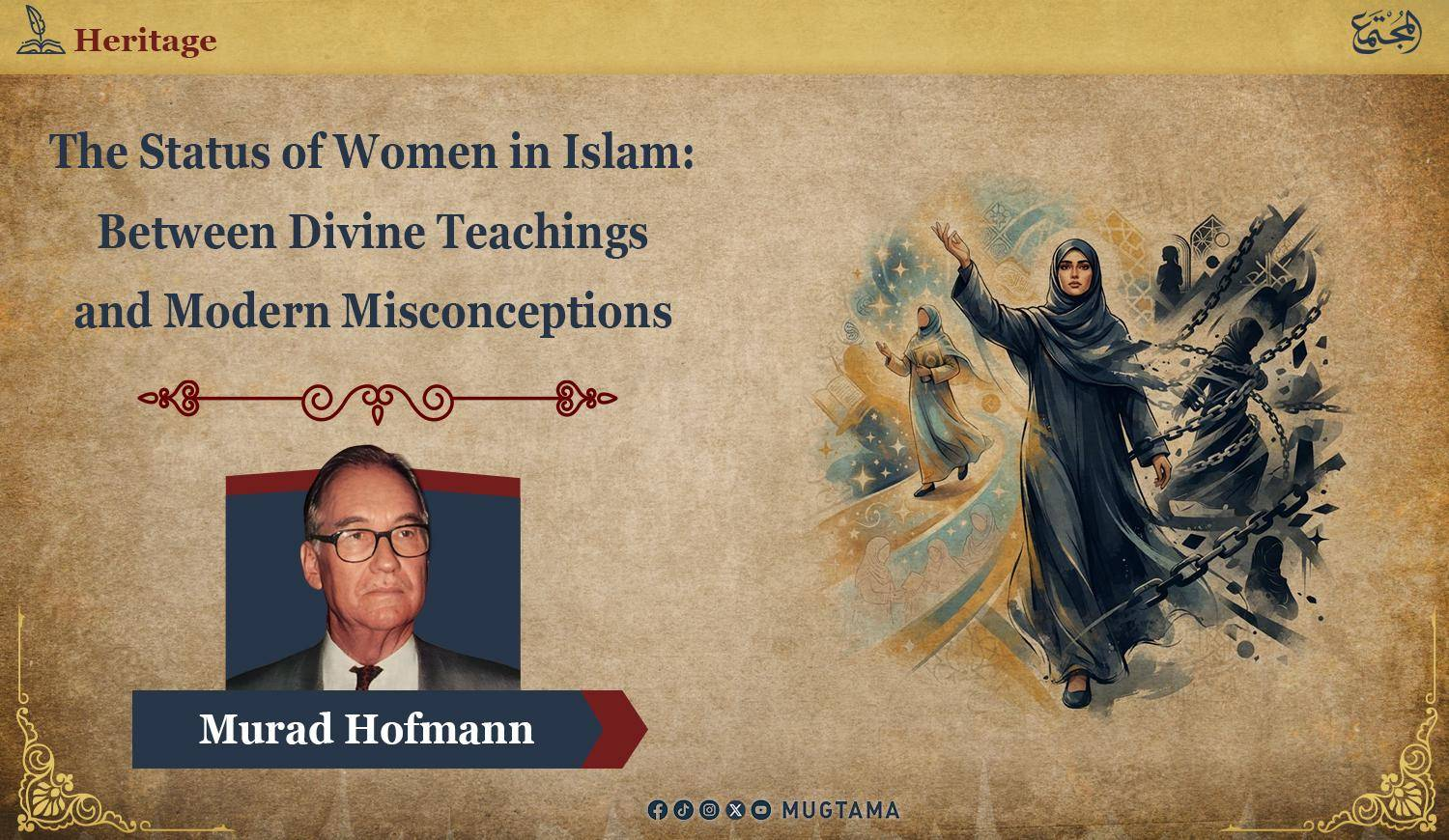
The Status of Women in Islam: Between Divine Teachings and Modern Misconceptions

Virgil
Gheorghiu offers a remarkable portrayal of the status and importance of women among the Bedouins
in his account of the life of the Prophet Muhammad (peace be upon him). Writing
with exceptional poetic sensitivity and emotional depth, he observes:
“The
position enjoyed by women among the Arabs is scarcely matched by that enjoyed
by women among any other people on earth. She is a source of tenderness swaying
amid the harshness of the desert, graceful in stature and form, bringing to
mind a tree laden with fruit. In the desert, beautiful women make up for the
absence of orchards and gardens, with all their delightful fruits, shade, and
blossoms. They are the streams and pools, the fragrance and sweet basil; they
are the cascading waterfalls and the gushing, overflowing springs. In the
desert, woman is the most magnificent and beautiful thing the earth has ever
known or the sky has ever sheltered. All this abundance of beauty and delight
is gathered into a single body: the body of Eve.”
After
such a description, can anyone still seriously imagine that the Arabs of
pre-Islamic times despised and humiliated women?
How Islam Established the Dignity and
Equality of Women
Readers
may know that the Quran contains no chapter entitled “Man” or “Men,” yet it
dedicates an entire chapter to women as an honor to them: Surah An-Nisa’ (The
Women). This chapter addresses women’s rights and family life as central
themes. Indeed, its opening verse goes further, affirming that men and women
share the same origin and establishing their fundamental equality. In that very
verse, Allah places particular emphasis on the rights and proper treatment of
women, saying: {O humanity! Be mindful of your Lord
Who created you from a single soul, and from it He created its mate, and
through both He spread countless men and women. And be mindful of Allah—in
Whose Name you appeal to one another—and ˹honour˺ family ties. Surely Allah is ever Watchful over you.} [An-Nisa’ 4:1]
The Quran
is a wise Book, free from contradiction or inconsistency. Its structure, style,
and message are marked by unity and coherence. It addresses men and women
alike, without distinguishing between them in their standing before God. Both, despite their biological differences, are members of the same community, each contributing
to it according to the abilities and capacities Allah has granted them. Both
are subject to the same conditions of existence that apply equally to all
created beings, male and female.
Is it
reasonable or acceptable, then, to imagine that this religion permits laws that
oppress women, violate their rights, or justify hostility towards them?
The Prophet Muhammad’s Respect for Women
The
Prophet himself was undoubtedly a man in every sense of the word, yet women held a position of great honor in his eyes and were entrusted with
major responsibilities. Even women who champion women’s rights and defend them,
including Muslim women themselves, firmly acknowledge this remarkable reality. Fatema
Mernissi is one such example.
Most
people are familiar with Muhammad’s (peace be upon him) love for his youngest
wife, the exceptionally intelligent `A’ishah, daughter of Abu Bakr (may Allah
be pleased with them both). Less widely known, however, is his devotion to his
first wife, Lady Khadijah (may
Allah be pleased with her), who was fifteen years older than him. It was
Khadijah herself who asked to marry him; in other words, she was the one who
sent him a marriage proposal.
She
remained his only wife throughout the twenty-four years of their married life.
Their marriage was a happy and blessed one, and he did not marry another woman
until she passed away.
There is
also no doubt that the Prophet’s subsequent marriages to other women,
undertaken in his capacity as the leader and head of the Muslim community at
the time (the equivalent of a head of state today), carried significant
political, social, and legislative implications. After considering all this,
could anyone seriously believe that a man like Muhammad (peace be upon him)
would have wanted his noble message to be distorted by giving it a character
marked by hatred, contempt, and degradation of women?
The Western Misconception of Muslim Women
Yet the
greatest obstacle standing in the way of Islam’s spread in the Christian West
is the deeply entrenched perception among non-Muslims that casts Muslim women
in a negative light. According to this widespread view, Muslim women are
restricted and denied the freedom to develop and use their abilities; their
role is confined to the kitchen, their responsibilities limited to household
affairs and raising children. They are supposedly seen only when fully covered,
with their time divided between their husbands and their Lord. After all this,
they are portrayed as humiliated, oppressed, and powerless.
The
reality, however, is that there is no smoke without fire. Who, today, would
deny that the status and role of women in Muslim-majority countries have become
a serious issue? This is so despite the fact that Islam did justice to women
and restored the rights that pre-Islamic ignorance had taken away from them, in
an era marked by corruption, violations, and oppression that had become
customary among the people of that time.
-------------------------------------------------------------
Taken from: “Islam The Alternative” By Murad
Hofmann
